Hi, what do you want to do?






Curated OER
"A Pig is Big"
Students explore the concept of big, bigger, and biggest. They examine and classify items by size, listen to and discuss the book "A Pig is Big," complete a fill in the blank activity, and create a tri-fold that illustrates two items...

Curated OER
Important Rivers of the World
Third graders become familiar with names of the different parts of a river, define and locate drainage basins, locate six of the continents and explore the major rivers on each one, conduct research on a river of their choice.

Curated OER
Marine Communities
Students view a video and then complete lab exercises to help them explain marine communities and animals in them.

Curated OER
Magnetic Discovery Bottle
Students examine how to conduct simple investigations and use simple equipment to gather data. In this magnet lesson students decide what types of objects are attracted to magnets.

Curated OER
Macroinvertebrate Sampling
Students identify macroinvertebrate species to investigate ecological systems and the relationship between humans and the environment.

Curated OER
Ride the Tide
Students examine the cause-and-effect relationship between tides and the rocky coast ecosystem. They complete a worksheet that illustrates the intertidal zone.

Curated OER
The Atmosphere and Flight
Students investigate evaporation and condensation, and apply the concepts to understanding cloud formation.

Curated OER
Float Your Boat
Students investigate buoyancy, displacement and density. In this flotation lesson students study the Archimedes' Principle, analyze data and draw conclusions.

Curated OER
Growing Tomatoes From Seed Activity
In this growing tomatoes worksheet, students plant tomato seeds in February, and follow their growth through the summer break. They observe and investigate the plant growth from seed to plant.

Curated OER
Trout In The Classroom
Students have trout in their classroom and complete journaling, checklists, temperature checking, and ammonia level recording. In this trout lesson plan, take weekly observation records of their trout.

Curated OER
Glucose Factory
Fourth graders determine, through laboratory activity, the presence or absence of glucose in a variety of plant leaves and stems. They work in groups and perform a three part laboratory which shows them how plants convert sunlighht to food.

Curated OER
Gardening for Beauty, Food, and Enjoyment
First graders create their own garden. In this plant instructional activity, 1st graders discover the essential elements for a plant to grow. They planted their own garden and read the amount of space needed and the sunlight preferred...

Curated OER
Time-Lapsed Observations
Students explore timed observations for science investigations. They record ideas on a chart related to a classroom closed terrarium. They repeat their observations for several days and time observations for changing shadows during the...

Curated OER
Selecting Soil Organisms in Compost
Young scholars demonstrate that many of the enzyme systems needed to break down--and therefore clean up-society's wastes already exist in nature among the decomposers. They select the best starch-munching organisms by altering the...

Curated OER
Measurement: When Degrees Matter
Eighth graders record the temperature change of the beakers. In this general science lesson, 8th graders create their own data table for recording observations. They discuss experimental results and cite real life applications.

Curated OER
How Does Climate Affect Our Shelter Needs?
Fourth graders investigate how weather influences shelter choices. They explore the concept of insulation and discuss some traditional Native American shelters. They discuss the shelters used by the Okanogan people during the various...

Curated OER
Youth Engagement
Students examine and then discuss opposite sides of controversial issues such as neighborhood curfews, lowering voter age, etc. They learn civic responsibility and cultivate tolerance for others' opinions.
Science Education Resource Center at Carleton College
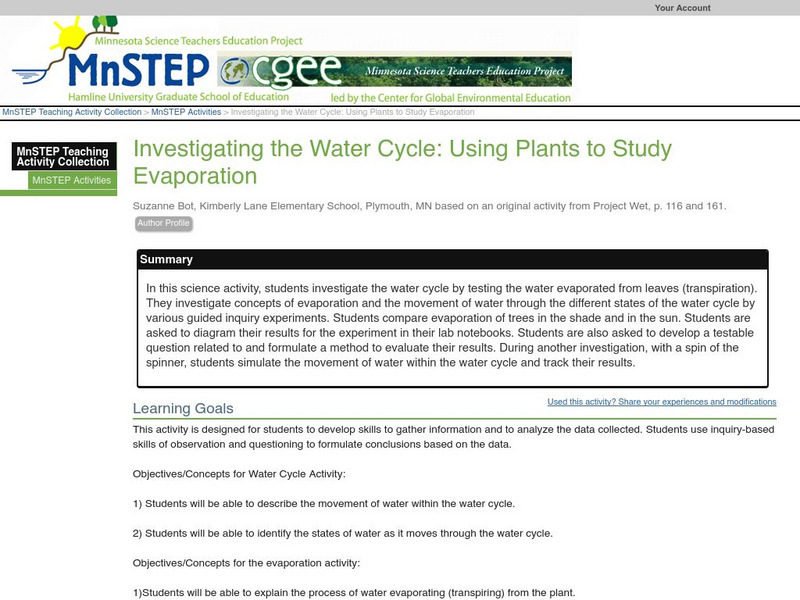
Serc: Investigating the Water Cycle: Using Plants to Study Evaporation
In this science activity, students investigate the water cycle by testing the water evaporated from leaves (transpiration). They investigate concepts of evaporation and the movement of water through the different states of the water...
Science Education Resource Center at Carleton College
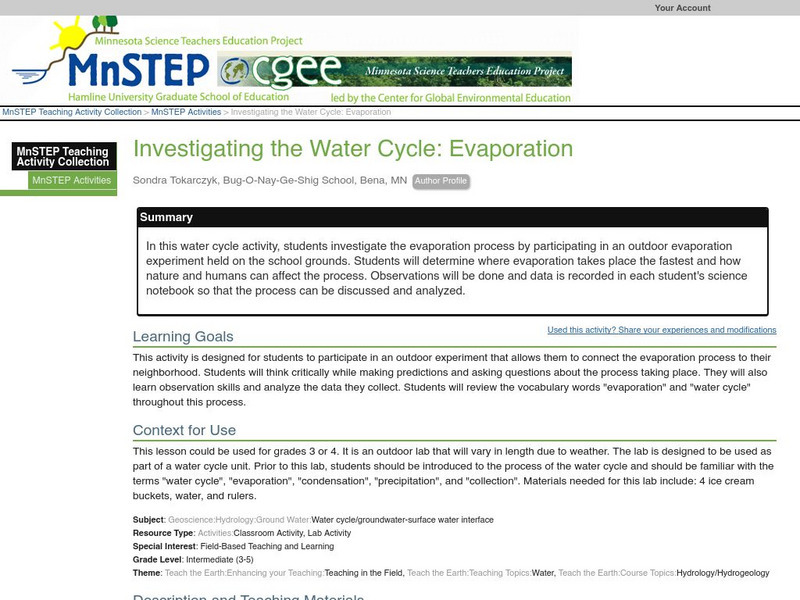
Serc: Investigating the Water Cycle: Evaporation
In this water cycle activity, students investigate the evaporation process by participating in an outdoor evaporation experiment held on the school grounds. Students will determine where evaporation takes place the fastest and how nature...
Utah State Office of Education
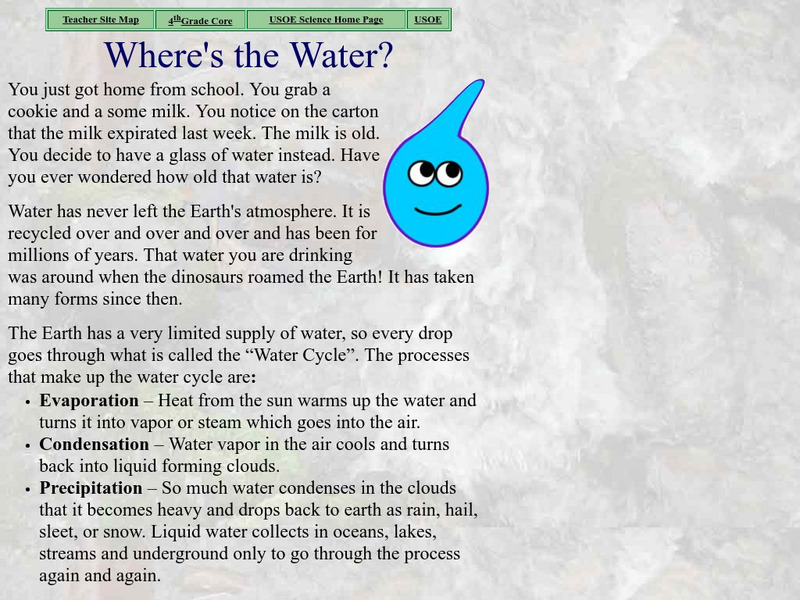
Utah Science: Where's the Water?
Discover the ins and outs of the water cycle through this collection of experiments and activities.
National Association of Geoscience Teachers
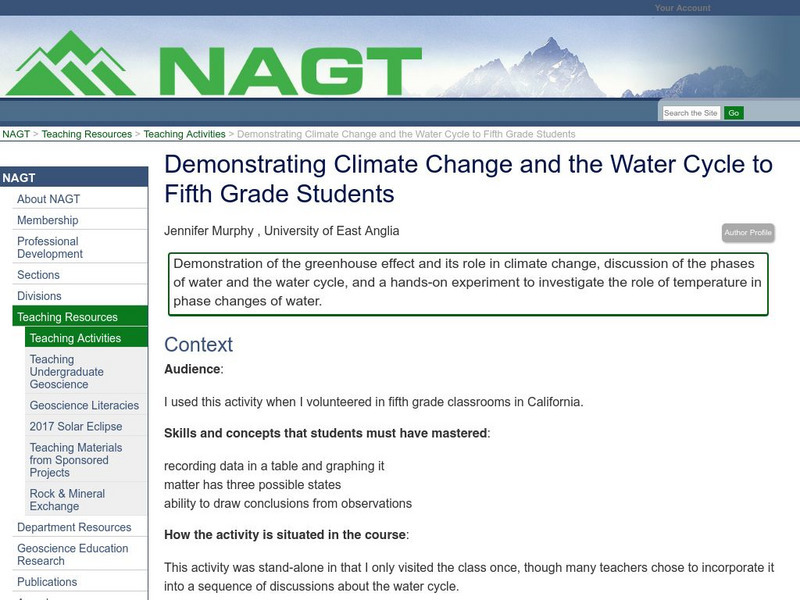
Nagt: Demonstrating Climate Change and the Water Cycle
Demonstration of the greenhouse effect and its role in climate change, discussion of the phases of water and the water cycle, and a hands-on experiment to investigate the role of temperature in phase changes of water.

Alabama Learning Exchange
Alex: The Water Cycle
This is a hands applied lesson plan to help students experience the water cycle on a smaller scale. Because of the hands-on nature of the activity, it works well to help students with a language barrier understand complicated vocabulary.

Other
Njawwa: Kids' Water Zone
Students can learn fun facts about water, perform experiments with it, and play games about it. Includes links and a suggested reading list.

American Geosciences Institute
American Geosciences Institute: Earth Science Week: Earth's Hydrologic Cycle
In this experiment, young scholars create a model of the water cycle and learn about its crucial role in moving water around the Earth.