Hi, what do you want to do?






Curated OER
What's the Matter with My Jell-o?
Students work in teams of four as they conduct four controlled Jell-O experiments over a two-day period. The Family Page extends this learning to the community by providing families with challenges to explore at home.

Curated OER
The Drag of Drag
Students are introduced to drag. Then they summarize drag by saying that the drag is proportional to the square of the velocity. Students then solve problems an example of such a problem: Explain why swimming underwater is faster than...

Curated OER
Working with Solutions
In this solutions worksheet, students review how molarity is calculated and how to prepare a dilute solution. This worksheet has 5 problems to solve.

Curated OER
The Interactive Periodic Table of the Elements
Students study the different types of metals. In this investigative lesson students watch a demonstration on the effects of temperature on atoms and take a tour through baone matter.

Curated OER
Science Quiz-General Knowledge
In this science quiz worksheet, students complete a set of 20 true or false questions covering a variety of general science topics. An answer key is included.

Curated OER
Hurricanes and the Importance of Wetlands
Students explain how wetlands minimize the impact of hurricanes. In this earth science lesson, students investigate how different materials affect the steam plume path. They complete their worksheet after the lab.

Curated OER
States of Matter
This particle PowerPoint includes many pictures to illustrate solids, liquids and gasses and the behavior of their particles.
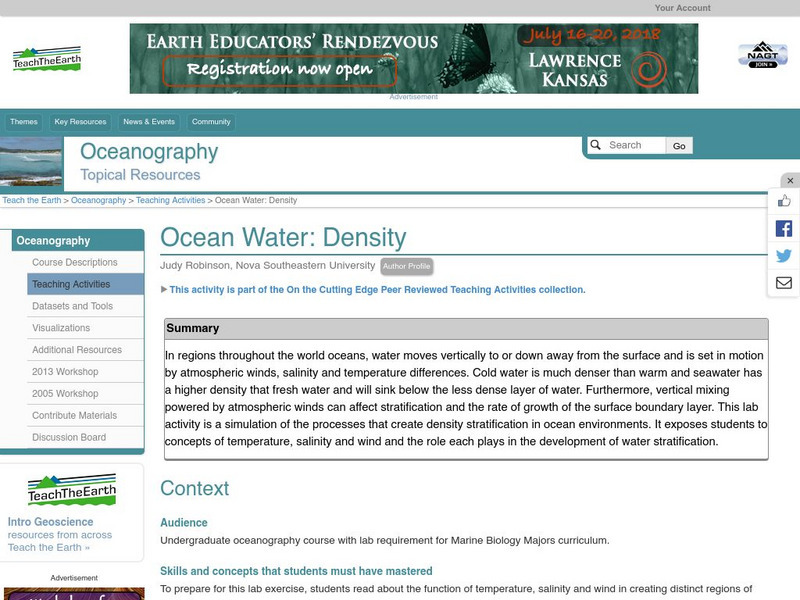
Science Education Resource Center at Carleton College
Serc: Ocean Water: Density
In this lesson students will learn about the stratification of the ocean by using a simulation to show the different densities. The simulation explores how temperature, salinity, and wind affect the development of water stratification.
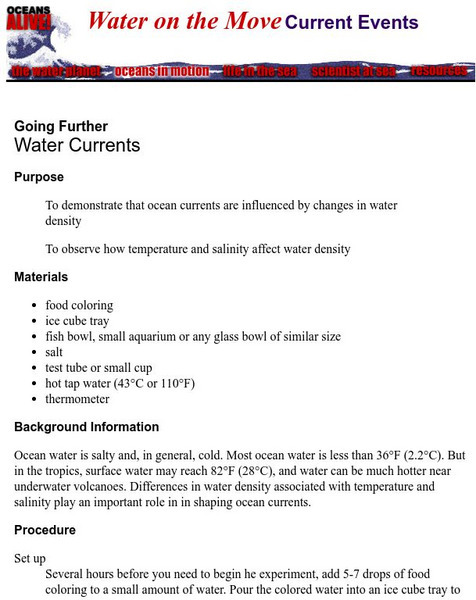
Museum of Science
Museum of Science: Water Density Experiment
A simple lab activity to demonstrate that ocean currents are influenced by changes in water density.
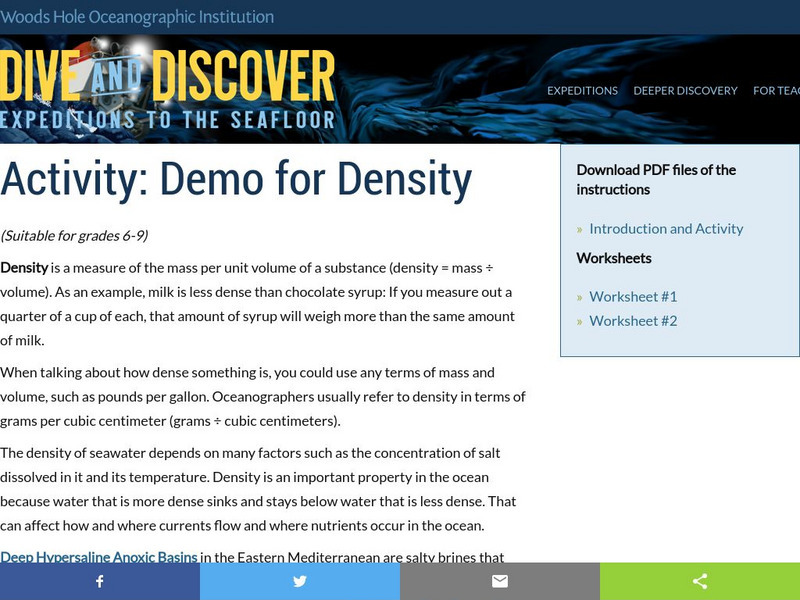
Woods Hole Oceanographic Institution
Woods Hole Oceanography Institute: Activity: Demo for Density
In this experiment, students look at Deep Hypersaline Anoxic Basins, or DHABs, that are present in the Eastern Mediterranean, and make a model of a DHAB to investigate how liquids that have different densities can form layers. This...
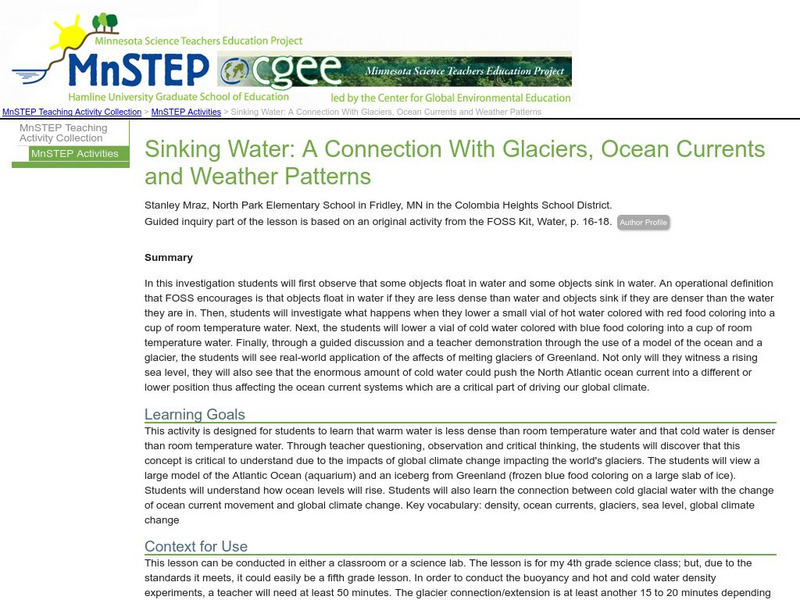
Science Education Resource Center at Carleton College
Serc: Mn Step: Sinking Water: Glaciers, Ocean Currents and Weather Patterns
A lesson where students learn how warm water is less dense than cold water, and what this means for global climate change as ice from the polar regions melts. Students will do experiments in buoyancy and water density when hot or cold,...
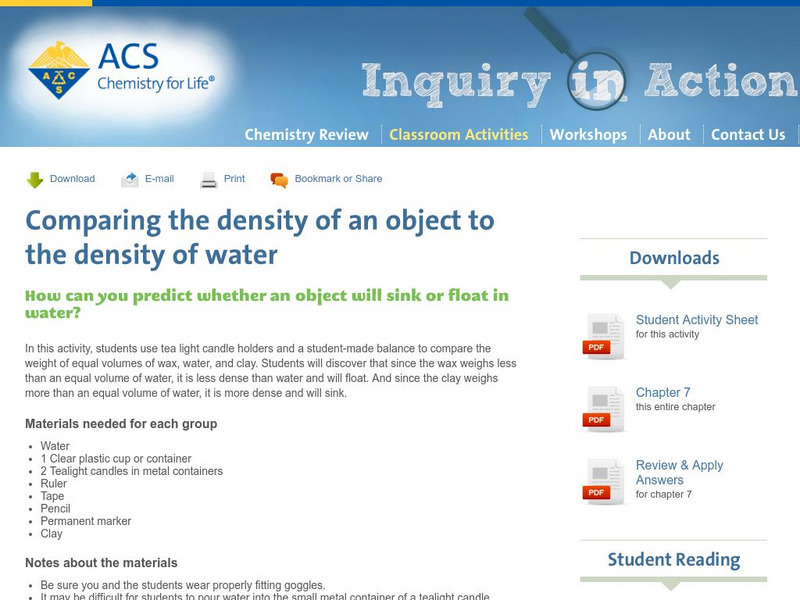
American Chemical Society
Inquiry in Action: Compare the Density of an Object to the Density of Water
In this activity, students use tea light candle holders and a student-made balance to compare the weight of equal volumes of wax, water, and clay. Students will discover that since the wax weighs less than an equal volume of water, it is...

US Navy
Office of Naval Research: Ocean Water
This highly informative site delves into salinity, pressure, density, temperature acoustics, and optics associated with ocean water. A quick quiz follows the information presented.

Khan Academy
Khan Academy: Biology: Specific Heat, Heat of Vaporization, and Density of Water
Why does ice float? In this article answer that question by learning about the topics of Specific heat capacity, evaporative cooling, and heat of vaporization of water.
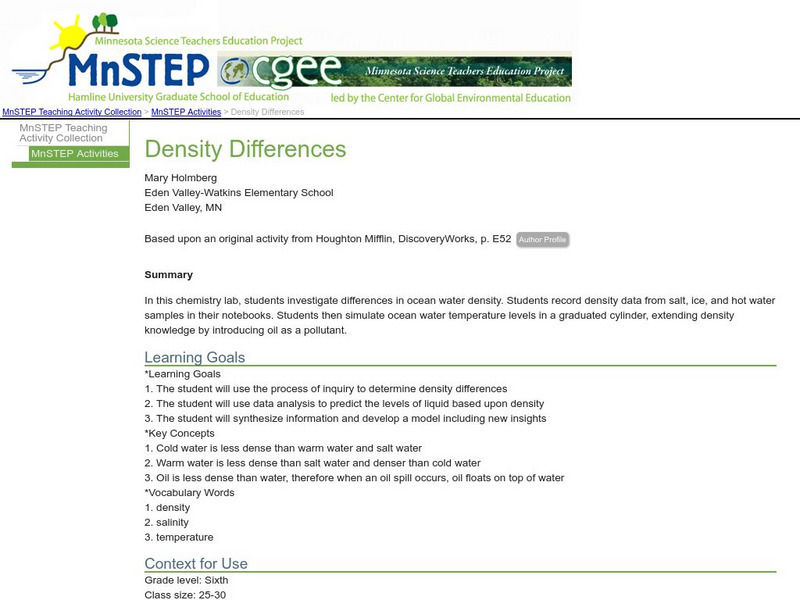
Science Education Resource Center at Carleton College
Serc: Density Differences
Students investigate differences in ocean water density, and record density data from salt, ice, and hot water samples in their notebooks. Students then simulate ocean water temperature levels in a simulation.
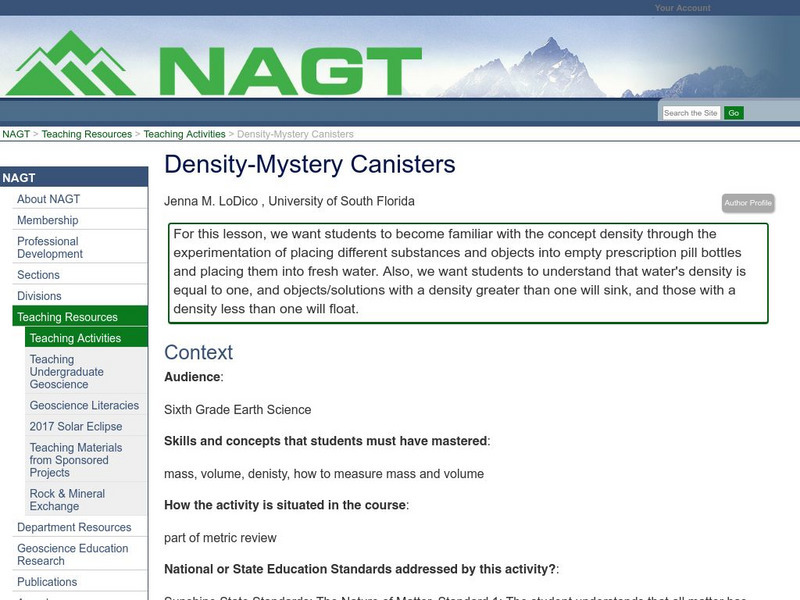
National Association of Geoscience Teachers
Nagt: Density Mystery Canisters
Students experiment with items that sink or float, and learn that water's density is equal to one, and objects/solutions with a density greater than one will sink, and those with a density less than one will float.
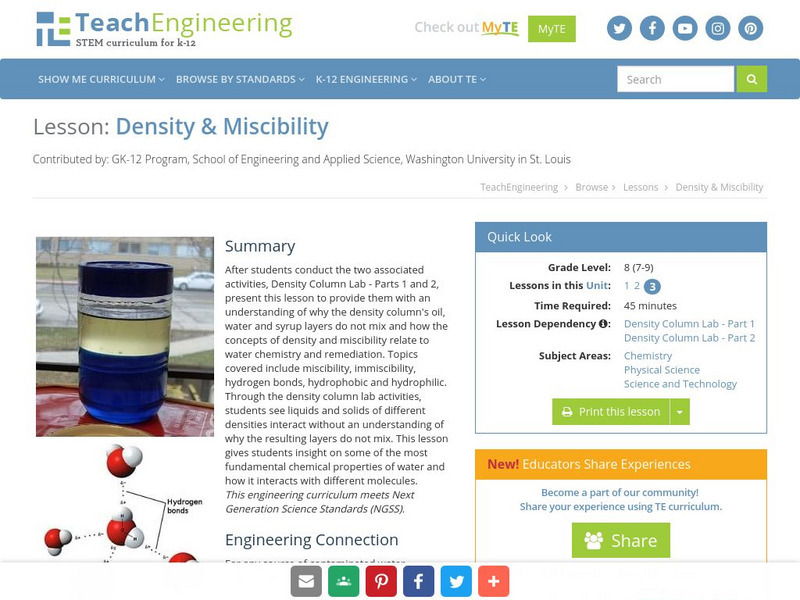
TeachEngineering
Teach Engineering: Density & Miscibility
After students conduct the two associated activities, Density Column Lab - Parts 1 and 2, present this lesson to provide them with an understanding of why the density column's oil, water and syrup layers do not mix and how the concepts...
American Chemical Society
Middle School Chemistry: Density of Water
Students discover the concept that density is a characteristic property of water by measuring the volume and mass of water and calculating its density.
American Chemical Society
Inquiry in Action: Changing the Density of a Liquid: Heating and Cooling
In this activity, students will investigate whether the temperature of water affects its density. Students will place colored hot and cold water in a cup of room-temperature water to see that cold water sinks while hot water floats. Then...
American Chemical Society
Middle School Chemistry: Temperature and Density
Observe how heating and cooling affect the density of water. Combine the concepts of temperature, molecular motion, and density to learn that hot water is less dense than room temperature water and that cold water is more dense.
American Chemical Society
Middle School Chemistry: Density: Sink and Float for Liquids
Students determine whether a liquid will sink or float in water by comparing its density to the density of water.
American Chemical Society
Inquiry in Action: Comparing the Density of Different Liquids
How do the densities of vegetable oil, water, and corn syrup help them to form layers in a cup? Students will carefully pour vegetable oil, water, and corn syrup in any order into a cup and discover that regardless of the order they are...
American Chemical Society
Inquiry in Action: Changing the Density of an Object: Changing Shape
Throughout the activities in this investigation, students may have wondered how a boat made out of steel, which is more dense than water, can float. This activity addresses that question. Students will see that changing the shape of an...
American Chemical Society
Middle School Chemistry: Density: Sink and Float for Solids
Students determine whether an object will sink or float by comparing its density to the density of water.
Other popular searches
- Layering Water Density
- Water Density Experiments
- Floating Egg Water Density
- Liquid Density Water
- Water Density Animation
- Density of Water
- Water Density Worksheet
- Water Density Experements
- Water Density Using Raisins
- Water Density Freezing Water
- Water Density Using Rasins
- Density Hot Water