
Other
Is the Speed of Light Constant?
Using a question and answer format, this page discusses the question: "Is the Speed of Light Constant?" Discusses some of the history and experiments performed with light and the conclusions drawn from those findings.

Science Struck
Science Struck: How Does Light Travel Through Space and Other Media?
A detailed discussion of the nature of light, how it can travel through a vacuum, and how the speed of light is affected when light travels through a medium.
University of Colorado
University of Colorado: Physics 2000: More About Visualizing Electromagnetic Waves
Discusses the nature of an electromagnetic wave. Explains the oscillating electric field and represents it through clever graphics and animations.
American Museum of Natural History
American Museum of Natural History: Ole Roemer and the Speed of Light
This resource provides a concise overview of the speed of light and the Ole Roemer, the first man to measure it.
American Museum of Natural History
American Museum of Natural History: Play With Color and Light
See what happens when you mix different colors of lights.
Georgia Department of Education
Ga Virtual Learning: Physical Science: Light and Optics
Students will investigate the properties of light waves. They will learn about the different types of electromagnetic waves and mechanical waves, and investigate the phenomena of reflection, refraction, interference, and diffraction.
Globio
Glossopedia: Light
Light is a form of energy. We see it in many different forms all around us. It's the sunlight that pours through your bedroom window and wakes you up. Images and in-depth information on light can all be accessed in this article.
Simon Fraser University
Chem1 Virtual Textbook: The Language of Light
Acting as a subtopic of the General Chemistry Virtual Textbook's section on Atoms and the Periodic Table, this site discusses light in relation to particles and waves. The difference between particles and waves is addressed along with...
University of Maryland
University of Maryland: Optics, Electromagnetic Waves
This site from the University of Maryland provides part of an anecdotal history of optics and the study of light. Extremely thorough treatment of how scientists came to believe in the wave nature of light, the idea of an electromagnetic...
University of Maryland
Optics Highlights: Optics, Electromagnetic Waves, Quanta
Part of an anecdotal history on optics and the study of light. Extremely thorough treatment of the scientific evidence which led scientists to believe in the particle nature of light. Includes a short biographical sketch and discusses...
Massachusetts Institute of Technology
Mit: Open Course Ware: Courses: Physics Ii: Electricity and Magnetism
College-level physics course highlighting electricity and magnetism. This course is divided into several modules including electric fields, magnetic fields, electromagnetic forces, conductors and dielectrics, electromagnetic waves, and...
TeachEngineering
Teach Engineering: Light It Up
Through an introduction to the design of lighting systems and the electromagnetic spectrum, students learn about the concept of daylighting as well as two types of light bulbs (lamps) often used in energy-efficient lighting design....
PBS
Pbs Learning Media: Let's Explore Light: Lesson Plan
Learners will use observations and evidence to describe that objects can only be seen if they are illuminated by an external light source or give off their own light. Media is used to supplement student observations and encourage...
Synopsys
Synopsys: Optics: A Gentle Intro to Optical Design: Wave Particle Duality
Discusses the manner in which light behaves as both wave and particle. This dualistic nature of light is one topic of many on the page.
National High Magnetic Field Laboratory
Magnet Academy: Timeline of Electricity and Magnetism: 1900 1909
Albert Einstein publishes his special theory of relativity and his theory on the quantum nature of light, which he identified as both a particle and a wave. With ever new appliances, electricity begins to transform everyday life.
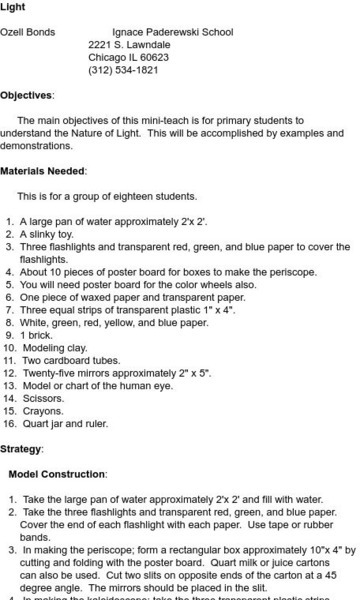
Science and Mathematics Initiative for Learning Enhancement (SMILE)
Smile: Light (Intermediate)
Lesson plan for various group activities about light. Provides demonstration and directions for the plans along with assessment.
Geography 4 kids
Geography4 kids.com: Waves and Particles
Understand how light moves in small particles in the electomagntic spectrum.
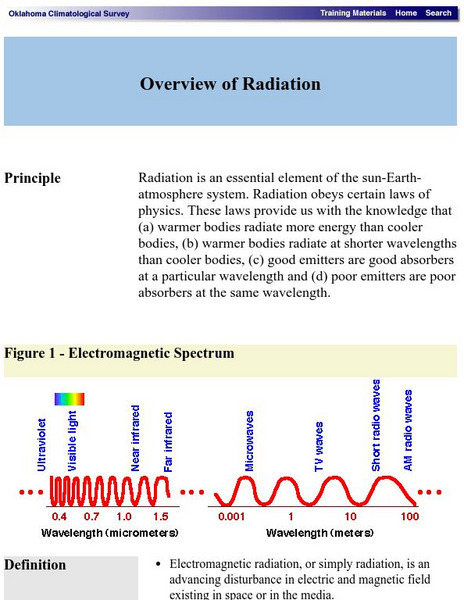
Oklahoma Mesonet
Oklahoma Climatological Survey: Overview of Radiation
This site details what radiation is, the physics of radiation, and radiative transfer as it occurs in nature. Content explores the electromagnetic spectrum, electromagnetic waves, properties of radiation, and solar radiation.
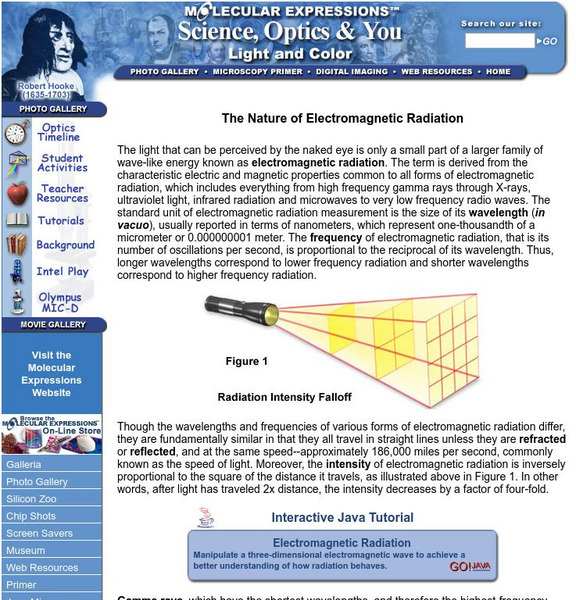
Florida State University
Florida State University: Nature of Electromagnetic Radiation
This site from The Florida State University provides an informational page on electromagnetic radiation discusses the characteristics and properties of its many forms including X-rays, gamma rays, ultraviolet radiation, infrared...
Museum of Science
The Atom's Family: Radiometer
Help Dracula find out about light waves by using a virtual radiometer.
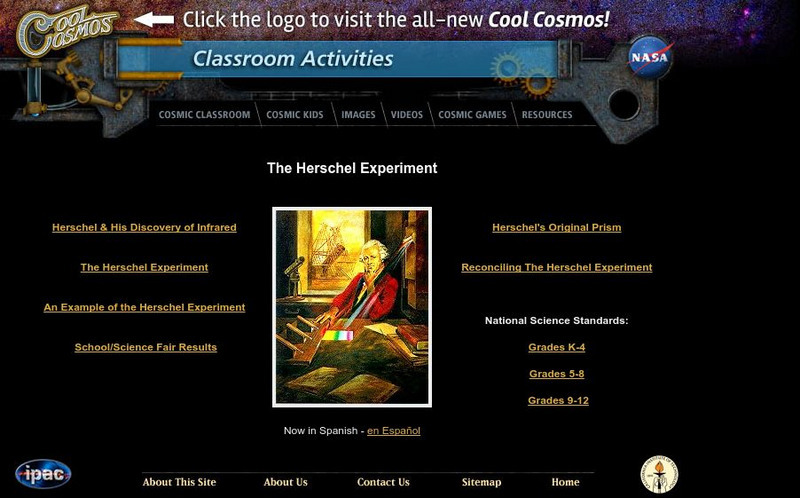
California Institute of Technology
Cool Cosmos: The Herschel Experiment
This website provides a background on the discoverer of infared light--Sir Frederick William Herschel. A version of the experiment Herschel conducted in the 1800s is provided as well.
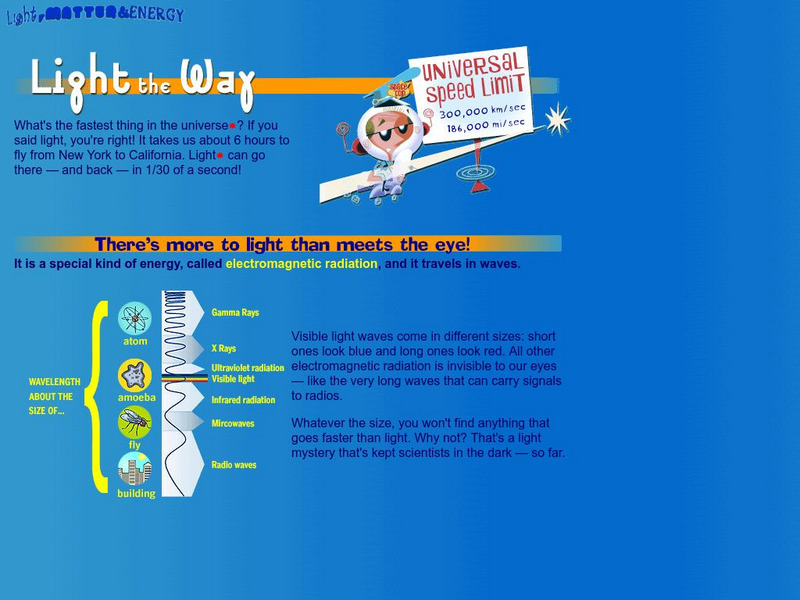
American Museum of Natural History
American Museum of Natural History: O Logy: Light, Matter, Energy: Light the Way
What is electromagnetic radiation and how does it work? Review a captioned graphic that explains electromagnetic radiation and the visible and invisible types of radiation on the electromagnetic spectrum.
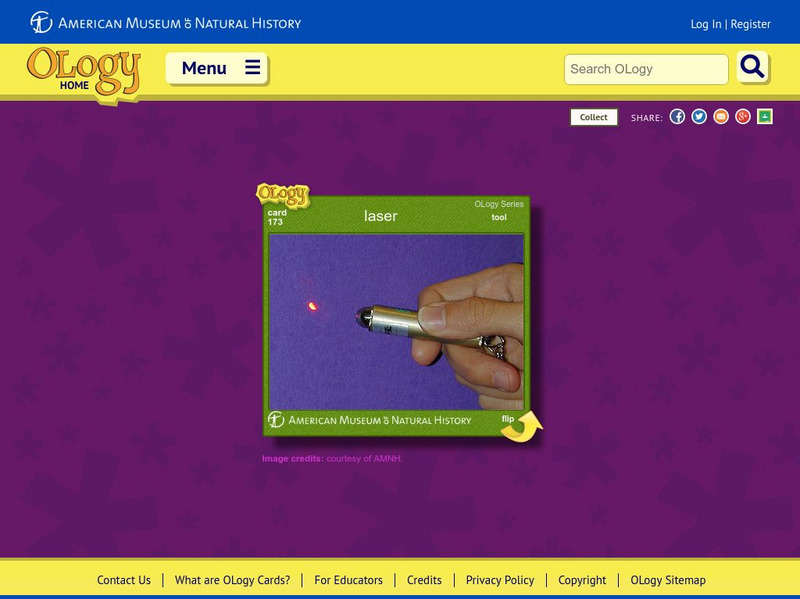
American Museum of Natural History
American Museum of Natural History: Laser O Logy Card
Flip over this interactive OLogy card to find fast facts, questions and answers, and similar bite-size pieces of information about the properties and uses of lasers.
CK-12 Foundation
Ck 12: Photoelectric Effect
[Free Registration/Login may be required to access all resource tools.] Students will understand the photoelectric effect and that light has both particle and wave properties. Includes a simulation for exploring the photoelectric effect.