Hi, what do you want to do?






Science Struck
Science Struck: Wavelength of Light
Describes the characteristics of light, presents two formulas for calculating its wavelength, and provides a table of the different wavelength ranges across the electromagnetic spectrum.
Science Buddies
Science Buddies: Mixing Light to Make Colors
You know how to make new colors by mixing paint or crayons. For example, you get green by mixing yellow and blue, or orange by mixing red and yellow. With paint, blue, yellow, and red are primary colors, which you can use to make other...
PBS
Pbs Learning Media: Wavelength
In this interactive activity adapted from the University of Utah's ASPIRE Lab, students will learn how to measure wavelengths and see how wavelength affects the color of the light that we see.
TeachEngineering
Teach Engineering: The Energy of Light
In this introduction to light energy, students learn about reflection and refraction as they learn that light travels in wave form. Through hands-on activities, they see how prisms, magnifying glasses and polarized lenses work. They also...
CK-12 Foundation
Ck 12: Wave Speed Calculations
[Free Registration/Login may be required to access all resource tools.] Students investigate and analyze characteristics of waves, including velocity, and calculate the relationship between wave speed, frequency, and wavelength.
University of Colorado
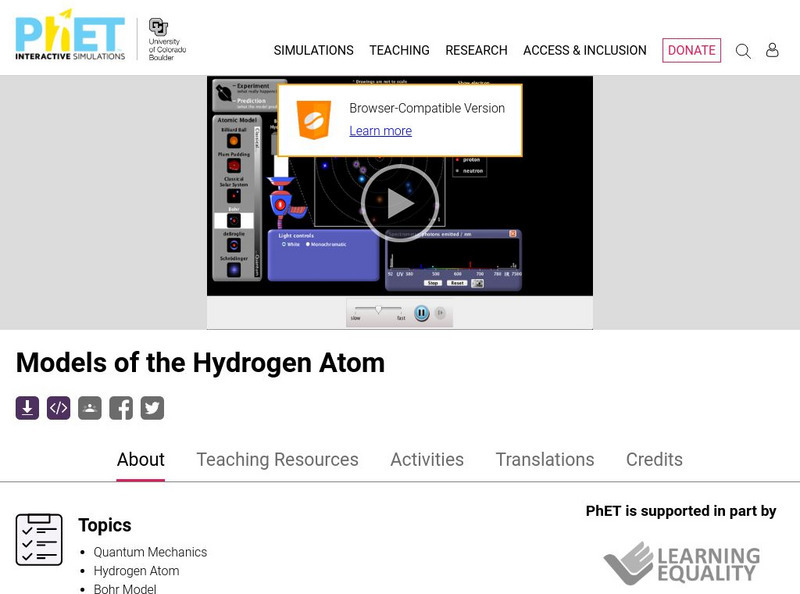
University of Colorado: Ph Et Interactive Simulations: Models of the Hydrogen Atom
How did scientists figure out the structure of atoms without looking at them? Try out different models by shooting light at the atom. Check how the prediction of the model matches the experimental results.
Science Struck
Science Struck: Color Spectrum Chart With Frequencies and Wavelengths
Read about the visible light spectrum and learn the frequencies and wavelengths for each of the primary and secondary colors.
CK-12 Foundation
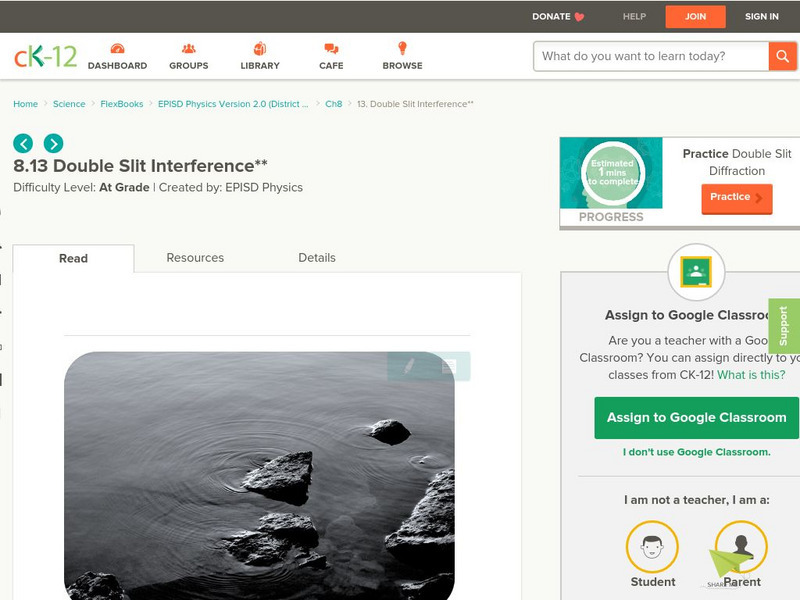
Ck 12: Double Slit Interference
[Free Registration/Login may be required to access all resource tools.] Explains the terms diffraction, interference, and interference patterns. Describes the double slit experiment and how to determine the wavelength of a double slit...
NASA
Nasa: Imagine the Universe: What's the Frequency, Roy G. Biv
In this very detailed lesson plan from NASA, students investigate wavelength and frequency within the electromagnetic spectrum.

Ducksters
Ducksters: Physics for Kids: Light Spectrum
Kids learn about the science of the light spectrum. Wavelengths and frequencies of the electromagnetic waves including visible light, primary colors, and subtractive colors.
NASA
Nasa: Sci Jinks: What Causes a Rainbow?
Find out whatever you wanted to know about rainbows and how they form. Check out the section on folklore regarding rainbows too.
NASA
Nasa: Imagine the Universe: Welcome to the World of Multiwavelength Astronomy!
This Imagine the Universe site provides an introduction into the multiwavelength universe and astronomy. Site provides graphics, links to a quiz, facts on this topic as well as teacher resources.
NASA
Nasa: Space Place: The Electromagnetic Spectrum
Find out how energy, frequency, and wavelength are related in terms of the electromagnetic spectrum.