Hi, what do you want to do?






Physics Classroom
The Physics Classroom: Light Waves/color: Absorption, Reflection, Transmission
In this physics classroom, students learn how and why light of certain frequencies can be selectively absorbed, reflected or transmitted.
NASA
Nasa: Tour of the Electromagnetic Spectrum: Visible Light
Visible light waves are the only electromagnetic waves we can see. We see these waves as the colors of the rainbow. Each color has a different wavelength. Red has the longest wavelength and violet has the shortest wavelength. When all...

Open Curriculum
Open Curriculum: Bounded Waves
To understand how bounded waves behave and how reflection of waves affects the wave components.
CK-12 Foundation
Ck 12: Physics: Wave Optics Study Guide
A study guide for concepts related to wave optics.

Open Curriculum
Open Curriculum: Free Waves
With this article, students can learn about and understand the concept of wave motion.
Science Struck
Science Struck: How Does Light Travel Through Space and Other Media?
A detailed discussion of the nature of light, how it can travel through a vacuum, and how the speed of light is affected when light travels through a medium.
Physics Classroom
The Physics Classroom: Light Waves and Color: Two Point Source Interference
Students examine the findings of Thomas Young's light experiment, which showed that an interference pattern results when light from two sources meets up while traveling through the same medium.
Physics Classroom
The Physics Classroom: Light Waves/color: Visible Light and the Eye's Response
Students learn how the eye responds to visible light, and how that function ultimately allows us to see.
Physics Classroom
The Physics Classroom: Light Waves and Color: Polarization
Through illustrated practice problems and video clips, students learn about polarization of light.
Physics Classroom
The Physics Classroom: Waves: Waves and Wavelike Motion
Here is an introduction to the concept of waves and wavelike motion people experience anywhere and everywhere.
Physics Classroom
The Physics Classroom: Light Waves/color: Electromagnetic and Visible Spectra
This illustrated physics tutorial explains the electromagnetic and visible spectra of light using illustrated examples and interactive practice problems.
American Museum of Natural History
American Museum of Natural History: Ole Roemer and the Speed of Light
This resource provides a concise overview of the speed of light and the Ole Roemer, the first man to measure it.

Georgia State University
Georgia State University: Hyper Physics: Wave Particle Duality
The dualistic nature of light is discussed. The photoelectric effect and the Davisson-Germer experiment are contrasted as empirical evidence supporting each of the two views - particle and wave - of the nature of light. The photoelectric...
University of Maryland
University of Maryland: Optics Highlights: Wave Optics
Part of an anecdotal history of optics and the study of light. Extremely thorough treatment of how scientists came to believe in the wave nature of light. Includes a short biographical sketch and discusses the work of Thomas Young...
Science Buddies
Science Buddies: Wire Wilt: Light Emitting Diodes Fade as Temperature Increases
In this electronics science fair project, students will investigate how the output of an LED flashlight changes as its temperature increases.
Simon Fraser University
Chem1 Virtual Textbook: The Language of Light
Acting as a subtopic of the General Chemistry Virtual Textbook's section on Atoms and the Periodic Table, this site discusses light in relation to particles and waves. The difference between particles and waves is addressed along with...
NASA
Rxte Learning Center: Frequency, Wave Length, and Energy Activity
Resource focuses on the relationship between the frequency, wavelength and speed of light. Has a link to an interactive activity relating frequency, wavelength, and energy.
Creative Science Centre
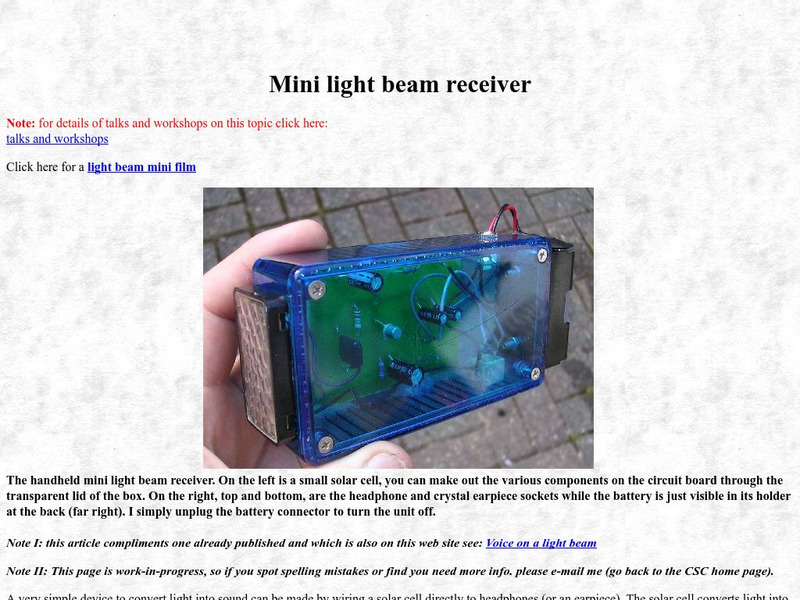
Creative Science Centre: Mini Light Beam Receiver
A very simple device to convert light into sound can be made by wiring a solar cell directly to headphones (or an earpiece). The solar cell converts light into electricity and the headphones convert electricity into sound. The limitation...
Other
Ward's Science: Will the Light Shine?
Young scholars will determine the effect of placing objects made with different materials in the path of a beam of light. This lesson includes background information, guiding questions, directions, and a chart to record data.

Open Curriculum
Open Curriculum: Wave Optics
Learn about the diffraction of light using the wave model and Huygen's principle.
Space Telescope Science Institute
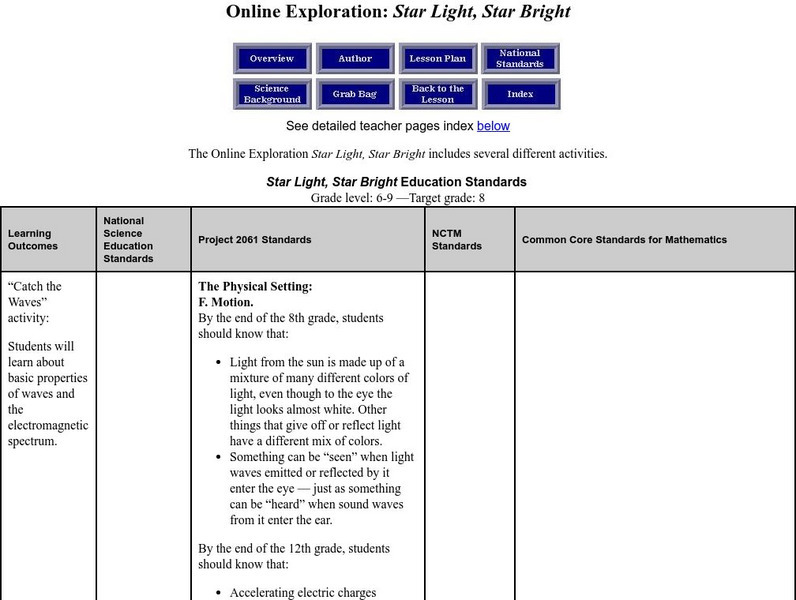
Amazing Space: Star Light, Star Bright
This online exploration provides an opportunity to identify the different properties of waves and the relationship that exists between energy, wavelength, and frequency. Correlate images from the Hubble Telescope to the wavelength,...
Discovery Education
Discovery Education: The Em Spectrum: Waves of Energy
Students are introduced to the electromagnetic spectrum through this group research activity. Each group investigates a different wavelength range within the em spectrum and reports back to class. Discussion ideas also included.
Physics Classroom
The Physics Classroom: Light Waves and Color: Blue Skies and Red Sunsets
Students will focus on the interaction of sunlight with atmospheric particles to produce blue skies and red sunsets.
Physics Classroom
The Physics Classroom: Light Waves and Color: Color Addition
Through illustrated example problems, and some interactive practice, students learn about color addition and color perception.
Other popular searches
- Light Waves
- Light and Sound Waves
- Properties of Light Waves
- Light Waves Activity
- Light & Sound Waves
- Light Waves Lab
- Light Spectrum Waves
- Interactions of Light Waves
- Light Waves Powerpoint
- Light Waves Astronomy
- Light Sound Waves
- Light and Radio Waves