Hi, what do you want to do?





PBS
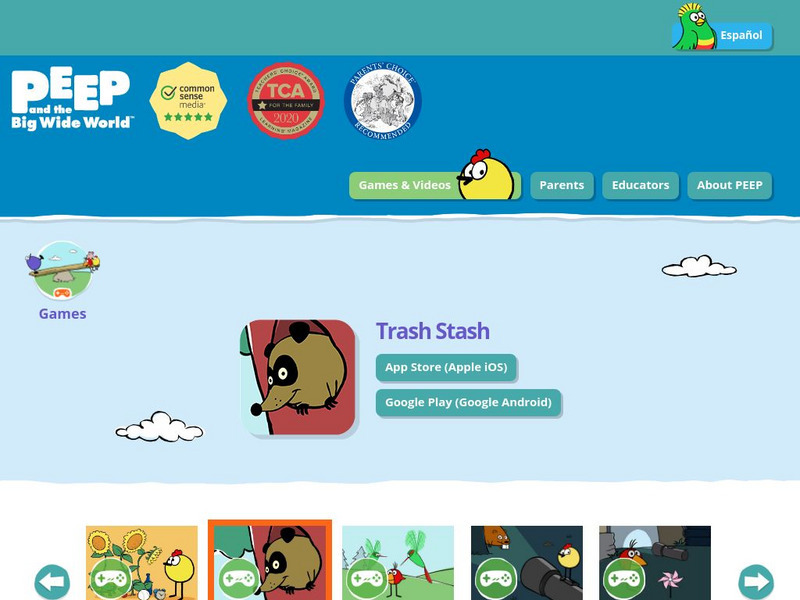
Wgbh: Peep and the Big Wild World: Games: Trash Stash
Cleverly animated sorting game introduces young learners to the mathematical concepts of comparing, sorting, and grouping. [All instructions and prompts are voiced, not written, making this an excellent resource for English language...
PBS
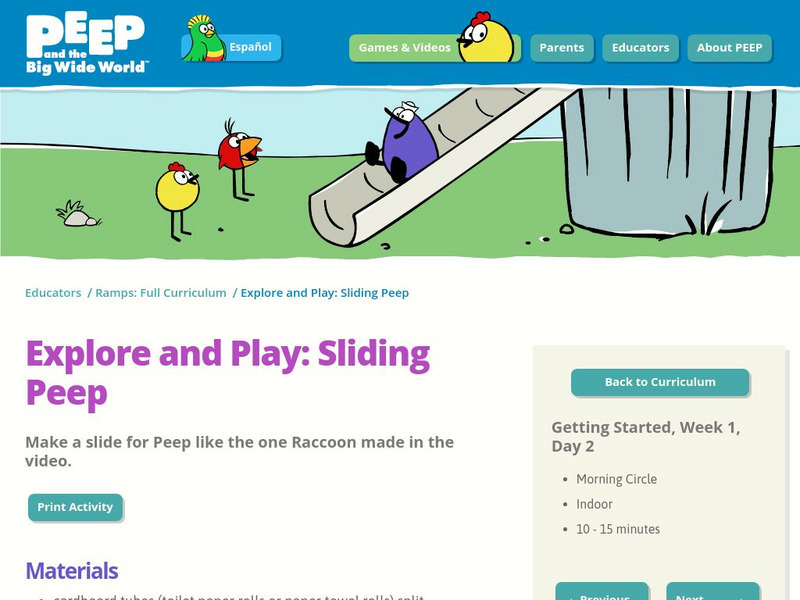
Wgbh: Peep and the Big Wide World: Explore and Play: Sliding Peep
Students make their own ramps and test them out by sending various objects down them.
PBS
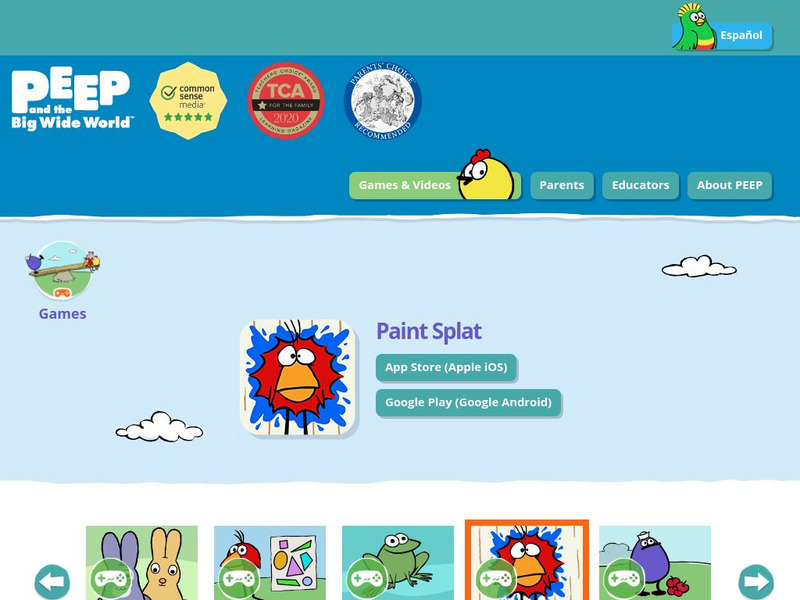
Wgbh: Peep and the Big Wild World: Games: Paint Splat
Young players will enjoy this cleverly animated color-mixing game that guides them through the process of mixing and matching colors. [All instructions and prompts are voiced, not written, making this an excellent resource for English...
PBS
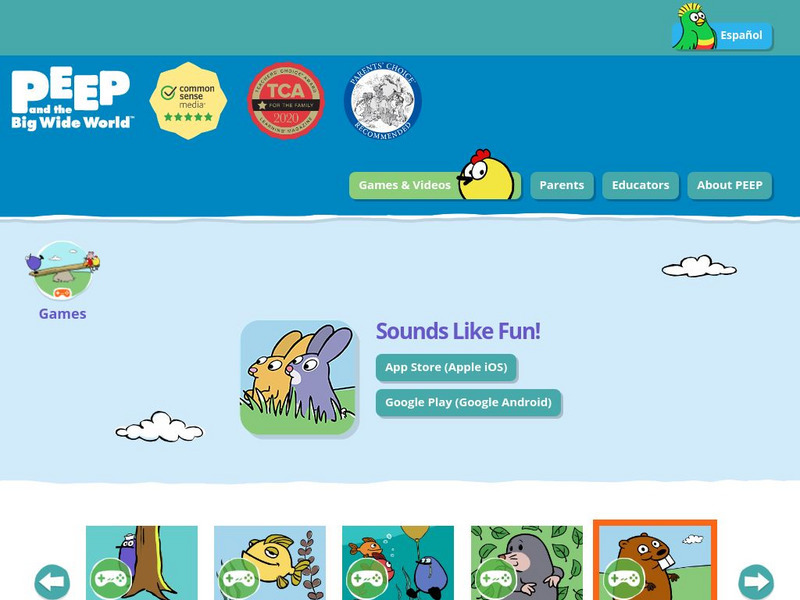
Wgbh: Peep and the Big Wide World: Games: Sounds Like Fun!
Cleverly animated game that alerts young learners to the musical sounds all around them in their everyday environments. A useful exercise in helping children understand sound patterns and repetitive beats and the meaning of start and...
PBS
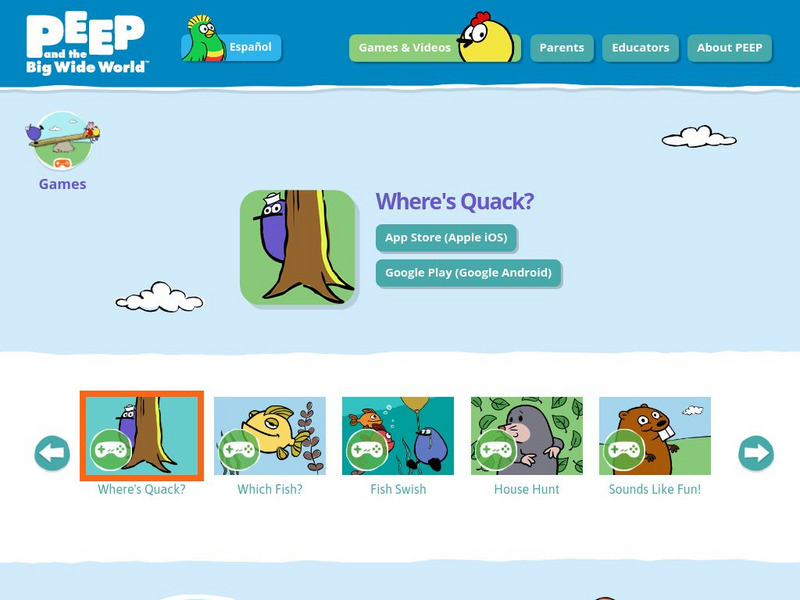
Wgbh: Peep and the Big Wild World: Games: Where's Quack?
Hide-and-seek game instructs players to find Quack, a purple duck, in a series of different landscapes. [All instructions and prompts are voiced, not written, making this an excellent resource for English language learners who need...
![Wgbh: Peep and the Big Wild World: Games: Fish Wish [Count 1, 2, or 2 Fish] Interactive](https://content.lessonplanet.com/knovation/original/508999-92d2a43d86347d4534490557458ad2bc.jpg?1661368604 "Wgbh: Peep and the Big Wild World: Games: Fish Wish [Count 1, 2, or 2 Fish] Interactive")
PBS
Wgbh: Peep and the Big Wild World: Games: Fish Wish [Count 1, 2, or 2 Fish]
Players click buttons to tell how many fish they see: 1, 2, or 3. [All instructions and prompts are voiced, not written, making this an excellent resource for English language learners who need practice in listening to and understanding...

PBS
Pbs: Africans in America: Angelina Grimke Weld's Speech at Pennsylvania Hall
The text of a speech given by abolitionist Angelina Grimke Weld on May 17, 1838.

PBS
Pbs Learning Media: Whales in the Making
This graphic from Evolution, traces the evolution of whales from land-dwelling mammals to the aquatic creatures we know today. A PDF is included that diagrams the evolutionary process that is believed to have taken place.
PBS
Pbs Learning Media: Global Weather Machine
In this illustrated essay from NOVA Online, explore the cyclical process of weather creation and the effects of El Nino on the global weather system.
PBS
Pbs Learning Media: Radio Transmission
This interactive activity from A Science Odyssey tracks the journey of a sound wave from the moment a musician sings into a microphone until his voice reaches the vibrating speakers of an AM Radio.
PBS
Pbs Learning Media: The Structure of Metal
In this interactive activity from the NOVA Web site, animations explain different aspects of the properties of metal.
PBS
Pbs Learning Media: Birth of a Supernova, Type Ia
In this interactive activity from NOVA Online, learn about a type of exploding star - a Type Ia supernova - that is so bright that astronomers can measure the distance to the galaxy in which it resides, and even learn which elements make...
PBS
Pbs Learning Media: Galileo: His Experiments
This interactive activity from the NOVA Web site samples Galileo's experiments with falling objects, projectiles, inclined planes, and pendulums.
PBS
Pbs Learning Media: What Killed the Dinosaurs?
This Evolution Web feature explores how evidence can support a variety of hypotheses surrounding the mystery behind the extinction of the dinosaurs.
PBS
Pbs Learning Media: What's Up With the Weather: Graphs
Examine this graph from FRONTLINE/NOVA: "What's Up with the Weather?" Web site to see dramatic increases in three greenhouse gases over the last two hundred years.
PBS
Pbs Learning Media: Darwin's Diary
At the online companion Web site of "Evolution," the seven-episode series on PBS, delve into the private thoughts of a reluctant revolutionary--Charles Darwin.
PBS
Pbs Learning Media: Darwin's Letters to Lyell
In this letter written to his friend and mentor Charles Lyell less than three weeks after the publication of "On the Origin of Species", Darwin describes the reaction of the great anatomist Richard Owen to his theory. From Charles...
PBS
Pbs Learning Media: The Transforming Leap, From Four Legs to Two
John Noble Wilford, a "New York Times" science writer, outlines various hypotheses on the origin of bipedalism.
PBS
Pbs Learning Media: Engineer a Crop: Transgenic Manipulation
You're the geneticist now. In this interactive feature developed for the companion Web site for NOVA/FRONTLINE: "Harvest of Fear," use the latest in genetic technology to engineer your own "supercrop" of tomatoes.
PBS
Pbs Learning Media: Forensics and Dna Profiling
Find out how DNA profilers analyze bits of tissue to identify human remains. From the NOVA: "Lost on Everest" Web site.
PBS
Pbs Learning Media: Genome Facts
This list from NOVA: "Cracking the Code of Life" Web site provides some of the basic, yet impressive, facts and figures about the Human Genome Project.
PBS
Pbs Learning Media: What's Coming to Dinner? Genetically Modified Foods
Browse through a table full of genetically modified (GM) foods to see what's available now and what's to come. From FRONTLINE/NOVA: "Harvest of Fear."
PBS
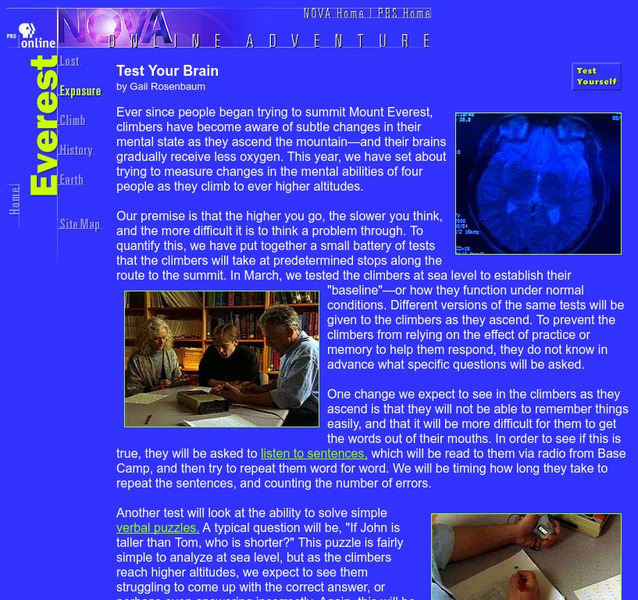
Pbs Learning Media: Everest: Test Your Brain Under Low Oxygen Conditions
This interactive feature from the NOVA: "Everest" Web site lets you take the same brain quizzes that researchers have used to test the brain function of climbers on Mount Everest.
PBS
Pbs Learning Media: Deep Sea Bestiary
This document from NOVA: "Into the Abyss" describes the physical and behavioral traits of some of the least-known and most unlikely creatures on Earth.