Hi, what do you want to do?






Government of South Australia
Don't Waste Your Energy
Don't lift another finger, this physical and environmental science unit has everything you need to begin teaching your class about energy. Starting with a look at the greenhouse effect, these lessons and activities take young scientists...

Royal Society of Chemistry
Energy—Gifted and Talented Chemistry
What has more energy than a room full of pupils after a fire drill? This lesson plan! Explore the changes in energy during different chemical reactions, discover why some reactions feel cold and others feel hot, and tackle the concept of...

American Chemical Society
Energy Foundations
Only 10 percent of an incandescent bulb's energy is used to create light; the remaining 90 percent is heat. In the unit of activities, young chemists examine energy through hands-on activities, videos, discussions, and...

Teach Engineering
Solar Water: Heat it Up!
Young engineers are instructed to design and build their own solar water heaters. Then, they calculate the efficiency and cost and compare them to commercially available models. This is a full unit for pupils to apply their knowledge.

Next Generation Science Storylines
Why Do Some Things Get Colder (or Hotter) When They React?
Some reactions absorb heat while others release it. Young scholars investigate both types of reactions in a 12-lesson unit. Each lesson presents a lab investigation that monitors temperature and considers the types of reactions taking...

Columbus City Schools
Keeping It Hot!
Hot off the presses, this collection of thermal energy activities, lessons, and printables is sure to amaze. Demonstrate how thermal energy moves about in a system using simple materials. Pupils demonstrate their understanding...

Intel
Plugging into the Sun
What's cooking? A sizzling STEM unit challenges scholars to build a solar cooker that can successfully cook an egg. The unit opens with a study of Earth's rotation, the sun's energy, and shadows. Pupils use a compass and thermometer to...

Houghton Mifflin Harcourt
That’s Amazing!: English Language Development Lessons (Theme 3)
That's Amazing! is the theme of an English language development unit created by Houghton Mifflin. Following a speak, look, move, and listen routine, scholars delve into topics; seasons, weather, animals, landforms, telling...
E-learning for Kids
E Learning for Kids: Science: Kaap De Goede Hoop: What Is Heat?
Anesu lives at the Kaap De Goede Hoop (Cape of Good Hope), and is learning about sources of heat. Join her on the adventure.

California Institute of Technology
Nasa: Cool Cosmos: What Is Heat?
Eight different types of energy that can convert into thermal energy are described. A movement activity and an experiment are included in this overview of thermal energy.
CK-12 Foundation
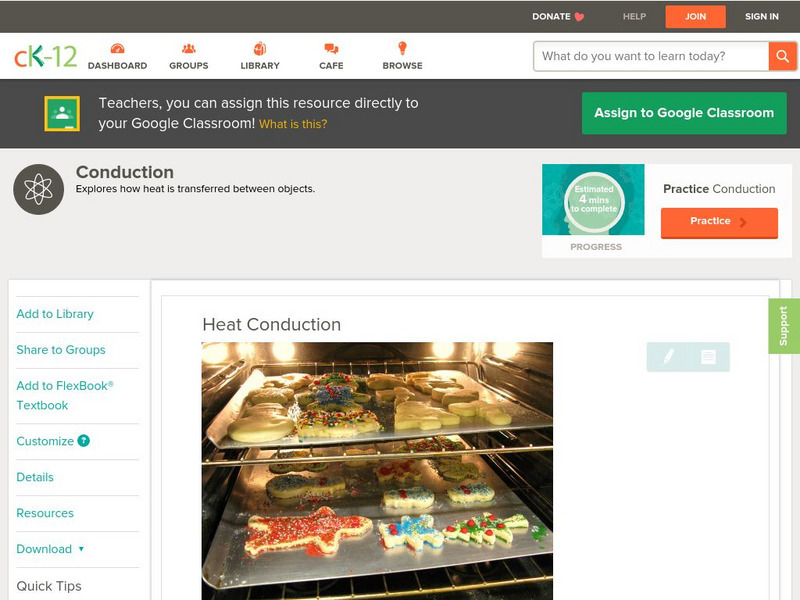
Ck 12: Physical Science: Heat Conduction
[Free Registration/Login may be required to access all resource tools.] Investigates what conduction is, how it works, and gives examples of conduction.

Concord Consortium
Concord Consortium: Heat and Temperature
Learn that temperature measures average kinetic energy, and heat is the transfer of energy from hot systems to cold systems. Consider what makes a good conductor. (Requires Java)
Sophia Learning
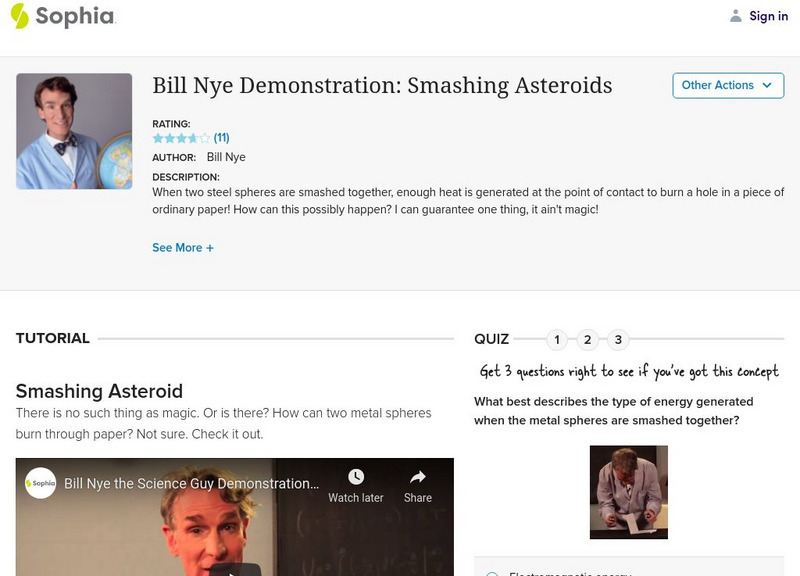
Sophia: Bill Nye Demonstration: Smashing Asteroids
Watch and learn as Bill Nye the Science Guy demonstrates what happens when two steel spheres are smashed together. Enough heat is generated at the point of contact to burn a hole in a piece of ordinary paper. [1:05]

Concord Consortium
Concord Consortium: What Makes Water Special?
Activity 2 investigates Why is water different from other liquids? This activity will discover the properties of different liquids. Students will explore what makes honey gooey and thicker than water. And why some liquids evaporate...

CK-12 Foundation
Ck 12: Kinetic Theory of Temperature
[Free Registration/Login may be required to access all resource tools.] In this online lesson students will be introduced to conditions required for an ideal gas. They will also learn about the similarities and differences between...
CK-12 Foundation
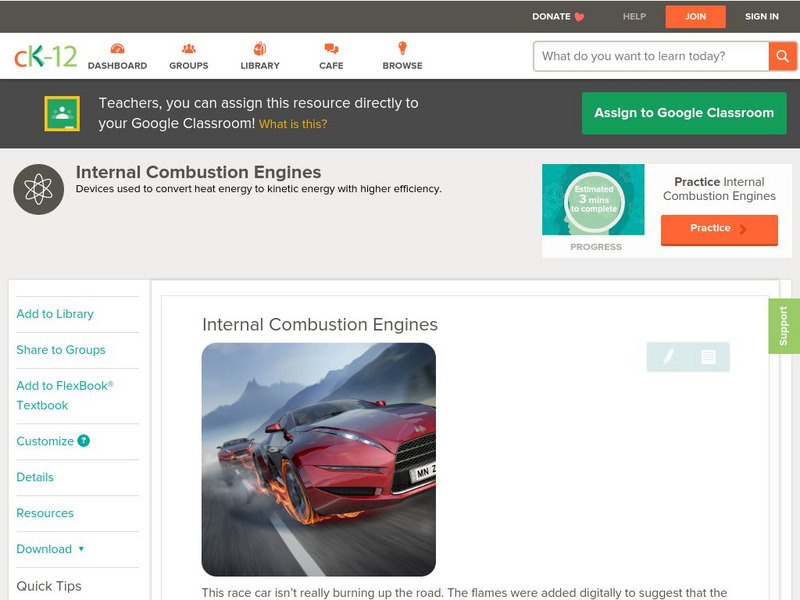
Ck 12: Physical Science: Internal Combustion Engines
[Free Registration/Login may be required to access all resource tools.] Explains what an internal combustion engine is, how it works, and how kinetic energy from the engine turns the wheels of a car.