Hi, what do you want to do?






Curated OER
Streamlines and Breadlines
Students explore the Great Depression. For this Great Depression lesson, students research selected websites and analyze primary sources to conduct inquiries regarding the depression, northern migration, and urbanization. Students author...

Curated OER
Building a Circulation City
Students examine how the workings of the human circulatory system were discovered. In this circulation lesson students view a video, divide into groups and act out their given system.

Curated OER
South Africa Story: Apartheid, Diamonds & Gold
Students explore South Africa. In this South Africa lesson, students investigate the natural resources of the nation and how they have impacted the culture and history of the nation. Students also create a children's book regarding...

Curated OER
Music of Slavery and Oppression in the Mid-1800's
Young scholars examine 19th century life for African-Americans. In this slavery lesson, students analyze the lyrics of slave songs and present their findings to their classmates.

Curated OER
The Debate Over Teaching Intelligent Design
High schoolers explain the current nationwide debate regarding the teaching of intelligent design alongside evolution in public schools. They examine the content of the debate and then analyze and critique the merits and flaws of both...

Curated OER
Horsepower: Harnessed for War
Students explore the technology of war. In this war technology lesson, students research the fighting styles of the Vikings, the Normans, and Medieval Knights.

Curated OER
Exploring Heroism
Young scholars research heroism online. In this heroism lesson, students use the documentary of Heroes of Ground Zero to explore the theme of heroism. Young scholars complete five days of activities to research and participate in...

Curated OER
Rafe's Classroom Secrets
Students consider Rafe's classroom secrets and teaching methods.

Curated OER
The Inside Story
Students think about and investigate some of the social problems facing their communities: what causes them; how extensive they are; and what can be done to solve them.

Curated OER
Welcome to Leonard Bernstein's New York
Learners study the life and musical work of Leonard Bernstein. They examine the history of New York City using three Broadway musicals in a web based lesson. They create a portrayal of their own town in this multi-lesson activity.

Curated OER
Using Primary Documents: The 1906 San Francisco Earthquake
Students examine primary documents from various key historical events, including those from the 1906 San Francisco earthquake. They discuss the importance of such documents.

Curated OER
Peddling Puccini
Pupils explore the art of the opera. They listen to examples of opera and conduct research to find out more about the opera world. Then they develop advertisements that focus on aspects that might interest young people about opera and...

Curated OER
India's Endangered Tigers
Learners explore India through maps, as well India's tigers. In this investigating India lesson students use the Internet to research the tiger and its environment.

Curated OER
Think About It: Adding to a Story
In this adding to a story activity, students read a sentence, then choose the word from a pair that would appropriately add to the story. One example is completed for students
PBS
Wnet: Thirteen: Web Service for Teachers
WNET, New York's public television station, offers a free, subscriber service for teachers. You can preview the home page and then register with the site. It provides access to lesson plans, classroom activities, teacher resources,...
PBS
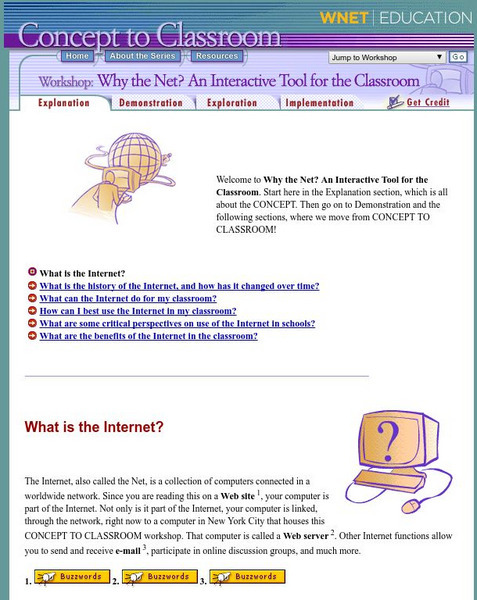
Wnet: Thirteen: Why the Net? An Interactive Tool for the Classroom
This online workshop for integrating technology in the classroom features topics on how to use the Internet for educational purposes. Content includes a full explanation, demonstrations, explorations, and guidelines for implementation....
PBS
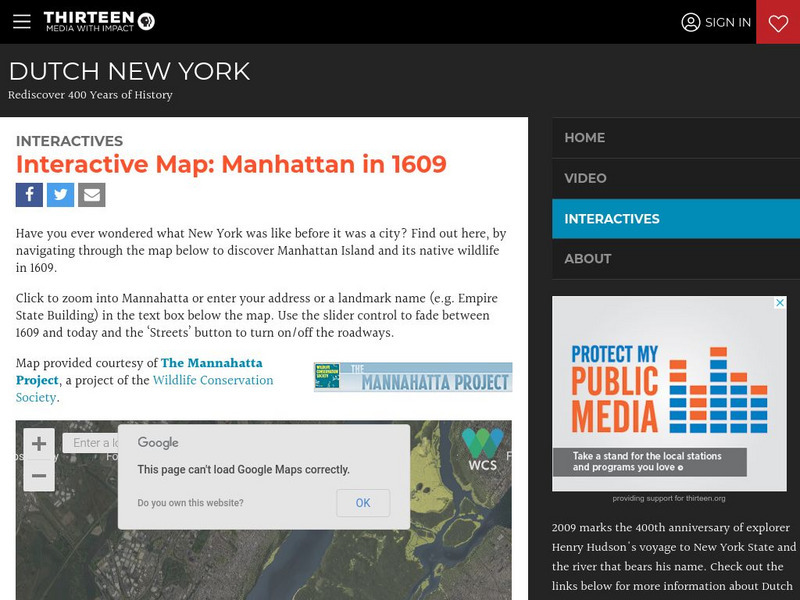
Wnet: Thirteen: Interactive Map: Manhattan in 1609: Dutch New York
Explore Dutch New York through this historical interactive map and learn what wildlife, landscape, and people lived there in 1609 compared with today. Click on 'Interactives' for additional resources, e.g., a 1626 letter from Peter...
PBS
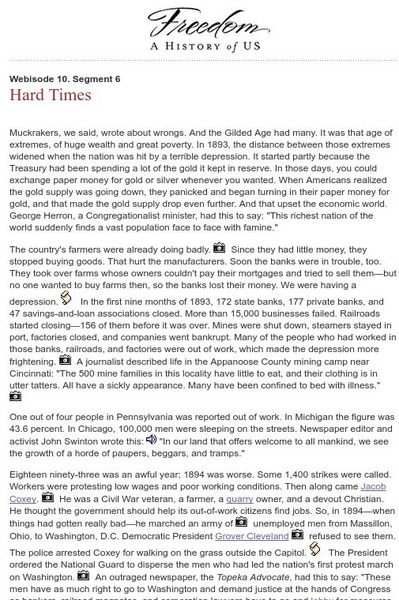
Wnet: Thirteen: Freedom: A History of Us. Printable Page
This article "Freedom: A History of US: Webisode 10, Segment 6: Hard Times," from Thirteen WNET New York, gives the reader an informative snapshot of the cause and impact of the Gilded Age depression of 1893. Students and teachers will...
PBS
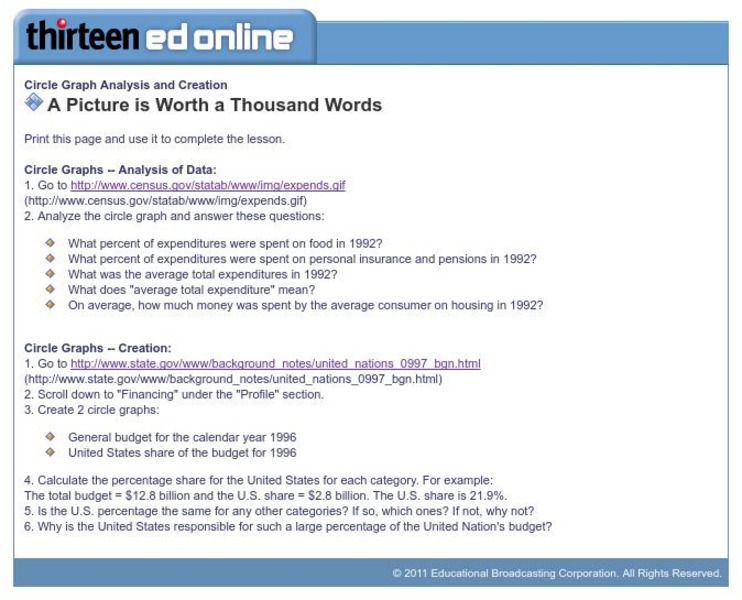
Wnet: Thirteen: Circle Graph Analysis and Creation
This site, which is provided for by WNET, gives a great way to practice using circle graphs through these exercises. One is analyzing a pie graph from the Census Bureau and the other creating pie charts using government data.

PBS
Wnet: Thirteen: Slavery & Making of America: Imagining Freedom During/after Civil War
In this interactive game, students are presented with a political drawings and cartoons from the period 1860-1877, and they must choose which historical event related to the end of slavery best matches each image.

PBS
Wnet (New York): Opera Primer
Get to know more about opera with this well written website. Many people unfamiliar with opera can be intimidated by it or even think it is boring. This site will show you just what an opera is and maybe even convince to become a fan.
PBS
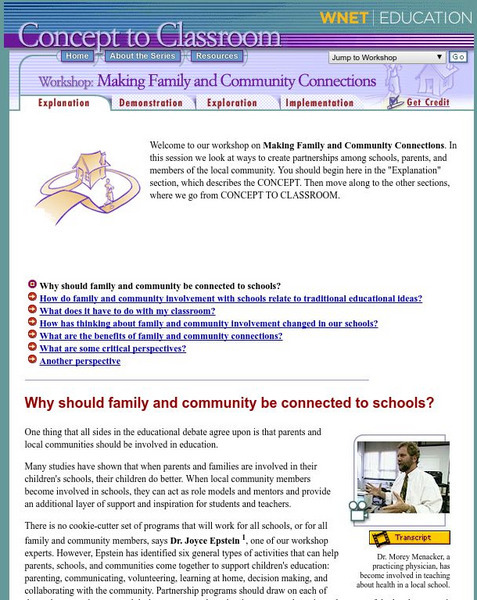
Wnet: Thirteen: Concept to Classroom Workshop: Making Family and Community Connections
Creating partnerships among schools, parents and local communities can lead to increased learning for students, strengthening their decision making skills, collaboration skills, and overall learning.
PBS
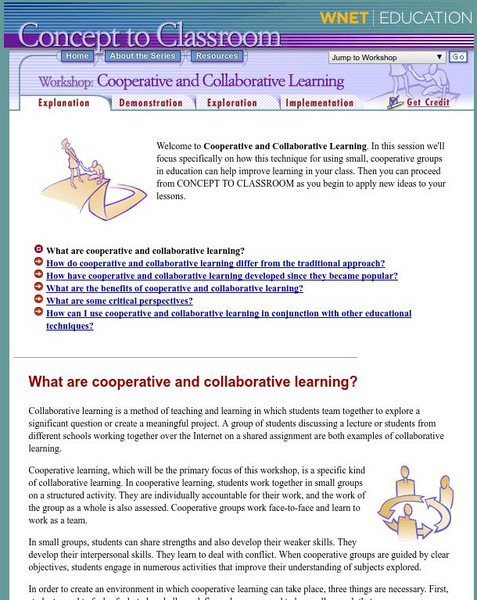
Wnet: Thirteen: Concept to Classroom: Cooperative and Collaborative Learning
Discover how to create a cooperative and collaborative learning environment in your classroom. This site features a definition for this type of learning strategy and ways to implement it in your classroom.
PBS
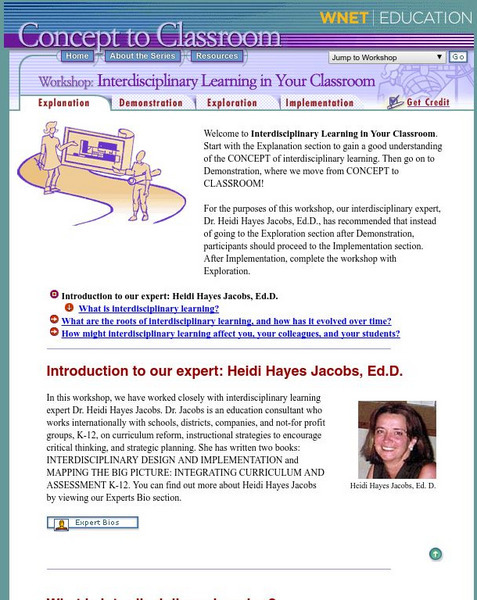
Wnet: Thirteen: Workshop: Interdisciplinary Learning in Your Classroom
What is interdisciplinary learning? How does this buzz word play into today's classroom? Find the answers to these questions when you visit this educational resource. Learn how to implement this strategy into your curriculum.