Hi, what do you want to do?





TeachEngineering
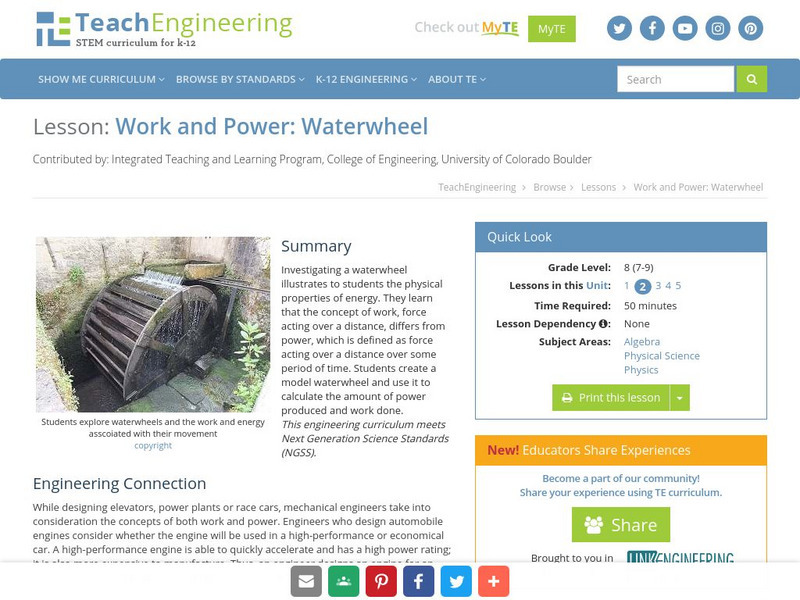
Teach Engineering: Work and Power: Waterwheel
Investigating a waterwheel illustrates to students the physical properties of energy. They learn that the concept of work, force acting over a distance, differs from power, which is defined as force acting over a distance over some...

Physics Aviary
Physics Aviary: Work to Ke Lab
This lab is designed to have students discover the relationship between the work that is done by a force and the speed gained by the object experiencing the force. Students can adjust the strength of the force. They can decide how much...
Physics Classroom
The Physics Classroom: Work, Energy, and Power: Internal vs. External Forces
Through illustrated examples and interactive examples, students learn about the two categories of forces are referred to as internal forces and external forces.
Texas Education Agency
Texas Gateway: Kinetic Energy and the Work Energy Theorem
By the end of this section, you will be able to explain work as a transfer of energy and net work as the work done by the net force and to explain and apply the work-energy theorem.
Texas Education Agency
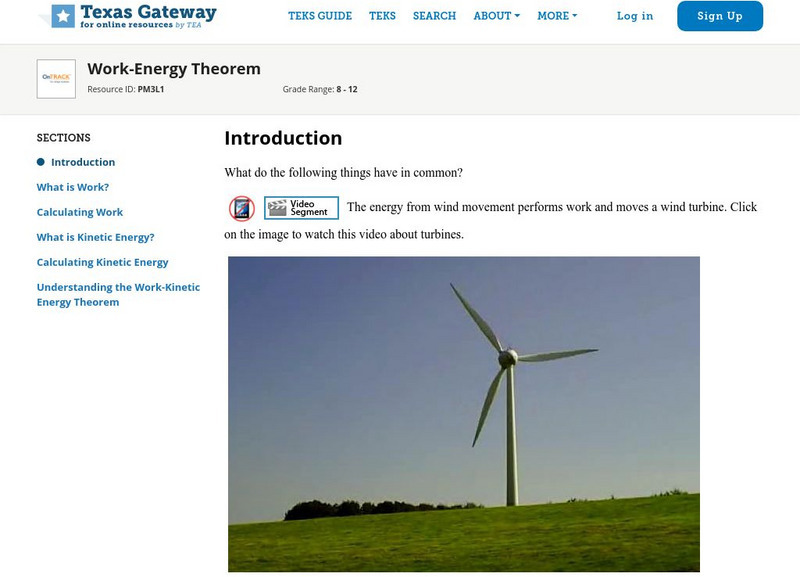
Texas Gateway: Work Energy Theorem
Using diagrams, illustrations, and relevant data, students will calculate the net work done on an object, the change in an object's velocity, and the change in an object's kinetic energy.
Texas Education Agency
Texas Gateway: Ap Physics: Gravitational Potential Energy
By the end of this section, you will be able to explain gravitational potential energy in terms of work done against gravity, show that the gravitational potential energy of an object of mass m at height h on Earth is given by PEg = mgh,...
TeachEngineering
Teach Engineering: Energy of Motion
By taking a look at the energy of motion all around us, students learn about the types of energy and their characteristics. They first learn about the two simplest forms of mechanical energy: kinetic and potential energy, as illustrated...
CK-12 Foundation
Ck 12: Work
[Free Registration/Login may be required to access all resource tools.] In this module, calculate work and explain how it relates to the overarching idea of energy.
Science Education Resource Center at Carleton College
Serc: Using Your Marbles: Making Energy Work for You
This activity is based on the common experiment of running a marble down a ramp to do work on a cup. Students will be able to see the relationship between mass and energy of the marble and the ramp height.
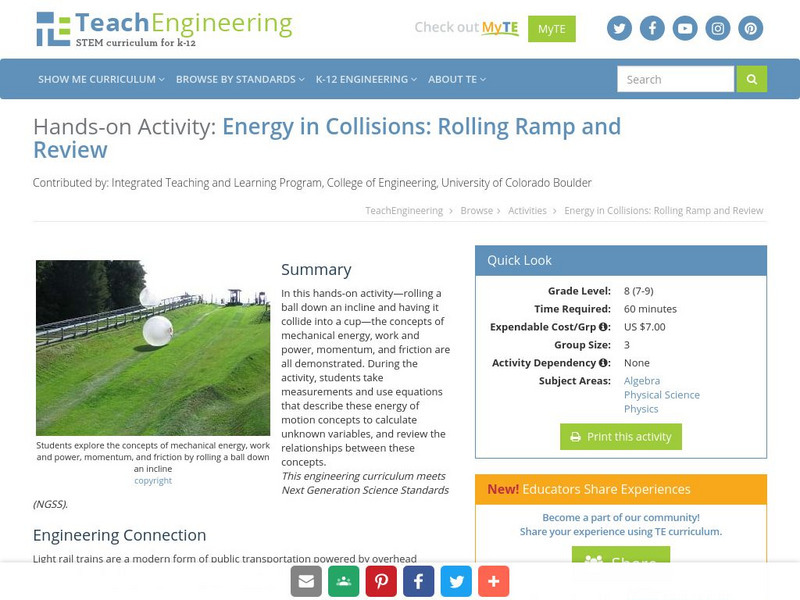
TeachEngineering
Teach Engineering: Ramp and Review
In this hands-on activity - rolling a ball down an incline and having it collide into a cup - the concepts of mechanical energy, work and power, momentum, and friction are all demonstrated. During the activity, students take measurements...

TeachEngineering
Teach Engineering: Ramp and Review (For High School)
In this hands-on activity - rolling a ball down an incline and having it collide into a cup - the concepts of mechanical energy, work and power, momentum, and friction are all demonstrated. During the activity, students take measurements...

Georgia State University
Georgia State University: Hyper Physics: Potential Energy
This site from Georgia State University Physics Department defines and explains the concept of potential energy. Using equations and graphics to illustrate the idea, it discusses the many types of potential energy (gravitational,...
Physics Classroom
The Physics Classroom: Energy Relationships for Satellites
The orbits of satellites are described and an energy analysis is performed. Kinetic, potential and total mechanical energy are explained and applied to the motion of satellites.
Physics Classroom
The Physics Classroom: Work, Energy, and Power: Power
In this interactive module, students learn the basic terminology and concepts of power as it has to do with work and energy.
Concord Consortium
The Concord Consortium: Molecular Workbench: Forces and Systems
See how motion is converted and the energy associated with the motion is used to do work.
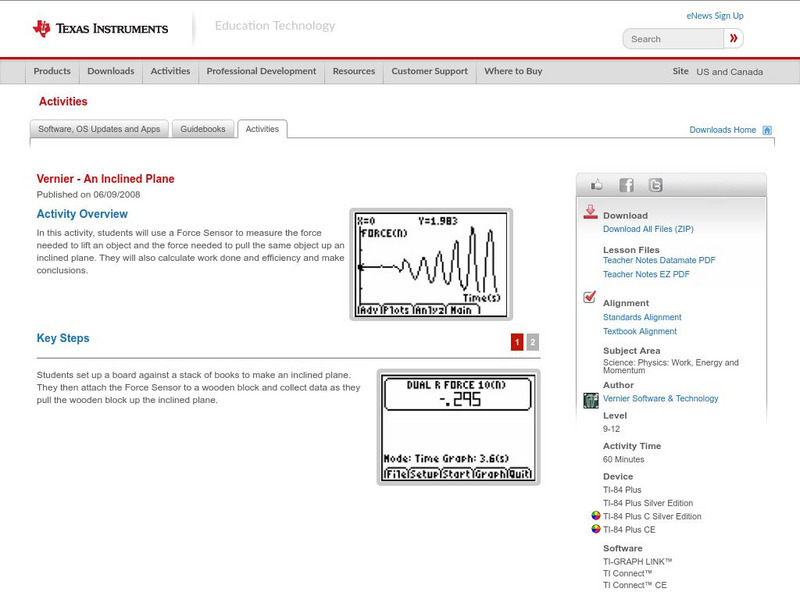
Texas Instruments
Texas Instruments: An Inclined Plane
In this activity, Students can use a Force Sensor to measure the force needed to lift an object and the force needed to pull the same object up an inclined plane. They will also calculate work done and efficiency and make conclusions.
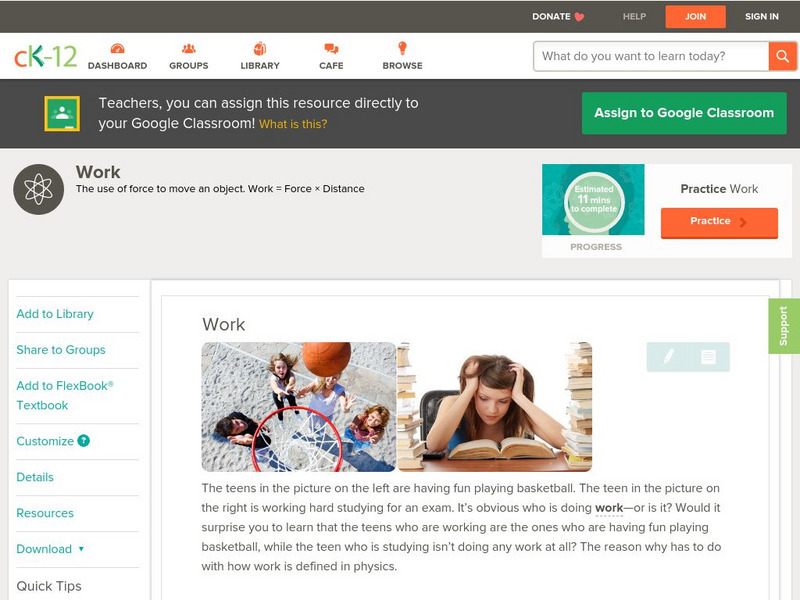
CK-12 Foundation
Ck 12: Physical Science: Work
[Free Registration/Login may be required to access all resource tools.] Definition of work and how it relates to force and distance.
TryEngineering
Try Engineering: Working With Watermills
Teams of students design, build, test, and evaluate a working watermill made from everyday materials. Lesson explores how watermills generate energy from water, while students gain an understanding of the structural engineering design...
Physics Classroom
The Physics Classroom: Work, Energy, and Power: Calculating Work Done by Forces
Through interactive practice problems and examples, students calculate the amount of work done by forces.
Physics Classroom
The Physics Classroom: Work, Energy, Power: Situations Involving External Forces
Through interactive exercises and illustrated examples, students analyze situations involving external forces.

FT Exploring
Ft Exploring: Energy, Heat Flow, and Life
Here you can learn all about heat flow, one of the major driving forces of nature, and how it works. It is the force behind weather, photosynthesis, animal behavior, and much more.
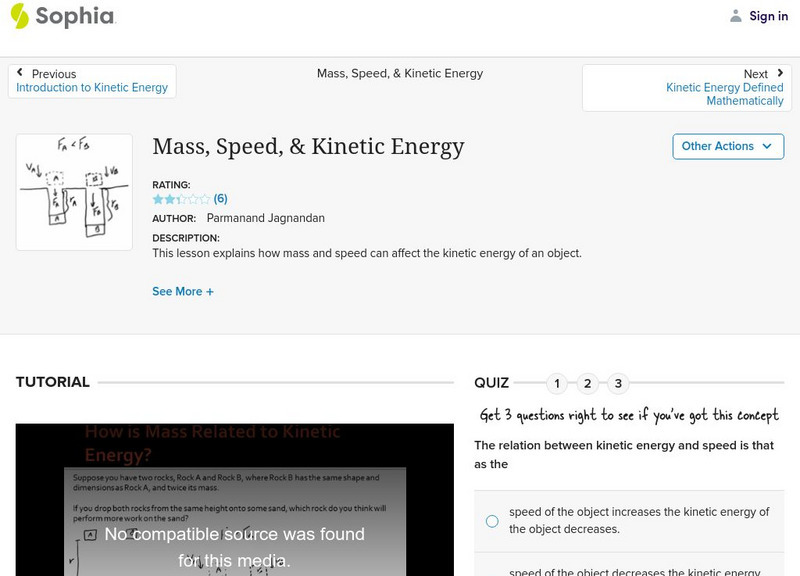
Sophia Learning
Sophia: Mass, Speed, & Kinetic Energy
Looking to review how kinetic energy is related to mass and speed? This video lesson review the concept of kinetic energy, mass, and speed with both definitions and problems. Problems are work through step-by-step so you can review how...
CK-12 Foundation
Ck 12 Exploration Series: Simulations: Physics: Block and Tackle
[Free Registration/Login Required] A video module where students learn about the relationship between force, work, energy, and mechanical advantage using a simple machine.

TED Talks
Ted: Ted Ed: How Does Work, Work?
In this video, Peter Bohacek explains the interplay between work and power and how it can be seen in the functioning of a clock. [4:31] Followed by a short quiz and a list of additional resources to explore.