Hi, what do you want to do?






Curated OER
Beach Zonation
Young scholars identify and separate the different zones of the beach by observation. They investigate beach zonation by gathering and comparing sand samples gathered from different areas of the beach.

Curated OER
Electrical motors
Students investigate and experiement with a 9-volt motor. They will use the connecting wire and battery pack to discover fans.

Curated OER
Shake, Rattle and Erupt
Students study myths regarding four earthquakes myths. They receive a list of supplies each family should have at home to prepare for an earthquake and construct an "Earthquake Preparation" poster showing some of the most important items...

Curated OER
Super Scientists Bingo
In this science activity, students select twenty-five scientists from the list to fill in their bingo card. Then they match each of the scientists listed to their correct description strip.

Curated OER
Super Scientists Code
In this science worksheet, middle schoolers use the key code on the right to unscramble each of the scientists. They also match each of the scientists found to their correct description.
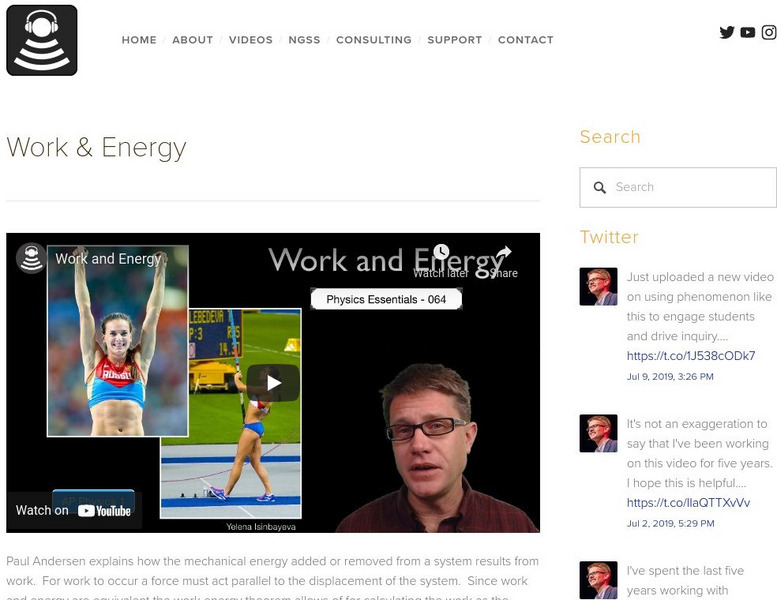
Bozeman Science
Bozeman Science: Work and Energy
In the following video Paul Andersen explains how the mechanical energy added or removed from a system results from work. For work to occur a force must act parallel to the displacement of the system. Since work and energy are equivalent...
![Harvard University: Math 21a Supplement 1 on Work and Energy [Pdf] Handout](https://static.lp.lexp.cloud/images/attachment_defaults/resource/large/FPO-knovation.png "Harvard University: Math 21a Supplement 1 on Work and Energy [Pdf] Handout")
Harvard University
Harvard University: Math 21a Supplement 1 on Work and Energy [Pdf]
A handout for a university calculus course. It looks at the application of Newton's Laws to calculate work and energy for a particle of mass with a force being exerted on it.
Physics Classroom
The Physics Classroom: Work and Energy: Energy Transformation Downhill Skiing
The intricate relationship between work and mechanical energy is depicted in the animation for students to be able to visualize.
Physics Classroom
The Physics Classroom: Work and Energy: Which Path Requires the Most Energy?
Suppose that a car traveled up three different sloped roadways from the base of a mountain to the summit of the mountain. Which path would require the most energy? See this animation and explanation for help.

Science Education Resource Center at Carleton College
Serc: Com Padre: Introduction to Work and Energy: The Hopper Popper Surprise
This activity will provide students with a qualitative understanding of the Work-Energy Theorem, especially on how the energy transferred depends on the distance over which the force is applied.

TeachEngineering
Teach Engineering: Energy Basics
Demos and activities in this lesson are intended to illustrate the basic concepts of energy science--work, force, energy, power etc., and the relationships among them. The "lecture" portion of the lesson includes many demonstrations to...

Georgia Department of Education
Ga Virtual Learning: Ap Physics 1: Work, Energy, and Power
The mathematical model for the relationships between work and energy serves to model physical problems and, more importantly, predict natural and man-made phenomena. Students discover the relationships which serve as a powerful...
Utah Education Network
Uen: Force, Energy, and Motion: Complex Machines for Simple Tasks!
Designed for Grade Eight, this collection of lessons provides information, examples and quizzes related to simple machines. Elementary students studying this topic will find this site informative as well.
Texas Education Agency
Texas Gateway: Nonconservative Forces
By the end of this section, you will be able to define nonconservative forces and explain how they affect mechanical energy, and to show how the principle of conservation of energy can be applied by treating the conservative forces in...
OpenStax
Open Stax: Potential Energy and Conservative Forces
In the following interactive students will define conservative force, potential energy, and mechanical energy. They will explain the potential energy of a spring in terms of its compression when Hooke's Law applies. Students will also...
Texas Education Agency
Texas Gateway: Ap Physics: Conservative Forces and Potential Energy
By the end of this section, you will be able to define conservative force, potential energy, and mechanical energy; explain the potential energy of a spring in terms of its compression when Hooke's law applies; and use the work-energy...
OpenStax
Open Stax: Nonconservative Forces
In the following interactive students will begin to define nonconservative forces and explain how they affect mechanical energy. They will show how the principle of conservation of energy can be applied by treating the conservative...
OpenStax
Open Stax: Kinetic Energy and the Work Energy Theorem
In the following interactive students will begin to explain work as a transfer of energy and net work as the work done by the net force. They will also explain and apply the work-energy theorem.
Physics Classroom
The Physics Classroom: The Work Energy Theorem
This page explores the quantitative relationship between work and mechanical energy in situations in which there are no external forces doing work. It is a basic analysis of situations in which mechanical energy is conserved. Examples...
TeachEngineering
Teach Engineering: Energy of Motion
By taking a look at the energy of motion all around us, students learn about the types of energy and their characteristics. They first learn about the two simplest forms of mechanical energy: kinetic and potential energy, as illustrated...
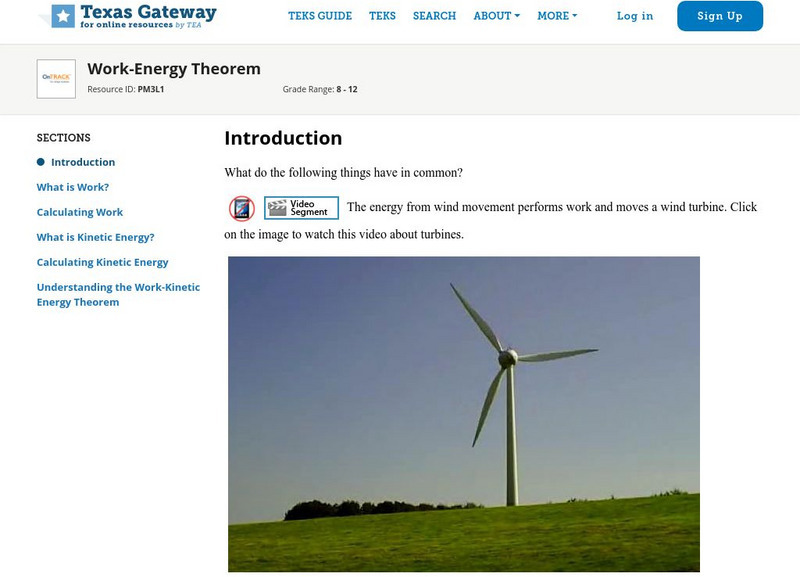
Texas Education Agency
Texas Gateway: Work Energy Theorem
Using diagrams, illustrations, and relevant data, students will calculate the net work done on an object, the change in an object's velocity, and the change in an object's kinetic energy.
Texas Education Agency
Texas Gateway: Ap Physics: Gravitational Potential Energy
By the end of this section, you will be able to explain gravitational potential energy in terms of work done against gravity, show that the gravitational potential energy of an object of mass m at height h on Earth is given by PEg = mgh,...
OpenStax
Open Stax: Work: The Scientific Definition
In the following interactive students will begin to explain how an object must be displaced for a force on it to do work. They will also explain how relative directions of force and displacement determine whether the work done is...
Texas Education Agency
Texas Gateway: Kinetic Energy and the Work Energy Theorem
By the end of this section, you will be able to explain work as a transfer of energy and net work as the work done by the net force and to explain and apply the work-energy theorem.