Hi, what do you want to do?






Curated OER
Arts Directors
Students reflect on a personally meaningful live performance and the circumstances necessary to create art. They study about the current leadership crisis facing the Met, Carnegie Hall, and the Public theater. In groups, students...

Curated OER
Family Cookbook
Second graders, in groups, produce a Family Cookbook by bringing recipes from home.

Curated OER
Larger Than Life Figures
Students prepare for and respond to literature selections. This package includes six lessons about larger than life figures from the American Literature series, each covering a different reading selection. Pre-reading and response...

Curated OER
Yorktown and Treaty of Paris
Eighth graders discuss the importance of battles fought during the Revolutionary War. They summarize the events, people, and strategies of significance in the Battle of Yorktown. They identify the significance of the the adoption of...

Curated OER
Comparing Cultures Through Symbols
Middle schoolers examine symbols used by the Plains Indians. Using examples of African art, they discuss what symbols they use that relate to the Native American symbols. They compare and contrast the two cultures and discuss as a class...

Curated OER
Tooling Around Arizona: Reading Arizona Maps
Students research Arizona maps. In this map lesson, students discuss map titles, scales, directions, elevation, and symbols. The class will examine topography, landforms, and rivers found on an Arizona map.

Curated OER
Welding
Students are introduced to the career of welding through a video and conduct a brainstorming session on careers. They identify components of the workplace in their chosen career field and develop a list of potential job sites in the...

Curated OER
Graphing Favorite Holidays
Students create spreadsheets and bar graphs based on results of survey of favorite holidays.

Curated OER
WWI Document Based Essay
Learners read various primary source documents on World War I. After reading each document, they answer discussion questions. Using the internet, they identify the causes of World War I as layed out by President Wilson and his reasons...

Curated OER
Is That a Plan? Problem-Solving: Using Diagrams and Models
Student solve problems using a flow chart. They solve real-world problems by using a diagram or model. They create their own diagrams for problem-solving. They explain how they drew the diagram and solved the problem.

Curated OER
Ancient Roman Influences in Israel and the Modern World
Students practice critical thinking skills. They compare Ancient Roman influences on the Middle East region (Beit Shean, Masada, and Zippori) with Ancient Roman influences still present in our culture today.

Curated OER
Changing the World: Social Entrepreneurs Part One
Students analyze the purpose of a social entrepreneur. In this entrepreneurship lesson, students create a "help wanted" advertisement and graphic organizer to provide information on how a social entrepreneur seeks long-term change by...

Curated OER
You Scratch my Back, I'll Scratch Yours
Students explore the concept of interdependence. In this integrated interdependence lesson, students interpret graphs and charts that require them to analyze the relationship between Mexico and the United States. Students also...

Curated OER
Representing Text Story Web: Pretest
In this story web worksheet, students answer multiple choice questions about how to make and use a story web. Students complete 10 questions total.

Curated OER
The Celestial Sphere and Circumpolar Motion
Students investigate the celestial sphere and circumpolar motion. In this science lesson, students view an applet, The Celestial Sphere and Circumpolar Motion. Students discuss the Earth's rotation and stellar movement.

Curated OER
Archaeological Study
Pupils analyze the difference between archaeology and anthropology while studying the evolution of different products. In this archaeology and anthropology lesson plan, students trace the progression of a certain tool or product and come...

Curated OER
McLean Train Yard
Students conduct online research and incorporate graphics and maps into a Powerpoint presentation that details life at the McLean train yard in its heyday.

Curated OER
Summarize information gathered and create a plaque to put on the Hall of Fame
Third graders summarize information. In this Hall of Fame lesson, 3rd graders gather information on inductees and paraphrase the information. Students use this to create decorate and create a sample plaque.

Curated OER
Nutrition and Fast Food: Making Informed Choices
Pupils identify the components of a balanced diet and their importance to good health. Students research their favorite types of fast food to determine how healthy they really are. Links to websites of popular fast food companies are...

Curated OER
Community Brochures
Second graders research facets of their community in order to create an informational brochure. After brainstorming ideas of what could be included in the brochure, student groups get information from the internet, the library or a...

Curated OER
Runaways Past and Present
Tenth graders use video and the Internet to compare runaway teenagers of the 1930s with runaways today. The lesson plan uses the integration of technology in order to build skills and conduct research.

Curated OER
View Tube Triangulation
Students investigate a particular object then calculate to find the class average and standard deviation. In this measuring distance lesson students list their calculations on a piece of paper.
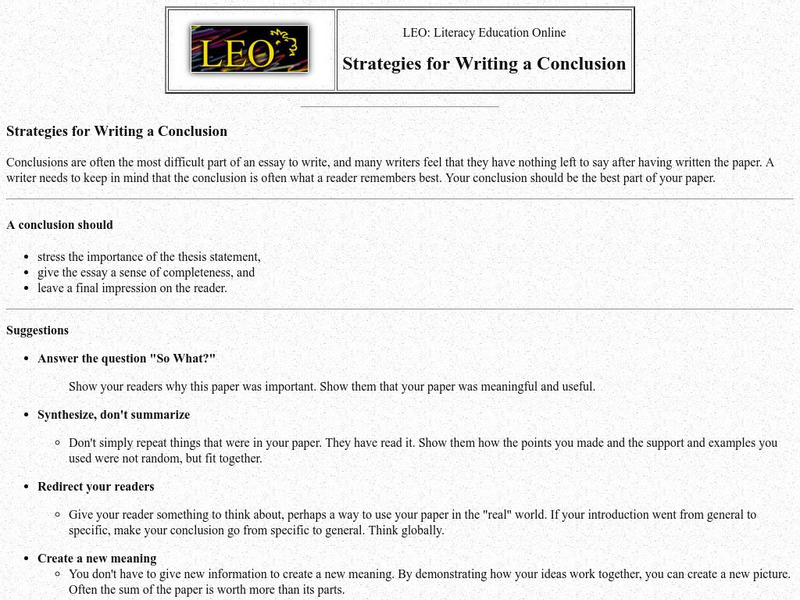
The Write Place
Literacy Education Online: Writing Conclusions Strategies
This site explains what a conclusion should do and gives strategies and suggestions for accomplishing that end. Includes examples. W.9-10.1e & W.9-10.2f, w.9-10.3e Conclusion, W.11-12.2f Conclusion
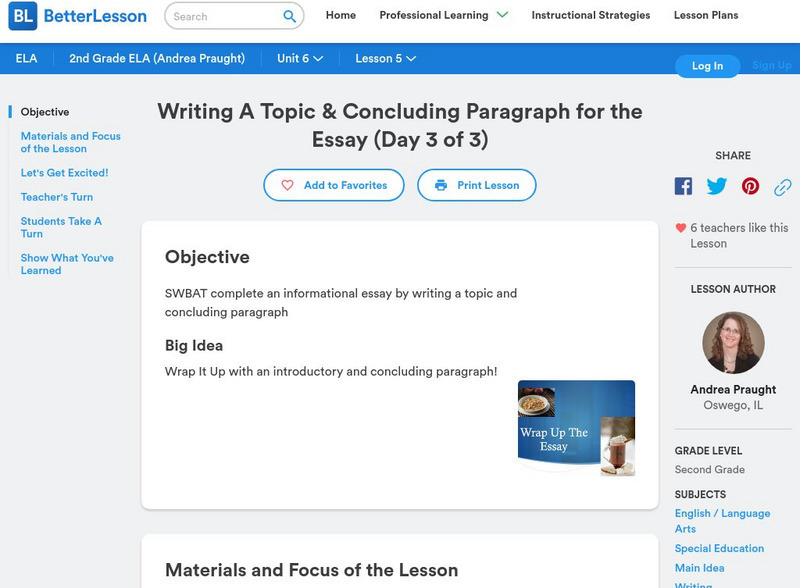
Better Lesson
Better Lesson: Writing a Topic & Concluding Paragraph for the Essay
This lesson is a final step towards supporting young scholars to practice writing an informative/explanatory paragraph conveying complex ideas and presenting information clearly and accurately. Second-grade students can usually write a...