



Lesson Planet
Search educational resources
  • Sign In Try It Free
  • AI Teacher Tools
    • Discover Resources Search reviewed educational resources by keyword, subject, grade, type, and more
    • Curriculum Manager (My Content) Manage saved and uploaded resources and folders To Access the Curriculum Manager Sign In or Join Now
    • Browse Resource Directory Browse educational resources by subject and topic
    • Curriculum Calendar Explore curriculum resources by date
    • Lesson Planning Articles Timely and inspiring teaching ideas that you can apply in your classroom
    • Our Story
    • Frequently Asked Questions
    • Testimonials
    • Contact Us
  • Pricing
  • School Access
    • Your school or district can sign up for Lesson Planet — with no cost to teachers
      Learn More
  • Sign In
  • Try It Free

Hi, what do you want to do?

Create a lesson plan
Generate resources with 80+ AI teacher tools
Search 200,000 instructional videos
Find a teaching resource
Australian Acad. Of Science: Food Waste: Preventing Multi Billion Dollar Problem ArticleAustralian Acad. Of Science: Food Waste: Preventing Multi Billion Dollar Problem Article
Publisher
Other
Resource Details
Curator Rating
Educator Rating
Not yet Rated
Grade
9th - 10th
Subjects
Science
3 more...
Resource Type
Articles
Audiences
For Administrator Use
2 more...
Lexile Measures
1340L
Article

Australian Acad. Of Science: Food Waste: Preventing Multi Billion Dollar Problem

Curated by ACT

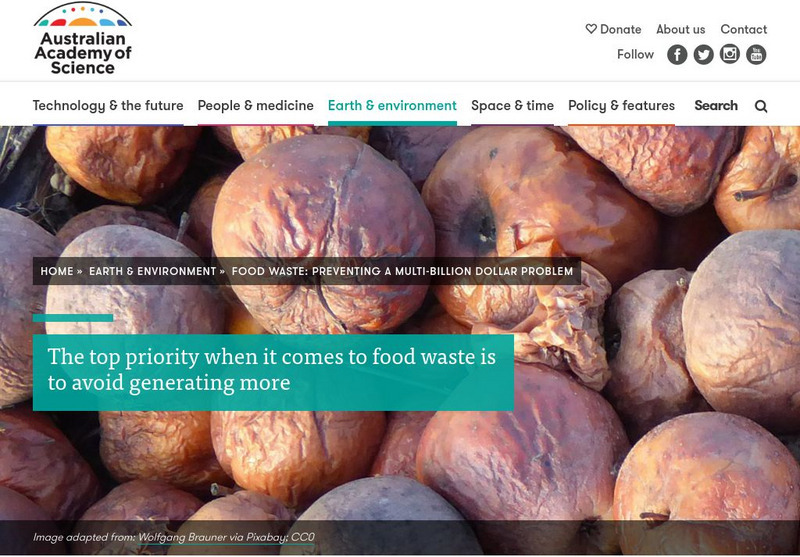
The top priority when it comes to food waste is to avoid generating more. Food waste includes all food intended for human consumption that never reaches us, as well as edible food that consumers throw away. As it rots in landfills, food waste generates potent greenhouse gases that accelerate global warming. Learn about the many initiatives being taken in Australia to combat this problem and how agricultural technology innovations such as sensor-enabled drones to monitor fields, predictive data analysis, and the use of agricultural robots, or agbots, are driving change.

3 Views 1 Download

Concepts

sustainability

Additional Tags

agricultural technology, food sustainability, australia's national food waste strategy, australian academy of science, australian academy of science: food waste: preventing a multi-billion dollar problem, agbots, farming with drones, preventing food waste, technological solutions to food waste

Classroom Considerations

  • Knovation Readability Score: 5 (1 low difficulty, 5 high difficulty)
  • The intended use for this resource is Instructional

See similar resources:

Lesson Plan

Filling Our Land with Landfills: Solid Waste Disposal

K20 Learn
Though it comprises only 5 percent of the world's population, the US generates 40 percent of the world's waste. Scholars learn about landfills, their safety, and other solid waste methods. They use experiments and research to learn more....
9th - 12th Science
CCSS: Adaptable
Instructional Video

The Surprising Origin of Thanksgiving Foods

Be Smart
Many of the foods pilgrims ate include foods people still eat at American Thanksgiving celebrations today. The turkey, a domesticated animal native to the Americas, often finds itself the center of attention on this holiday. Today's corn...
6 mins 6th - 12th Science
CCSS: Adaptable
Instructional Video

The Columbian Exchange: Crash Course History of Science #16

Crash Course
Back in 1492, when Columbus sailed the ocean blue, he discovered more than a new world! Part 16 in an ongoing History of Science series explores the Columbian Exchange and other major events in the Spanish colonial period. Viewers learn...
13 mins 9th - 12th Science
CCSS: Adaptable
Instructional Video

Love Letter to Food

MinuteEarth
Don't be rude to food! Scholars see the startling truth about food waste in a disturbing video. The series of statements from individuals around the country paints a picture of good intentions followed by wasteful habits like cooking too...
3 mins 6th - 12th Science
CCSS: Adaptable
Instructional Video

Darwin and Natural Selection: Crash Course History of Science #22

Crash Course
Charles Darwin studied many species, but he also hindered their continued study by eating his specimens. Like many sailors, he enjoyed the taste of the Galapagos tortoise so much for many years that no ship made it all the way back to...
13 mins 9th - 12th Science
CCSS: Adaptable
Instructional Video

Intro to History of Science: Crash Course History of Science #1

Crash Course
How, and where, did the scientific process as we know it begin? Journey back through time with the introductory video from Crash Course's History of Science series. The resource highlights what people do and don't know about the world,...
12 mins 9th - 12th Science
CCSS: Adaptable
Instructional Video

Turning Food Waste Into a Resource

PBS
One in every seven truckloads of perishable foods delivered to grocery stores gets thrown away. Is there anything that can be done with this waste? One solution is to recycle the old produce and turn it into fertilizer. The video, part...
5 mins 5th - 12th Science
CCSS: Adaptable
Instructional Video

Reducing Food Waste

California Academy of Science
The average American creates more than 240 pounds of food waste every year. Are there ways to reduce that number? The eighth lesson in the 13-part series covering Our Hungry Planet introduces multiple ideas for reducing food waste. It...
2 mins 6th - 10th Career & Technical Education
CCSS: Adaptable
Instructional Video

The Danger of Science Denial

TED-Ed
"Everyone is entitled to their own opinions... but they're not entitled to their own facts." Michael Specter, a well-respected science and technology journalist, speaks eloquently about modern attitudes toward science and progress and...
16 mins 9th - Higher Ed Science
Lesson Plan

What is the Nature of Science?

Curated OER
Conduct a survey about the nature of science with your high schoolers. They will record their responses in a table and then discuss the implications of scientific theory. Note: There are activity sheets, and forms included with this lesson.
9th - 12th Science
Try It Free
© 1999-2026 Learning Explorer, Inc.
Teacher Lesson Plans, Worksheets and Resources

Sign up for the Lesson Planet Monthly Newsletter

Open Educational Resources (OER)

  • Health
  • Language Arts
  • Languages
  • Math
  • Physical Education
  • Science
  • Social Studies
  • Special Education
  • Visual and Performing Arts
View All Lesson Plans

Discover Resources

  • Our Review Process
  • How it Works
  • How to Search
  • Create a Collection

Manage Curriculum

  • Edit a Collection
  • Assign to Students
  • Manage My Content
Contact Us Site Map Privacy Policy Terms of Use