



Lesson Planet
Search educational resources
  • Sign In Try It Free
  • AI Teacher Tools
    • Discover Resources Search reviewed educational resources by keyword, subject, grade, type, and more
    • Curriculum Manager (My Content) Manage saved and uploaded resources and folders To Access the Curriculum Manager Sign In or Join Now
    • Browse Resource Directory Browse educational resources by subject and topic
    • Curriculum Calendar Explore curriculum resources by date
    • Lesson Planning Articles Timely and inspiring teaching ideas that you can apply in your classroom
    • Our Story
    • Frequently Asked Questions
    • Testimonials
    • Contact Us
  • Pricing
  • School Access
    • Your school or district can sign up for Lesson Planet — with no cost to teachers
      Learn More
  • Sign In
  • Try It Free

Hi, what do you want to do?

Create a lesson plan
Generate resources with 80+ AI teacher tools
Search 200,000 instructional videos
Find a teaching resource
Bozeman Science: Wave Particle Duality of Light Instructional VideoBozeman Science: Wave Particle Duality of Light Instructional Video
Publisher
Bozeman Science
Resource Details
Curator Rating
Educator Rating
Not yet Rated
Grade
9th - 10th
Subjects
Science
2 more...
Resource Type
Instructional Videos
Audiences
For Administrator Use
2 more...
Lexile Measures
1040L
Instructional Video

Bozeman Science: Wave Particle Duality of Light

Curated by ACT

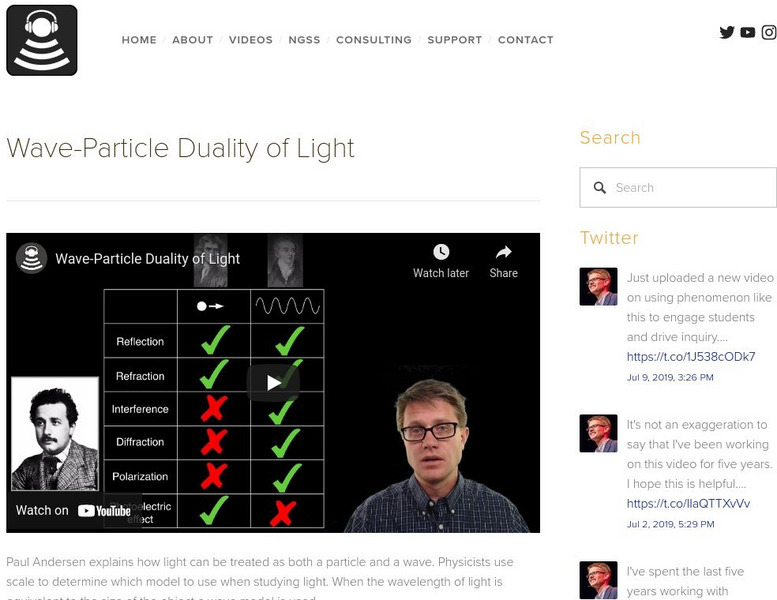
In the following video Paul Andersen explains how light can be treated as both a particle and a wave. Physicists use scale to determine which model to use when studying light. When the wavelength of light is equivalent to the size of the object a wave model is used. [3:34]

3 Views 1 Download

Concepts

light waves, wavelength

Additional Tags

wave model, wave particle duality, bozeman science: wave-particle duality of light, hs-ps4-1, wave-particle duality of light, waves and wave theory of light

Classroom Considerations

  • Knovation Readability Score: 3 (1 low difficulty, 5 high difficulty)
  • The intended use for this resource is Instructional

See similar resources:

Lesson Plan

Manitoba Education and Training: Physics: Particle and Wave Models of Light

Other
A collection of ideas for teaching students about the nature of light. They learn about the history behind theories of light and the contributions of different scientists. Includes lots of experiments to build their understanding of the...
9th - 10th Science
Lab Resource

What's the Difference Between Blue Light and Red Light?

Colorado State University
Finally, an electromagnetic spectrum lab that will get glowing reviews from your class! Explore the nature of light using red and blue LED sources and fantastic phosphorescent paper. Young scientists compare the effects of blue light...
6th - 12th Science
Instructional Video

The Wave/Particle Duality - Part 2

MinutePhysics
By imagining an electron as a particle of dust in a raindrop, the narrator helps viewers to understand wave-particle duality. Drawings and narration liken it to a particle being guided by a wave. The challenge, however, it to determine...
1 min 9th - 12th Science
Instructional Video

What is the Wave/Particle Duality? Part 1

MinutePhysics
Einstein rejected the idea of wave/particle duality, yet now we believe the concept to be true. A short video explains the properties of waves, particles, and the behavior of electrons, which act as both. The film concludes with...
1 min 9th - Higher Ed Science
CCSS: Adaptable
Instructional Video

What is the Wave/Particle Duality? Part 2

MinutePhysics
Electrons, neutrons, and photons display behavior explained by wave-particle duality. The video explains how to picture the duality of behaviors in these parts of atoms. The drawings and comparisons to the behavior of water focus on...
1 min 9th - Higher Ed Science
CCSS: Adaptable
Instructional Video

Can You Go the Speed of Light?

Veritasium
Is it physically possible to travel at the speed of light? A video in the Veritasium playlist discusses Einstein's Theory of Relativity. The narrator then challenges learners to consider the classic thought experiment: If you travel at...
4 mins 9th - 12th Science
CCSS: Adaptable
Instructional Video

The Speed of Light is NOT About Light

PBS
Just when you thought you had this figured out! Engage young physicists in an interesting look at the nature of a universal constant with a video, part of a PBS playlist on space time and measurement....
13 mins 10th - Higher Ed Science
CCSS: Adaptable
Handout

Georgia State University: Hyper Physics: Wave Particle Duality

Georgia State University
The dualistic nature of light is discussed. The photoelectric effect and the Davisson-Germer experiment are contrasted as empirical evidence supporting each of the two views - particle and wave - of the nature of light. The photoelectric...
9th - 10th Science
Instructional Video

Measuring Speed of Light

Curated OER
A beam of laser light is sent to a satellite from a transmitter and travels 40,000 km. Elapsed time is recorded. This is all done to prove that the speed of light is 300,000 km/sec. This interesting clip can be used when you teach young...
4 mins 9th - 12th Science
Unit Plan

Ck 12: Light

CK-12 Foundation
[Free Registration/Login may be required to access all resource tools.] In the following tutorial students will describe the relationships between speed, wavelength, and frequency of light. They will understand the photoelectric effect...
9th - 10th Science
Try It Free
© 1999-2026 Learning Explorer, Inc.
Teacher Lesson Plans, Worksheets and Resources

Sign up for the Lesson Planet Monthly Newsletter

Open Educational Resources (OER)

  • Health
  • Language Arts
  • Languages
  • Math
  • Physical Education
  • Science
  • Social Studies
  • Special Education
  • Visual and Performing Arts
View All Lesson Plans

Discover Resources

  • Our Review Process
  • How it Works
  • How to Search
  • Create a Collection

Manage Curriculum

  • Edit a Collection
  • Assign to Students
  • Manage My Content
Contact Us Site Map Privacy Policy Terms of Use