Lesson Planet
Search educational resources
  • Sign In Try It Free
  • AI Teacher Tools
    • Discover Resources Search reviewed educational resources by keyword, subject, grade, type, and more
    • Curriculum Manager (My Content) Manage saved and uploaded resources and folders To Access the Curriculum Manager Sign In or Join Now
    • Browse Resource Directory Browse educational resources by subject and topic
    • Curriculum Calendar Explore curriculum resources by date
    • Lesson Planning Articles Timely and inspiring teaching ideas that you can apply in your classroom
    • Our Story
    • Frequently Asked Questions
    • Testimonials
    • Contact Us
  • Pricing
  • School Access
    • Your school or district can sign up for Lesson Planet — with no cost to teachers
      Learn More
  • Sign In
  • Try It Free

Hi, what do you want to do?

Create a lesson plan
Generate resources with 80+ AI teacher tools
Search 200,000 instructional videos
Find a teaching resource
Famsi: Ceramic Sequence of Piedras Negras, Guatemala (2003) WebsiteFamsi: Ceramic Sequence of Piedras Negras, Guatemala (2003) Website
Publisher
Foundation for the Advancement of Mesoamerican Studies
Resource Details
Curator Rating
Educator Rating
Not yet Rated
Grade
9th - 10th
Subjects
Social Studies & History
2 more...
Resource Type
Websites
Audiences
For Administrator Use
2 more...
Lexile Measures
1350L
Language
English, Spanish
Website

Famsi: Ceramic Sequence of Piedras Negras, Guatemala (2003)

Curated by ACT

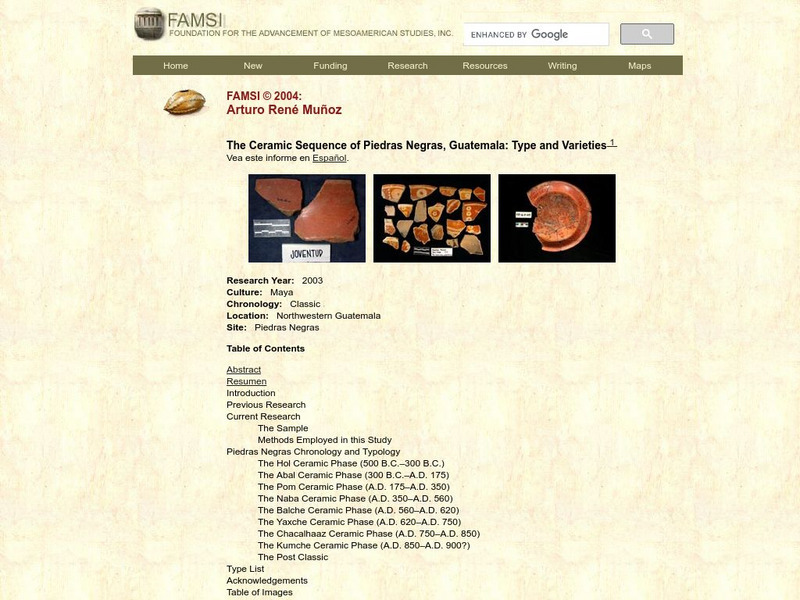
Report offers history of the production of ceramic pieces from 500 B.C. to 900 A.D. Photographs document each cultural phase and work. Readers can download this PDF at the bottom of the page.

3 Views 0 Downloads

Concepts

mayan culture, mexico

Additional Tags

mayan artifacts, mayan ceramics, piedras negras, world history, artisans

Classroom Considerations

  • This resource is only available on an unencrypted HTTP website.It should be fine for general use, but don’t use it to share any personally identifiable information

See similar resources:

Lesson Plan

Clay Wipe Away: Ceramics

Curated OER
Discuss Pre-Colombian South American art with your class, then get out the clay and create some. Pupils practice using the wipe-away technique to create a ceramic tile similar to those made by the Maya. Great web links and a...
9th - 12th Visual & Performing Arts
Handout

Famsi: Ceramics at Piedras Negras, Guatemala (2001)

Foundation for the Advancement of Mesoamerican Studies
Researcher relates phases in ceramic ware to political and social events in the history of Mayan people at Piedras Negras.
9th - 10th Social Studies & History
Website

Famsi: The Piedras Negras Project (2000)

Foundation for the Advancement of Mesoamerican Studies
Many details of the excavation processes at Piedras Negras allow researchers to write a probable history of the Mayan peoples who lived at this site until the time of its collapse.
9th - 10th Social Studies & History
Handout

Famsi: Archaeological Investigations in the Homul Region (2003)

Foundation for the Advancement of Mesoamerican Studies
Several PDF reports offered at this site offer insights to the sequence of construction by various cultural groups. Very descriptive details of each step of the excavation process and photographs are provided.
9th - 10th Social Studies & History
Website

Famsi: Economic Foundations of Mayapan Project (2001)

Foundation for the Advancement of Mesoamerican Studies
Although this excavation is still in progress, preliminary reports indicate occupants produced pottery for local and regional consumption. Also the production of tools and jewelry depended on materials from other parts of the region.
9th - 10th Social Studies & History
Website

Famsi: Primary Standard Sequence (Of Mayan Hieroglyphs) 2003

Foundation for the Advancement of Mesoamerican Studies
PDF document that shows structure of Mayan glyphs and translation, including spelling patterns and syntax. Photographs and charts show how meaning is derived from hieroglyphic strip.
9th - 10th Social Studies & History
Handout

Famsi: The Pomona Kingdom and Its Hinterland (2001)

Foundation for the Advancement of Mesoamerican Studies
Pomona Kingdom was contested by Palenque and Piedras Negras and fell under attack several times. A preliminary interpretation of findings allows for a reconstruction of how attacks might have occurred.
9th - 10th Social Studies & History
Website

Famsi: Investigations in Candelaria Caves and La Lima (2003)

Foundation for the Advancement of Mesoamerican Studies
Ceramics indicate trade rouses in this well-studied cave. Good insight into ritual practices and materials used in worship.
9th - 10th Social Studies & History
Website

Famsi: Archaeological Research at Cotzumalhuapa, Guatemala

Foundation for the Advancement of Mesoamerican Studies
Research at Cotzumalhuapa indicates that it was a major urban center that encompassed Bilbao El Baul, and El Castillo. Some discussion of colonial period use of site.
9th - 10th Social Studies & History
Website

Famsi: Analysis of Kaqchikel Skeletons: Iximche, Guatemala

Foundation for the Advancement of Mesoamerican Studies
Report of structural and chemical analysis of skeletal items offers insights into human sacrifice procedures and diet.
9th - 10th Social Studies & History
Try It Free
© 1999-2026 Learning Explorer, Inc.
Teacher Lesson Plans, Worksheets and Resources

Sign up for the Lesson Planet Monthly Newsletter

Open Educational Resources (OER)

  • Health
  • Language Arts
  • Languages
  • Math
  • Physical Education
  • Science
  • Social Studies
  • Special Education
  • Visual and Performing Arts
View All Lesson Plans

Discover Resources

  • Our Review Process
  • How it Works
  • How to Search
  • Create a Collection

Manage Curriculum

  • Edit a Collection
  • Assign to Students
  • Manage My Content
Contact Us Site Map Privacy Policy Terms of Use