Lesson Planet
Search educational resources
  • Sign In Try It Free
  • AI Teacher Tools
    • Discover Resources Search reviewed educational resources by keyword, subject, grade, type, and more
    • Curriculum Manager (My Content) Manage saved and uploaded resources and folders To Access the Curriculum Manager Sign In or Join Now
    • Browse Resource Directory Browse educational resources by subject and topic
    • Curriculum Calendar Explore curriculum resources by date
    • Lesson Planning Articles Timely and inspiring teaching ideas that you can apply in your classroom
    • Our Story
    • Frequently Asked Questions
    • Testimonials
    • Contact Us
  • Pricing
  • School Access
    • Your school or district can sign up for Lesson Planet — with no cost to teachers
      Learn More
  • Sign In
  • Try It Free

Hi, what do you want to do?

Create a lesson plan
Generate resources with 80+ AI teacher tools
Search 200,000 instructional videos
Find a teaching resource
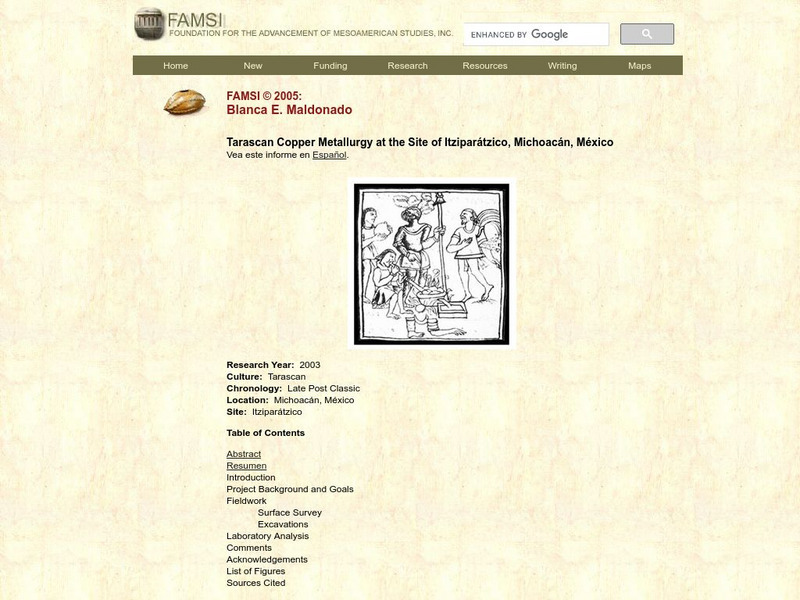
Famsi: Tarascan Copper Metallurgy at Itziparatzico (2003) HandoutFamsi: Tarascan Copper Metallurgy at Itziparatzico (2003) Handout
Publisher
Foundation for the Advancement of Mesoamerican Studies
Resource Details
Curator Rating
Educator Rating
Not yet Rated
Grade
9th - 10th
Subjects
Social Studies & History
2 more...
Resource Type
Handouts & References
Audiences
For Administrator Use
2 more...
Lexile Measures
0L
Language
English, Spanish
Handout

Famsi: Tarascan Copper Metallurgy at Itziparatzico (2003)

Curated by ACT

Excavation indicates Itziparatzico was an area of sophisticated copper metallurgy. It is not determined if work was for domestic use or trade. One important implication, however, is that copper is not found locally. Because the smelting process required three times more charcoal than ore, it is thought that Itziparatzico became the area for metallurgy for economical purposes.

3 Views 0 Downloads

Additional Tags

itziparatico, tarascan empire, tarascan artifacts, tarascan copper metallurgy, tarascan culture, pre-columbian mesoamerica

Classroom Considerations

  • This resource is only available on an unencrypted HTTP website.It should be fine for general use, but don’t use it to share any personally identifiable information

See similar resources:

Handout

Famsi: Classic Maya Borders and Frontiers (2003)

Foundation for the Advancement of Mesoamerican Studies
A look at the geology and topography of El Paraiso valley and its influence on communication, passage and trade. Report also considers architecture and "Mayanization" of area.
9th - 10th Social Studies & History
Website

Famsi: Investigating Tarascan State at Erongaricuaro, Mexico

Foundation for the Advancement of Mesoamerican Studies
Erongaricuaro site was compared to neighboring site of Uricho in the Tarascan State to determine social organization and social hierarchy. Copper is a marker of high status.
9th - 10th Social Studies & History
Handout

Famsi: Archaeological Investigations in the Homul Region (2003)

Foundation for the Advancement of Mesoamerican Studies
Several PDF reports offered at this site offer insights to the sequence of construction by various cultural groups. Very descriptive details of each step of the excavation process and photographs are provided.
9th - 10th Social Studies & History
Website

Famsi: Surface Archaeology in the Chilapa Zitiala Area (2003)

Foundation for the Advancement of Mesoamerican Studies
Study at the Chilapa-Zitlala, Mexico site indicates possibility of Olmec presence.
9th - 10th Social Studies & History
Website

Famsi: Dating Cholula, Mexico (2003)

Foundation for the Advancement of Mesoamerican Studies
Researchers infer that Cholula construction may have begun at the same time as Great Pyramid in Teotihuacan. Readers are able to download the PDF file.
9th - 10th Social Studies & History
Website

Famsi: Ceramic Sequence of Piedras Negras, Guatemala (2003)

Foundation for the Advancement of Mesoamerican Studies
Report offers history of the production of ceramic pieces from 500 B.C. to 900 A.D. Photographs document each cultural phase and work. Readers can download this PDF at the bottom of the page.
9th - 10th Social Studies & History
Try It Free
© 1999-2026 Learning Explorer, Inc.
Teacher Lesson Plans, Worksheets and Resources

Sign up for the Lesson Planet Monthly Newsletter

Open Educational Resources (OER)

  • Health
  • Language Arts
  • Languages
  • Math
  • Physical Education
  • Science
  • Social Studies
  • Special Education
  • Visual and Performing Arts
View All Lesson Plans

Discover Resources

  • Our Review Process
  • How it Works
  • How to Search
  • Create a Collection

Manage Curriculum

  • Edit a Collection
  • Assign to Students
  • Manage My Content
Contact Us Site Map Privacy Policy Terms of Use