



Lesson Planet
Search educational resources
  • Sign In Try It Free
  • AI Teacher Tools
    • Discover Resources Search reviewed educational resources by keyword, subject, grade, type, and more
    • Curriculum Manager (My Content) Manage saved and uploaded resources and folders To Access the Curriculum Manager Sign In or Join Now
    • Browse Resource Directory Browse educational resources by subject and topic
    • Curriculum Calendar Explore curriculum resources by date
    • Lesson Planning Articles Timely and inspiring teaching ideas that you can apply in your classroom
    • Our Story
    • Frequently Asked Questions
    • Testimonials
    • Contact Us
  • Pricing
  • School Access
    • Your school or district can sign up for Lesson Planet — with no cost to teachers
      Learn More
  • Sign In
  • Try It Free

Hi, what do you want to do?

Create a lesson plan
Generate resources with 80+ AI teacher tools
Search 200,000 instructional videos
Find a teaching resource
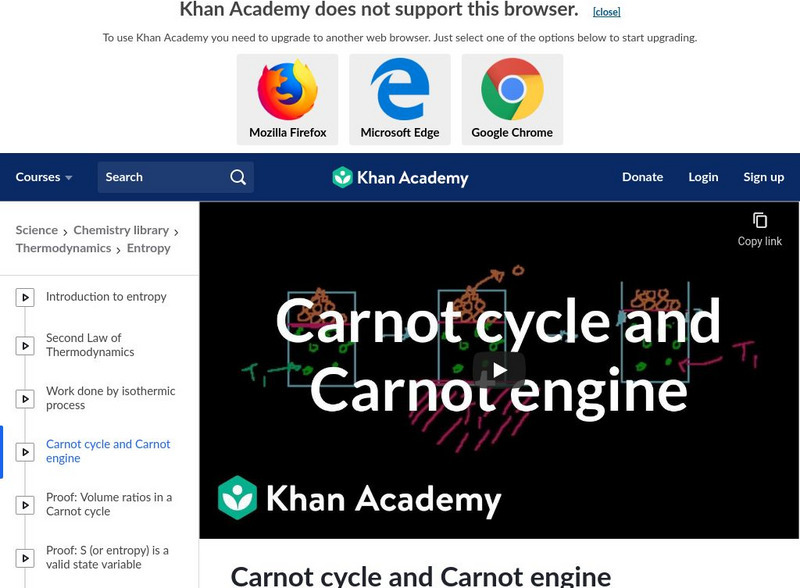
Khan Academy: Carnot Cycle and Carnot Engine Instructional Video
Publisher
Khan Academy
Resource Details
Curator Rating
Educator Rating
Not yet Rated
Grade
9th - 10th
Subjects
Science
2 more...
Resource Type
Instructional Videos
Audiences
For Administrator Use
2 more...
Lexile Measures
0L
Instructional Video

Khan Academy: Carnot Cycle and Carnot Engine

Curated by ACT

An introductory explanation of the Carnot Cycle and the Carnot Heat Engine. [20:52]

3 Views 0 Downloads

Concepts

kinetic energy

Additional Tags

2nd law of thermodynamics, adiabatic, internal energy, isothermic, khan academy: carnot cycle and carnot engine, second law of thermodynamics, carnot cycle

Classroom Considerations

  • Knovation Readability Score: 3 (1 low difficulty, 5 high difficulty)
  • The intended use for this resource is Instructional

See similar resources:

Instructional Video

Carnot Cycle and Carnot Engine, Thermodynamics, Physics

Khan Academy
The Carnot Cycle is the focus of this chemistry video. Carnot was a French engineer who proved that energy transfers happen in a cycle. They start and finish at the same pressure, volume, and temperature. A system that completes the...
21 mins 7th - 10th Science
Handout

Khan Academy: Cell Cycle Checkpoints

Khan Academy
Learn how cells use checkpoints to regulate the cell cycle. This article provides an overview of cell cycle control, outlining the factors that influence a cell's decision to pause or progress at each checkpoint.
9th - 10th Science
Instructional Video

Khan Academy: Circulatory System and the Heart

Khan Academy
Sal Khan introduces the circulatory system function and the structure and function of the heart. [14:53]
9th - 10th Science
Instructional Video

Khan Academy: Hess's Law and Reaction Enthalpy Change

Khan Academy
Using Hess's Law and standard heats of formation to determine the enthalpy change for reactions. [15:40]
9th - 10th Science
Article

Khan Academy: Crick, Watson, and Franklin

Khan Academy
This article describes the race to unlock the mystery of life by determining the double helix structure of the DNA molecule. The discovery of DNA and its structure is an example of collective learning.
9th - 10th Science
Instructional Video

Khan Academy: Capillary Action and Why We See a Meniscus

Khan Academy
A video introducing the intermolecular forces in water by exploring capillary action and the formation of a meniscus. Video will discuss the forces of adhesion and cohesion. [8:25]
9th - 10th Science
Instructional Video

Khan Academy: Specific Heat and Latent Heat of Fusion and Vaporization

Khan Academy
A video lecture explaining specific heat, heat of fusion, and the heat of vaporization. See a step-by-step example of how to calculate the amount of heat needed to change the temperature of water. Also explored is the energy required to...
9th - 10th Science
Instructional Video

Khan Academy: Seismic Waves and How We Know Earth's Structure

Khan Academy
This video illustrates and explains how seismic waves function. These waves are broken down into two types: surface and body. Take a look into why waves help understand the structure of Earth. [8:38]
9th - 10th Science
Instructional Video

Khan Academy: Empirical, Molecular, and Structural Formulas

Khan Academy
Video tutorial presents different ways of representing a molecule and gives examples to demonstrate the difference between empirical, structural, and molecular formulas. [6:49]
9th - 10th Science
Instructional Video

Khan Academy: Capillary Action and Why We See a Meniscus

Khan Academy
See how capillary action and the meniscus are related to intermolecular forces in water. [8:26]
9th - 10th Science
Try It Free
© 1999-2026 Learning Explorer, Inc.
Teacher Lesson Plans, Worksheets and Resources

Sign up for the Lesson Planet Monthly Newsletter

Open Educational Resources (OER)

  • Health
  • Language Arts
  • Languages
  • Math
  • Physical Education
  • Science
  • Social Studies
  • Special Education
  • Visual and Performing Arts
View All Lesson Plans

Discover Resources

  • Our Review Process
  • How it Works
  • How to Search
  • Create a Collection

Manage Curriculum

  • Edit a Collection
  • Assign to Students
  • Manage My Content
Contact Us Site Map Privacy Policy Terms of Use