



Lesson Planet
Search educational resources
  • Sign In Try It Free
  • AI Teacher Tools
    • Discover Resources Search reviewed educational resources by keyword, subject, grade, type, and more
    • Curriculum Manager (My Content) Manage saved and uploaded resources and folders To Access the Curriculum Manager Sign In or Join Now
    • Browse Resource Directory Browse educational resources by subject and topic
    • Curriculum Calendar Explore curriculum resources by date
    • Lesson Planning Articles Timely and inspiring teaching ideas that you can apply in your classroom
    • Our Story
    • Frequently Asked Questions
    • Testimonials
    • Contact Us
  • Pricing
  • School Access
    • Your school or district can sign up for Lesson Planet — with no cost to teachers
      Learn More
  • Sign In
  • Try It Free

Hi, what do you want to do?

Create a lesson plan
Generate resources with 80+ AI teacher tools
Search 200,000 instructional videos
Find a teaching resource
Museum of Science: Exploring the Oceans Website
Publisher
Museum of Science
Resource Details
Curator Rating
Educator Rating
Not yet Rated
Grade
9th - 10th
Subjects
Science
2 more...
Resource Type
Websites
Audiences
For Administrator Use
2 more...
Lexile Measures
1010L
Website

Museum of Science: Exploring the Oceans

Curated by ACT

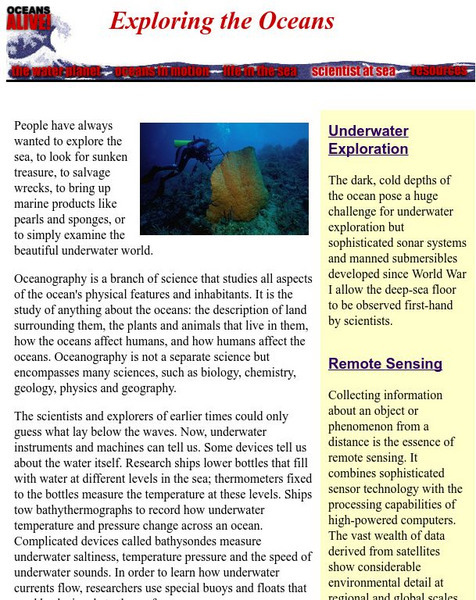
How do scientists collect information from the dark, cold depths of the ocean? Learn how scientists approach the problems of underwater exploration using remote sensing.

3 Views 1 Download

Concepts

ocean exploration, remote sensing, oceanography

Additional Tags

ocean study, underwater exploration

Classroom Considerations

  • Knovation Readability Score: 4 (1 low difficulty, 5 high difficulty)

See similar resources:

Lesson Plan

Molecular Gastronomy - Science in the Kitchen

Mascil Project
Some say cooking is an art—and a science! Scholars scope out the savory subject of molecular gastronomy with a series of related activities. The teacher's guide contains printable worksheets and helpful tips for implementing the lesson.
9th - 12th Science
CCSS: Adaptable
Instructional Video

The Americas and Time Keeping: Crash Course History of Science #5

Crash Course
Time, time, time ... see how it shaped an entire culture! Science scholars discover the mysteries of the Mayan and Incan cultures during the fifth video in a History of Science series. The narrator shows how these time keepers developed...
13 mins 9th - 12th Science
CCSS: Adaptable
Instructional Video

Medieval China: Crash Course History of Science #8

Crash Course
Medieval Chinese scientists were the masters of invention! Explore the wonders of the Far East through the eighth installment in a 15-part History of Science series. The resource covers contributions to science and technology by dynasty,...
13 mins 9th - 12th Science
CCSS: Adaptable
Instructional Video

Earth Science: Crash Course History of Science #20

Crash Course
How old is Earth and how do scientists know the answer? Throughout history, many researchers, scholars, and leaders answered this question with varying degrees of accuracy. The 20th episode of Crash Course History of Science introduces...
14 mins 9th - 12th Science
CCSS: Adaptable
Instructional Video

Biomedicine: Crash Course History of Science #34

Crash Course
Track biomedicine advances from the early 1800s to today! Young scholars learn about groundbreaking discoveries in medicine throughout history in the 34th installment of a larger Crash Course History of Science series. The lesson...
13 mins 9th - 12th Science
CCSS: Adaptable
Instructional Video

Roman Engineering: Crash Course History of Science #6

Crash Course
How did the vast Roman society contribute to science? See the wonders of the Appian Way all while examining the Roman thought process during video six in the History of Science series. The narrator compares the Roman view of doing...
12 mins 9th - 12th Science
CCSS: Adaptable
Instructional Video

Cathedrals and Universities: Crash Course History of Science #11

Crash Course
How are so many medieval buildings still standing today? And, how did ancient builders learn such skills? Discover the amazing feats of medieval engineers with part 11 in a 15-installment History of Science series. The narrator describes...
13 mins 9th - 12th Science
CCSS: Adaptable
Instructional Video

Alchemy: Crash Course History of Science #10

Crash Course
If the word alchemy makes you think of wizards gathered around bubbling cauldrons, you're not completely wrong! Introduce scholars to the history of chemistry during part 10 of a 15-part History of Science series. The video takes viewers...
13 mins 9th - 12th Science
CCSS: Adaptable
Instructional Video

The Industrial Revolution: Crash Course History of Science #21

Crash Course
The Industrial Revolution changed transportation systems, social systems, and economies. Episode 21 of Crash Course History of Science examines the Industrial Revolution. From the invention and improvements to the steam engine to the...
12 mins 9th - 12th Science
CCSS: Adaptable
Instructional Video

Exploring the Universe: Crash Course Big History #2

Crash Course
According to Carl Sagan, we are all made of star particles. The second video in a series of 16 explains what happened after the big bang. It discusses cosmic background radiation, chemistry, galaxies, heavy elements, and the creation of...
15 mins 9th - Higher Ed Science
Try It Free
© 1999-2026 Learning Explorer, Inc.
Teacher Lesson Plans, Worksheets and Resources

Sign up for the Lesson Planet Monthly Newsletter

Open Educational Resources (OER)

  • Health
  • Language Arts
  • Languages
  • Math
  • Physical Education
  • Science
  • Social Studies
  • Special Education
  • Visual and Performing Arts
View All Lesson Plans

Discover Resources

  • Our Review Process
  • How it Works
  • How to Search
  • Create a Collection

Manage Curriculum

  • Edit a Collection
  • Assign to Students
  • Manage My Content
Contact Us Site Map Privacy Policy Terms of Use