Lesson Planet
Search educational resources
  • Sign In Try It Free
  • AI Teacher Tools
    • Discover Resources Search reviewed educational resources by keyword, subject, grade, type, and more
    • Curriculum Manager (My Content) Manage saved and uploaded resources and folders To Access the Curriculum Manager Sign In or Join Now
    • Browse Resource Directory Browse educational resources by subject and topic
    • Curriculum Calendar Explore curriculum resources by date
    • Lesson Planning Articles Timely and inspiring teaching ideas that you can apply in your classroom
    • Our Story
    • Frequently Asked Questions
    • Testimonials
    • Contact Us
  • Pricing
  • School Access
    • Your school or district can sign up for Lesson Planet — with no cost to teachers
      Learn More
  • Sign In
  • Try It Free

Hi, what do you want to do?

Create a lesson plan
Generate resources with 80+ AI teacher tools
Search 200,000 instructional videos
Find a teaching resource
Nasa Classroom of the Future: Environment Module: Uv Menace Unit PlanNasa Classroom of the Future: Environment Module: Uv Menace Unit Plan
Publisher
Center for Educational Technologies
Resource Details
Curator Rating
Educator Rating
Not yet Rated
Grade
9th - 10th
Subjects
Science
2 more...
Resource Type
Unit Plans
Audiences
For Administrator Use
2 more...
Instructional Strategy
Independent Practice
Lexile Measures
0L
Unit Plan

Nasa Classroom of the Future: Environment Module: Uv Menace

Curated by ACT

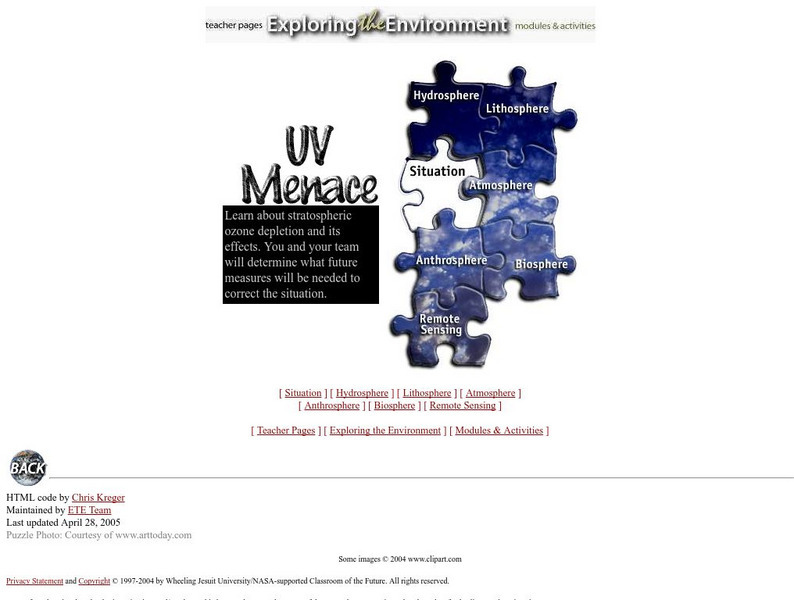
This site provides information and activities for classes to learn more about ozone depletion and UV radiation.

3 Views 0 Downloads

Concepts

air pollution, radiation, ultraviolet light, ultraviolet radiation, ozone depletion

Additional Tags

air quality, atmosphere, biosphere, cfc, hole in the ozone layer, hydrosphere, lithosphere, ozone, ozone destruction, ozone hole, ozone layer, stratospheric ozone, antarctic hole, antarctic ozone hole, uv exposure, anthrosphere, chlorofluorocarbon, how ozone pollution works, ozone chemistry, ozone degrading chemicals, ozone thinning

Classroom Considerations

  • Knovation Readability Score: 5 (1 low difficulty, 5 high difficulty)
  • The intended use for this resource is Instructional|practice
  • This resource is only available on an unencrypted HTTP website.It should be fine for general use, but don’t use it to share any personally identifiable information

See similar resources:

Lesson Plan

Survival of the Fittest - Variations in the Clam Species Clamys sweetus

Howard Hughes Medical Institute
It's not often that you come across a clever laboratory activity that is both imaginative and comprehensive! Using M&M's and Reese's peanut butter candies to represent two different clam species, young biologists test for "relative...
6th - 12th Science
CCSS: Designed
Instructional Video

How UV Causes Cancer and Aging

Veritasium
As the rates of skin cancer rise to become the most common type of cancer in the United States, scientists directly relate sunscreen usage to skin cancer prevention. Doctors research exactly how ultraviolet light changes cells. Viewers...
5 mins 9th - 12th Science
CCSS: Adaptable
Unit Plan

Nasa Classroom of the Future: Temperate Rainforest: Ecology and Land Use

Center for Educational Technologies
Use these resources to study the ecology of the rainforest of the Pacific Northwest and issues surrounding its preservation.
9th - 10th Science
Handout

Nasa Classroom of the Future: Florida Everglades

Center for Educational Technologies
This site is full of information and activities to help learn about the Florida Everglades, a unique wetland environment, and its future.
9th - 10th Science
Unit Plan

Nasa Classroom of the Future: Earth on Fire

Center for Educational Technologies
Information and activities looking at the impact of industrial and agricultural practices on global warming.
9th - 10th Science
Unit Plan

Nasa Classroom of the Future: Coral Reefs: Dissappearing Resource

Center for Educational Technologies
Why are the reefs disappearing? Use this site to explore the science behind the issue. Useful at several grade levels.
9th - 10th Science
Lesson Plan

Skin and the Effects of Ultraviolet Radiation

Teach Engineering
Though UV radiation can damage skin, it isn't all bad. The third installment in a six-part series allows the class to study the structure and function of skin. They learn about the different types of skin cancer and the SPF rating...
2 mins 10th - 12th Science
Instructional Video

The Anatomy of the Sun

PBS
Welcome to Sun 101! What better way to gain an understanding of our star than to learn about its anatomy? Physical science scholars peer inside to discover the inner workings of the sun through a video and discussion questions. The...
3 mins 6th - 12th Science
CCSS: Adaptable
Handout

Nasa: Tour of the Electromagnetic Spectrum: Visible Light

NASA
Visible light waves are the only electromagnetic waves we can see. We see these waves as the colors of the rainbow. Each color has a different wavelength. Red has the longest wavelength and violet has the shortest wavelength. When all...
9th - 10th Science
Lesson Plan

Nasa: Diameter of the Moon: Grades 4 12

NASA
This lab activity allows students to calculate the diameter of the moon using proportions. Also follow links to other NASA lesson plans.
9th - 10th Science
Try It Free
© 1999-2026 Learning Explorer, Inc.
Teacher Lesson Plans, Worksheets and Resources

Sign up for the Lesson Planet Monthly Newsletter

Open Educational Resources (OER)

  • Health
  • Language Arts
  • Languages
  • Math
  • Physical Education
  • Science
  • Social Studies
  • Special Education
  • Visual and Performing Arts
View All Lesson Plans

Discover Resources

  • Our Review Process
  • How it Works
  • How to Search
  • Create a Collection

Manage Curriculum

  • Edit a Collection
  • Assign to Students
  • Manage My Content
Contact Us Site Map Privacy Policy Terms of Use