Lesson Planet
Search educational resources
  • Sign In Try It Free
  • AI Teacher Tools
    • Discover Resources Search reviewed educational resources by keyword, subject, grade, type, and more
    • Curriculum Manager (My Content) Manage saved and uploaded resources and folders To Access the Curriculum Manager Sign In or Join Now
    • Browse Resource Directory Browse educational resources by subject and topic
    • Curriculum Calendar Explore curriculum resources by date
    • Lesson Planning Articles Timely and inspiring teaching ideas that you can apply in your classroom
    • Our Story
    • Frequently Asked Questions
    • Testimonials
    • Contact Us
  • Pricing
  • School Access
    • Your school or district can sign up for Lesson Planet — with no cost to teachers
      Learn More
  • Sign In
  • Try It Free

Hi, what do you want to do?

Create a lesson plan
Generate resources with 80+ AI teacher tools
Search 200,000 instructional videos
Find a teaching resource
National Archives Learning Curve: Crime and Punishment: Punishment Before 1450 Unit PlanNational Archives Learning Curve: Crime and Punishment: Punishment Before 1450 Unit Plan
Publisher
National Archives (UK)
Resource Details
Curator Rating
Educator Rating
Not yet Rated
Grade
9th - 10th
Subjects
Social Studies & History
2 more...
Resource Type
Unit Plans
Audiences
For Administrator Use
2 more...
Lexile Measures
990L
Unit Plan

National Archives Learning Curve: Crime and Punishment: Punishment Before 1450

Curated by ACT

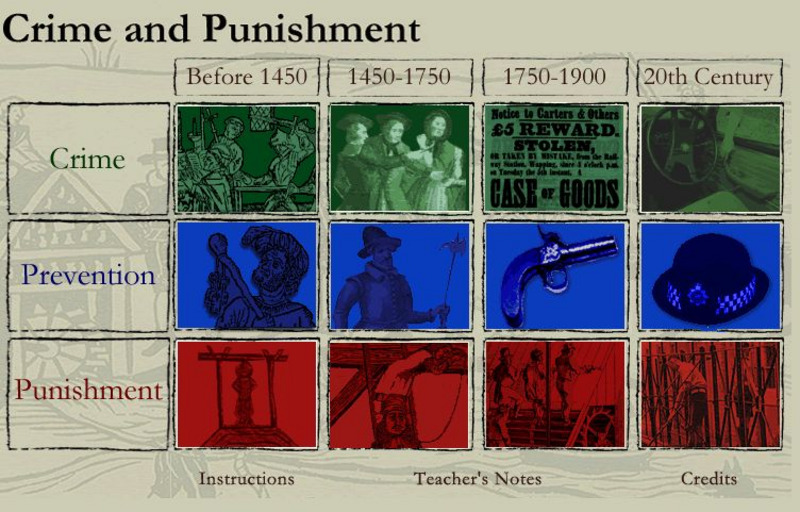
What were the purposes of punishments given by courts in the Middle Ages? This question is reviewed in this Learning Curve challenge. Students are given primary evidence and two case studies - Medieval punishments and Capital punishments - to help them come to a conclusion.

3 Views 0 Downloads

Concepts

capital punishment, crime and punishment

Additional Tags

justice system, medieval punishment, punishment, trial by combat, middle ages

Classroom Considerations

  • Knovation Readability Score: 3 (1 low difficulty, 5 high difficulty)

See similar resources:

Lesson Plan

Crime and Punishment

Heritage Foundation
You wouldn't give someone a 10-day timeout for eating a piece of candy. The US government, too, does not believe in unreasonable punishment. A variety of exercises exploring the clauses of the US Constitution prompts class members to...
9th - 12th Social Studies & History
CCSS: Adaptable
Lesson Plan

Crime and Punishment

Deliberating in a Democracy
Should the United States ban the death penalty? Scholars use real-life examples of criminal activity to come to their own conclusions on the death penalty. Primary source documents, as well as video clips, open the issue of capital...
9th - 12th Social Studies & History
CCSS: Adaptable
Instructional Video

The Treadmill's Dark and Twisted Past

TED-Ed
Did you know that treadmills were actually designed as punishment devices? Check out this short history of what has now become a staple of fitness centers.
4 mins 3rd - 12th Social Studies & History
Lesson Plan

Critiquing Hate Crimes Legislation

Teaching Tolerance
The high school lesson explores what hate crimes are and how the government has responded to those crimes. Academics read legislation, analyze political cartoons, and complete hands-on-activities to understand what motivates individuals...
9th - 12th Social Studies & History
Lesson Plan

National Debt and Wars

National Council of Teachers of Mathematics
Take a functional approach to the national debt. Learners collect information about the national debt by decade and plot the data. They determine whether an exponential curve is a good fit for the data by comparing the percent changes...
9th - 12th Math
CCSS: Adaptable
Lesson Plan

Stacey Abrams: Changing the Trajectory of Protecting People’s Voices and Votes

National Woman's History Museum
In this project-based learning lesson, young social scientists investigate Stacey Abrams' campaign to protect the voting rights of people across the nation. Investigators learn how to annotate assigned articles, watch videos, and collect...
1 hr 30 mins 9th - 12th Social Studies & History
CCSS: Designed
Lesson Plan

National Archives: What Congress Does and Why It Matters

US National Archives
Students will analyze primary sources related to Congress to learn the specific powers of the Legislative Branch. Included is a chart to download and print, worksheets, materials, and an answer key. Primary sources to be examined are...
9th - 10th Social Studies & History
Lesson Plan

National Archives Learning Curve: The German Occupation of the Rhineland

National Archives (UK)
Partial original copies of documents from various nations of the Allies force responding to the occupation by Germans of Rhineland region.
9th - 10th Social Studies & History
Unit Plan

National Archives Learning Curve: Snapshot: Domesday Book

National Archives (UK)
A history lesson examines the question, "What Can We Learn About the 11th Century" based on the Domesday Book. Background information and teacher notes included.
9th - 10th Social Studies & History
Lesson Plan

League of Nations

Curated OER
What is the League of Nations, when did it begin, and what is it's purpose? Young political minds can explore the answers to these questions through political cartoon analysis. Included are several political cartoons, an analysis...
9th - 10th Social Studies & History
Try It Free
© 1999-2026 Learning Explorer, Inc.
Teacher Lesson Plans, Worksheets and Resources

Sign up for the Lesson Planet Monthly Newsletter

Open Educational Resources (OER)

  • Health
  • Language Arts
  • Languages
  • Math
  • Physical Education
  • Science
  • Social Studies
  • Special Education
  • Visual and Performing Arts
View All Lesson Plans

Discover Resources

  • Our Review Process
  • How it Works
  • How to Search
  • Create a Collection

Manage Curriculum

  • Edit a Collection
  • Assign to Students
  • Manage My Content
Contact Us Site Map Privacy Policy Terms of Use