



Lesson Planet
Search educational resources
  • Sign In Try It Free
  • AI Teacher Tools
    • Discover Resources Search reviewed educational resources by keyword, subject, grade, type, and more
    • Curriculum Manager (My Content) Manage saved and uploaded resources and folders To Access the Curriculum Manager Sign In or Join Now
    • Browse Resource Directory Browse educational resources by subject and topic
    • Curriculum Calendar Explore curriculum resources by date
    • Lesson Planning Articles Timely and inspiring teaching ideas that you can apply in your classroom
    • Our Story
    • Frequently Asked Questions
    • Testimonials
    • Contact Us
  • Pricing
  • School Access
    • Your school or district can sign up for Lesson Planet — with no cost to teachers
      Learn More
  • Sign In
  • Try It Free

Hi, what do you want to do?

Create a lesson plan
Generate resources with 80+ AI teacher tools
Search 200,000 instructional videos
Find a teaching resource
Pbs Teachers: Stationed in the Stars Article
Publisher
PBS
Resource Details
Curator Rating
Educator Rating
Not yet Rated
Grade
9th - 10th
Subjects
Science
2 more...
Resource Type
Articles
Audiences
For Administrator Use
2 more...
Lexile Measures
1200L
Article

Pbs Teachers: Stationed in the Stars

Curated by ACT

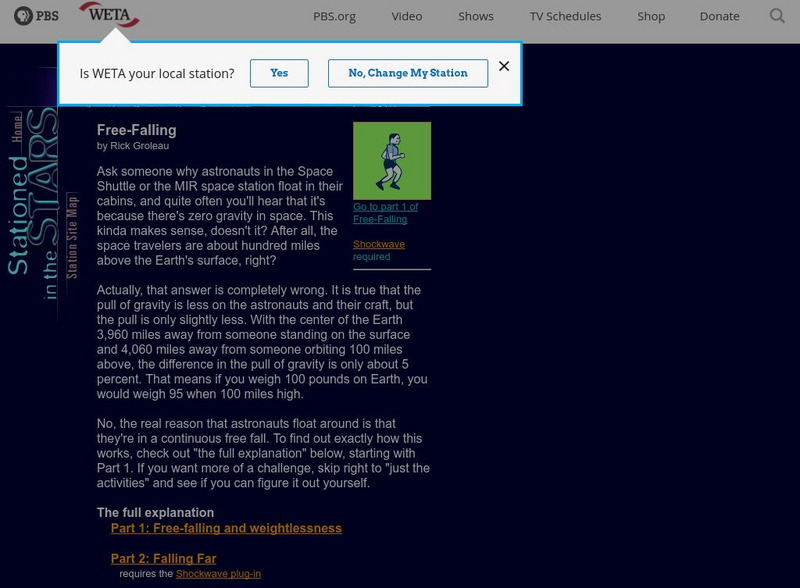
Examine the factors that impact an astronaut's freefall in space. Differentiate between zero gravity, weightlessness and freefall.

3 Views 0 Downloads

Concepts

weightlessness, gravity

Additional Tags

freefall, zero gravity, nova, pbs

Classroom Considerations

  • Knovation Readability Score: 3 (1 low difficulty, 5 high difficulty)

See similar resources:

Lesson Plan

Survival of the Fittest - Variations in the Clam Species Clamys sweetus

Howard Hughes Medical Institute
It's not often that you come across a clever laboratory activity that is both imaginative and comprehensive! Using M&M's and Reese's peanut butter candies to represent two different clam species, young biologists test for "relative...
6th - 12th Science
CCSS: Designed
Lesson Plan

Navigation in the Ancient Mediterranean and Beyond

Space Awareness
Ancient texts, like Homer's Odyssey, mentions navigating ships by observing constellations. Pupils learn about the link between history and astronomy as they relate to navigation in the Bronze Age. Scholars complete two hands-on...
9th - 11th Science
CCSS: Adaptable
Unit Plan

An Inconvenient Truth in the Classroom

National Wildlife Federation
Global warming — what a hot topic! A thorough unit challenges learners to research, read, explore, and write about carbon, its role and increasing nature in our atmosphere, and how global warming is affecting lives and environments...
8th - 12th Science
CCSS: Adaptable
App

GoSkyWatch Planetarium for iPad - The Astronomy Star Guide

GoSoftWorks
Digital compass alignment enables navigation of the skies with true orientation at any time. Just point to the sky or "aim for the stars!" This application acts as a virtual telescope, allowing you to zoom in on any object that is...
6th - Higher Ed Science
Instructional Video

The Life Of A Star Explained In 1 Minute

University of California
We know about many different life cycles of animals and plants, but did you know stars also have a life cycle? The video illustrates the life of a star in under one minute from the formation of helium to the collapse of the star. 
1 min 9th - 12th Science
Instructional Video

The Smallest Star in the Universe

SciShow
They may be small, but probably still mighty! The characteristics of what astronomers have defined as stars have a minimum size requirement. The tiniest stars pack a lot into a small package—and still have all the properties of their...
4 mins 9th - 12th Science
CCSS: Adaptable
Instructional Video

There's Going to Be a New Star in the Sky

SciShow
There's something to look forward to in 2021 or 2022! Although the actual event occurred almost 2,000 years ago, the appearance of a new star will become evident from Earth in a few short years. The video instructor from the solar...
5 mins 9th - 12th Science
CCSS: Adaptable
Instructional Video

The Last Star in the Universe—Red Dwarfs Explained

Kurzgesagt – In a Nutshell
Up to 75 percent of the stars in the Milky Way are red dwarfs, yet we can't see any from Earth. The video explains what makes red dwarf stars unique. It highlights the potential for finding aliens or a planet humans could live on once...
6 mins 9th - Higher Ed Science
CCSS: Adaptable
Lesson Plan

Ocean Circulation in the North Atlantic

PBS
Swirling and churning, the waters of the North Atlantic play a vital role in Earth's climate! Discover the many factors that produce circulation using a multimedia lesson from PBS's Weather and Climate series for high schoolers. Scholars...
9th - 12th Science
CCSS: Adaptable
Website

Journey to the Stars

American Museum of Natural History
Fifteen detailed pictures and informative captions delve deep into the exploration of stars—their life cycle and importance in the universe. 
6th - 12th Science
Try It Free
© 1999-2026 Learning Explorer, Inc.
Teacher Lesson Plans, Worksheets and Resources

Sign up for the Lesson Planet Monthly Newsletter

Open Educational Resources (OER)

  • Health
  • Language Arts
  • Languages
  • Math
  • Physical Education
  • Science
  • Social Studies
  • Special Education
  • Visual and Performing Arts
View All Lesson Plans

Discover Resources

  • Our Review Process
  • How it Works
  • How to Search
  • Create a Collection

Manage Curriculum

  • Edit a Collection
  • Assign to Students
  • Manage My Content
Contact Us Site Map Privacy Policy Terms of Use