Lesson Planet
Search educational resources
  • Sign In Try It Free
  • AI Teacher Tools
    • Discover Resources Search reviewed educational resources by keyword, subject, grade, type, and more
    • Curriculum Manager (My Content) Manage saved and uploaded resources and folders To Access the Curriculum Manager Sign In or Join Now
    • Browse Resource Directory Browse educational resources by subject and topic
    • Curriculum Calendar Explore curriculum resources by date
    • Lesson Planning Articles Timely and inspiring teaching ideas that you can apply in your classroom
    • Our Story
    • Frequently Asked Questions
    • Testimonials
    • Contact Us
  • Pricing
  • School Access
    • Your school or district can sign up for Lesson Planet — with no cost to teachers
      Learn More
  • Sign In
  • Try It Free

Hi, what do you want to do?

Create a lesson plan
Generate resources with 80+ AI teacher tools
Search 200,000 instructional videos
Find a teaching resource
Science Buddies: Roller Coaster Marbles: How Much Height to Loop the Loop? ActivityScience Buddies: Roller Coaster Marbles: How Much Height to Loop the Loop? Activity
Publisher
Science Buddies
Resource Details
Curator Rating
Educator Rating
Not yet Rated
Grade
9th - 10th
Subjects
Science
2 more...
Resource Types
Activities & Projects
1 more...
Audiences
For Administrator Use
2 more...
Lexile Measures
1080L
Activity

Science Buddies: Roller Coaster Marbles: How Much Height to Loop the Loop?

Curated by ACT

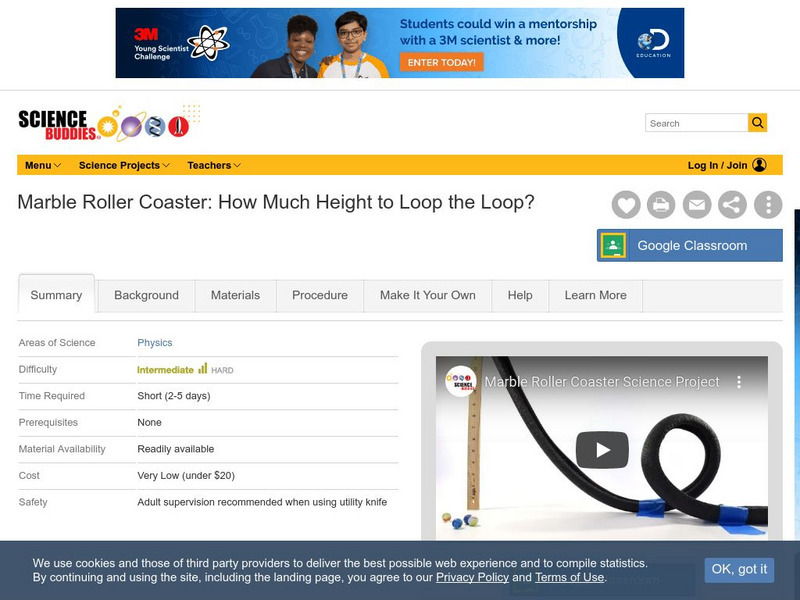
This is a really fun project even if you don't like going on roller coasters yourself. You'll build a roller coaster track for marbles using foam pipe insulation and masking tape, and see how much of an initial drop is required to get the marble to "loop the loop." It's a great way to learn about how stored energy (potential energy) is converted into the energy of motion (kinetic energy).

3 Views 1 Download

Concepts

energy, gravity

Additional Tags

marbles, science fair project, physics, science buddies, roller coaster, science project

Classroom Considerations

  • Knovation Readability Score: 3 (1 low difficulty, 5 high difficulty)

See similar resources:

Lesson Plan

Fibers, Dyes, and the Environment

Cornell University
Nanofibers can be made through electrospinning or force spinning in order to reduce the negative impact on the environment. Pupils study the role of fibers and dye on the environment through a series of five hands-on activities. Then,...
6th - 12th Science
CCSS: Adaptable
Lesson Plan

Ocean Acidification: Whats and Hows

Consortium for Ocean Science Exploration and Engagement (COSEE)
Open this lesson by demonstrating the production of acidic carbon dioxide gas by activated yeast. Emerging ecologists then experiment with seashells to discover the effect of ocean acidification on shelled marine organisms. They measure...
9th - 12th Science
Lesson Plan

Getting Ready for the All American Eclipse!

Astronomical Society of the Pacific
Give your pupils a front row seat at the biggest light show in the sky this year! In addition to admiring the total solar eclipse, young astronomers can explain the phenomenon with a little help from an inquiry-based lesson. The focus of...
K - 12th Science
Lesson Plan

Methane Hydrates – What's the Big Deal?

NOAA
Have you ever tried to light ice on fire? With methane hydrate, you can do exactly that. The ice forms with methane inside so it looks like ice, but is able to burn. The lesson uses group research and a hands-on activity to help scholars...
9th - 12th Science
CCSS: Adaptable
Instructional Video

How Much Plastic is in the Ocean?

Be Smart
Plastics in our oceans not only create unsightly litter, but they also threaten habitats. A video episode maps the location of the majority of the plastic debris and explains the impact the debris has on our world. The lesson also...
5 mins 6th - 12th Science
CCSS: Adaptable
Instructional Video

The Search for the Earliest Life

PBS
Life existed on Earth more than four billion years ago, much earlier than scientists predicted. Eons presents a lively video as part of a larger series. It explains the recent findings on multiple continents that alter the timeline of...
6 mins 6th - 12th Science
CCSS: Adaptable
Instructional Video

The Science of Six Degrees of Separation

Veritasium
The concept of everyone on earth being separated by only six degrees of social connections originated more than 100 years ago. Connect the dots using an installment from an engaging video series that takes a look at various social...
9 mins 9th - 12th Math
CCSS: Adaptable
Instructional Video

The Age of Reptiles in Three Acts

PBS
Reptiles survived the largest extinction event on the planet and then they grew into the most dominant class of the Mesozoic Era. They quickly evolved into giants on land, sea, and air. In an episode of the PBS Eons series viewers learn...
11 mins 6th - 12th Science
CCSS: Adaptable
Instructional Video

The Science of Skin

TED-Ed
Almost one fifth of your weight is in your skin, but why does it weigh so much? Viewers learn about the integumentary system and the many functions it performs constantly to keep them safe. Then, they answer multiple choice and...
5 mins 6th - 12th Science
CCSS: Adaptable
Instructional Video

The Ferocious Predatory Dinosaurs of Cretaceous Sahara

TED-Ed
What's not to love about dinosaurs? Lucky for us humans, we can love to learn about them from 100 million years away, especially a group of extra large predatory dinosaurs from the Cretaceous period. Watch a descriptive video that...
4 mins 6th - 12th Science
CCSS: Adaptable
Try It Free
© 1999-2026 Learning Explorer, Inc.
Teacher Lesson Plans, Worksheets and Resources

Sign up for the Lesson Planet Monthly Newsletter

Open Educational Resources (OER)

  • Health
  • Language Arts
  • Languages
  • Math
  • Physical Education
  • Science
  • Social Studies
  • Special Education
  • Visual and Performing Arts
View All Lesson Plans

Discover Resources

  • Our Review Process
  • How it Works
  • How to Search
  • Create a Collection

Manage Curriculum

  • Edit a Collection
  • Assign to Students
  • Manage My Content
Contact Us Site Map Privacy Policy Terms of Use