



Lesson Planet
Search educational resources
  • Sign In Try It Free
  • AI Teacher Tools
    • Discover Resources Search reviewed educational resources by keyword, subject, grade, type, and more
    • Curriculum Manager (My Content) Manage saved and uploaded resources and folders To Access the Curriculum Manager Sign In or Join Now
    • Browse Resource Directory Browse educational resources by subject and topic
    • Curriculum Calendar Explore curriculum resources by date
    • Lesson Planning Articles Timely and inspiring teaching ideas that you can apply in your classroom
    • Our Story
    • Frequently Asked Questions
    • Testimonials
    • Contact Us
  • Pricing
  • School Access
    • Your school or district can sign up for Lesson Planet — with no cost to teachers
      Learn More
  • Sign In
  • Try It Free

Hi, what do you want to do?

Create a lesson plan
Generate resources with 80+ AI teacher tools
Search 200,000 instructional videos
Find a teaching resource
Serc: Bot Ec: The San Andreas Fault's Rate of Movement Lesson PlanSerc: Bot Ec: The San Andreas Fault's Rate of Movement Lesson Plan
Publisher
Science Education Resource Center at Carleton College
Curator Rating
Educator Rating
Not yet Rated
Lesson Plan

Serc: Bot Ec: The San Andreas Fault's Rate of Movement

Curated by ACT

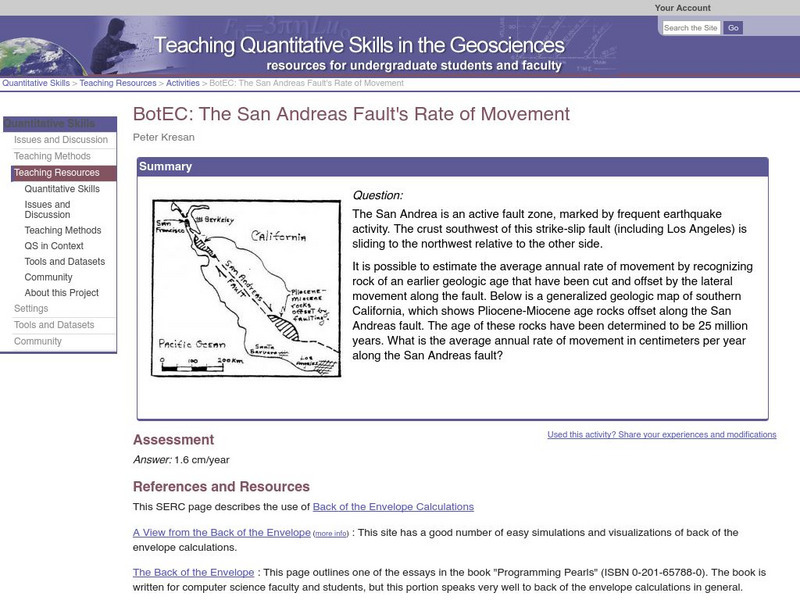
The San Andrea is an active fault zone, marked by frequent earthquake activity. The crust southwest of this strike-slip fault (including Los Angeles) is sliding to the northwest relative to the other side. It is possible to estimate the average annual rate of movement by recognizing rock of an earlier geologic age that have been cut and offset by the lateral movement along the fault. Below is a generalized geologic map of southern California, which shows Pliocene-Miocene age rocks offset along the San Andreas fault. The age of these rocks have been determined to be 25 million years. What is the average annual rate of movement in centimeters per year along the San Andreas fault?

3 Views 1 Download
Concepts

earthquakes

Additional Tags

serc, the san andreas fault's rate of movement, earthquake
Show More Show Less

Resource Details

Grade
9th - 10th
Subjects
Science
2 more...
Resource Type
Lesson Plans
Audiences
For Administrator Use
1 more...
Lexile Measures
0L

See similar resources:

PPT

Rates of Reactions end Enzymes

Curated OER
Introducing enzymes and the controlling factors of a reaction this slideshow displays the typical rate of reaction graph and labels the main sections. The summaries of ways to measure reaction rates are valuable and the examples of...
7th - 10th Science
Instructional Video

Introduction to Rates of Reaction

JFR Science
Why are rates of reaction so important? Discover the answer to this, and many other questions, through a video from JFR Science. Pupils examine how, through the balanced chemical equation and experimentation, they can determine how fast...
7 mins 9th - Higher Ed Science
CCSS: Adaptable
Handout

Usgs: The San Andreas Fault

US Geological Survey
A great overall site that tells us about the San Andreas fault, where it is and what kind of movements have occurred. It then goes on to talk about earthquakes in general and their occurrences along fault lines.
9th - 10th Science
Website

U.s. Geological Survey: San Andreas Fault at Wallace Creek

US Geological Survey
See interactive, 360 degree panoramic photos of the San Andreas Fault. Aerial photos of the fault were taken using a technique called Kite Aerial Photography.
9th - 10th Science
Lesson Plan

Rate of Decomposition of Hydrogen Peroxide

Curated OER
Students devise an experiment to test the rate of decomposition of hydrogen peroxide. In this rate of reactions lesson plan, students use the given information in the lab to write a procedure that will allow them to find the rate of...
9th - 12th Science
Instructional Video

Khan Academy: Rate of Reaction

Khan Academy
Definition of reaction rate, and examples of calculating the average rate of reaction. [9:09]
9th - 10th Science
Worksheet

Comparing the New Madrid and San Andreas Fault Zones

Curated OER
In this faults worksheet, students use an earthquake reference sheet to find the numbers for a modified Mercalli and Richter scale. They compare the San Andreas Fault zone and the New Madrid fault zone on the United States map. They...
7th - 10th Science
Graphic

Everytrail: Trail Map of San Andreas Fault Trail Exploration

Other
Use this map on the San Andreas Fault by following lines of posts that mark the various fault breaks in the Los Trancos Open Space Preserve. The trail takes hikers to see some of the effects of earthquakes in this otherwise tranquil...
9th - 10th Science
Instructional Video

Pbs Learning Media: Earthquakes: The Prehistoric Record

PBS
In this video segment adapted from NOVA, a geologist digs a trench along the San Andreas Fault to reveal three thousand years of earthquake history. Information from the layers of sediment may help geologists to predict earthquakes.3m 19s
9th - 10th Science
Interactive

Exploratorium: On the Road With the Faultline Project

Exploratorium
This outstanding multimedia website follows the San Andreas fault system up the California coast from San Diego to just north of San Francisco on the coast.
9th - 10th Science
Try It Free
© 1999-2026 Learning Explorer, Inc.
Teacher Lesson Plans, Worksheets and Resources

Sign up for the Lesson Planet Monthly Newsletter

Open Educational Resources (OER)

  • Health
  • Language Arts
  • Languages
  • Math
  • Physical Education
  • Science
  • Social Studies
  • Special Education
  • Visual and Performing Arts
View All Lesson Plans

Discover Resources

  • Our Review Process
  • How it Works
  • How to Search
  • Create a Collection

Manage Curriculum

  • Edit a Collection
  • Assign to Students
  • Manage My Content
Contact Us Site Map Privacy Policy Terms of Use