Lesson Planet
Search educational resources
  • Sign In Try It Free
  • AI Teacher Tools
    • Discover Resources Search reviewed educational resources by keyword, subject, grade, type, and more
    • Curriculum Manager (My Content) Manage saved and uploaded resources and folders To Access the Curriculum Manager Sign In or Join Now
    • Browse Resource Directory Browse educational resources by subject and topic
    • Curriculum Calendar Explore curriculum resources by date
    • Lesson Planning Articles Timely and inspiring teaching ideas that you can apply in your classroom
    • Our Story
    • Frequently Asked Questions
    • Testimonials
    • Contact Us
  • Pricing
  • School Access
    • Your school or district can sign up for Lesson Planet — with no cost to teachers
      Learn More
  • Sign In
  • Try It Free

Hi, what do you want to do?

Create a lesson plan
Generate resources with 80+ AI teacher tools
Search 200,000 instructional videos
Find a teaching resource
Teach Engineering: Balloons ActivityTeach Engineering: Balloons Activity
Publisher
TeachEngineering
Curator Rating
Educator Rating
Not yet Rated
Activity

Teach Engineering: Balloons

Curated by ACT

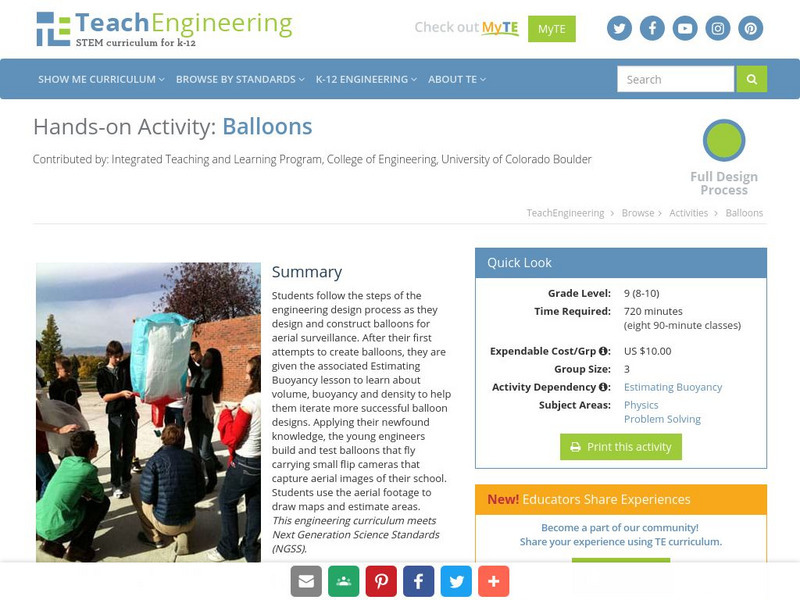
Students follow the steps of the engineering design process as they design and construct balloons for aerial surveillance. After their first attempts to create balloons, they are given the associated Estimating Buoyancy lesson to learn about volume, buoyancy and density to help them iterate more successful balloon designs.Applying their newfound knowledge, the young engineers build and test balloons that fly carrying small flip cameras that capture aerial images of their school. Students use the aerial footage to draw maps and estimate areas.

3 Views 0 Downloads
Concepts

buoyancy, density, stem

Additional Tags

aerial, engineering design process projects, surveillance, integrated teaching and learning program and laboratory, teachengineering, balloon, hot air balloon
Show More Show Less

Resource Details

Grade
9th - 10th
Subjects
Science
3 more...
Resource Type
Activities & Projects
Audiences
For Administrator Use
1 more...
Lexile Measures
0L

See similar resources:

Lesson Plan

Surface Friction and Wear Characteristics of Common Materials

Curated OER
Young scholars identify the factors affecting friction. In this physics lesson, students construct their own rocket car and race them. They graph the average speeds and discuss how lubricants affect friction between rubbing surfaces.
9th - 12th Science
Activity

Teach Engineering: In and Out Reactor

TeachEngineering
Students learn about material balances, a fundamental concept of chemical engineering. They use stoichiometry to predict the mass of carbon dioxide that escapes after reacting measured quantities of sodium bicarbonate with dilute acetic...
9th - 10th STEM
Activity

Teach Engineering: Splash, Pop, Fizz: Rube Goldberg Machines

TeachEngineering
Refreshed with an understanding of the six simple machines; screw, wedge, pully, incline plane, wheel and axle, and lever, student groups receive materials and an allotted amount of time to act as mechanical engineers to design and...
9th - 10th STEM
Activity

Teach Engineering: Action Reaction! Rocket

TeachEngineering
Students construct a rocket from a balloon propelled along a guide string. They use this model to learn about Newton's three laws of motion, examining the effect of different forces on the motion of the rocket.
7th - 9th Science
Activity

Teach Engineering: Hovercraft Racers!

TeachEngineering
Students gain first-hand experience on how friction affects motion. They build a hovercraft using air from a balloon to levitate a craft made from a compact disk (CD), learning that a bed of air under an object significantly reduces the...
7th - 9th Science
Activity

Teach Engineering: Preconditioning Balloons

TeachEngineering
Students use balloons (a polymer) to explore preconditioning a viscoelastic material behavior that is important to understand when designing biomedical devices. They improve their understanding of preconditioning by measuring the force...
10th - 12th STEM
Lesson Plan

Teach Engineering: Estimating Buoyancy

TeachEngineering
Students learn that buoyancy is responsible for making boats, hot air balloons and weather balloons float. They calculate whether or not a boat or balloon will float, and calculate the volume needed to make a balloon or boat of a certain...
9th - 10th Science
Lesson Plan

Robots from Junk

Curated OER
Students create balloon and rubber band models of robotic rovers to investigate the concepts of mass, torque, and friction. Through research and planning, students construct a rover test-bed that simulates the Martian environment.
9th - 12th Science
Try It Free
© 1999-2026 Learning Explorer, Inc.
Teacher Lesson Plans, Worksheets and Resources

Sign up for the Lesson Planet Monthly Newsletter

Open Educational Resources (OER)

  • Health
  • Language Arts
  • Languages
  • Math
  • Physical Education
  • Science
  • Social Studies
  • Special Education
  • Visual and Performing Arts
View All Lesson Plans

Discover Resources

  • Our Review Process
  • How it Works
  • How to Search
  • Create a Collection

Manage Curriculum

  • Edit a Collection
  • Assign to Students
  • Manage My Content
Contact Us Site Map Privacy Policy Terms of Use