



Lesson Planet
Search educational resources
  • Sign In Try It Free
  • AI Teacher Tools
    • Discover Resources Search reviewed educational resources by keyword, subject, grade, type, and more
    • Curriculum Manager (My Content) Manage saved and uploaded resources and folders To Access the Curriculum Manager Sign In or Join Now
    • Browse Resource Directory Browse educational resources by subject and topic
    • Curriculum Calendar Explore curriculum resources by date
    • Lesson Planning Articles Timely and inspiring teaching ideas that you can apply in your classroom
    • Our Story
    • Frequently Asked Questions
    • Testimonials
    • Contact Us
  • Pricing
  • School Access
    • Your school or district can sign up for Lesson Planet — with no cost to teachers
      Learn More
  • Sign In
  • Try It Free

Hi, what do you want to do?

Create a lesson plan
Generate resources with 80+ AI teacher tools
Search 200,000 instructional videos
Find a teaching resource
Teach Engineering: Catching the Perfect Sar Waves! Activity
Publisher
TeachEngineering
Curator Rating
Educator Rating
Not yet Rated
Activity

Teach Engineering: Catching the Perfect Sar Waves!

Curated by ACT

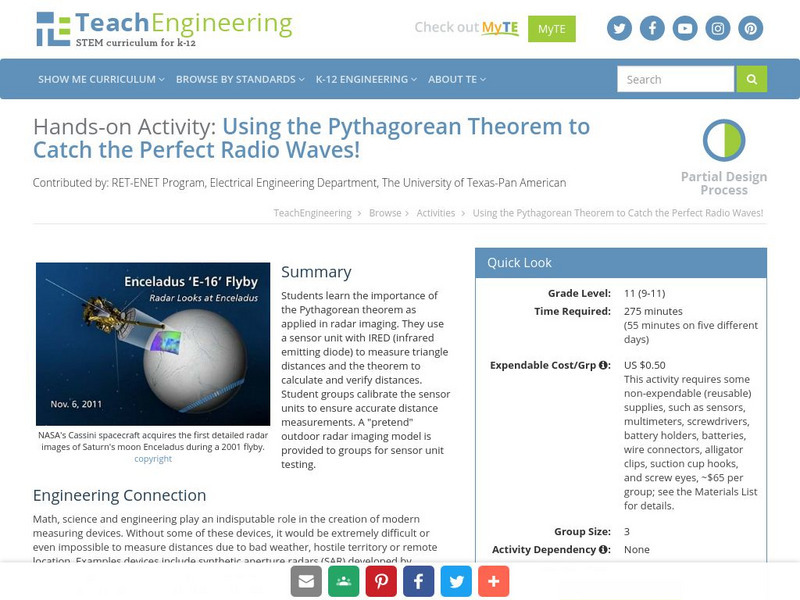
Students learn the importance of the Pythagorean theorem as applied in radar imaging. They use a sensor unit with IRED (infrared emitting diode) to measure triangle distances and the Pythagorean theorem to calculate and verify distances. Groups of three students calibrate the sensor units to ensure accurate distance measurements. A "pretend" outdoor radar imaging model is provided to student groups for sensor unit testing.

3 Views 0 Downloads
Concepts

pythagorean theorem, stem

Additional Tags

radar imaging, synthetic aperture radar, integrated teaching and learning program and laboratory, teachengineering, teachengineering: catching the perfect sar waves!, tools and technology
Show More Show Less

Resource Details

Grade
9th - 10th
Subjects
Science
2 more...
Resource Type
Activities & Projects
Audiences
For Administrator Use
1 more...
Lexile Measures
0L

See similar resources:

Lesson Plan

Engineered Music

Institute of Electrical and Electronics Engineers
Sound engineers investigate the structural design of a musical instrument, the recorder. They work in collaborative groups to choose an instrument to build out of everyday craft materials. It must be able to repeat a three-note sequence...
3rd - 12th Science
CCSS: Adaptable
Activity

Catching the Perfect SAR Waves!

Teach Engineering
Zero in on an interesting resource involving radar technology. Groups construct a radar sensing unit and learn to calibrate the system. Using the radar system and the Pythagorean Theorem, they calculate distances between objects.
9th - 11th Science
Lesson Plan

Teach Engineering: Riding the Radio Waves

TeachEngineering
In this lesson students learn how AM radios work through basic concepts about waves and magnetic fields. Waves are first introduced by establishing the difference between transverse and longitudinal waves, as well as identifying the...
7th - 9th Science
Lesson Plan

Teach Engineering: Exploring the Electromagnetic Spectrum

TeachEngineering
Students learn the basics of the electromagnetic spectrum and how various types of electromagnetic waves are related in terms of wavelength and energy. In addition, they are introduced to the various types of waves that make up the...
9th - 10th Science
Lesson Plan

Teach Engineering: Off the Grid

TeachEngineering
Students learn and discuss the advantages and disadvantages of renewable and non-renewable energy sources. They also learn about our nation's electric power grid and what it means for a residential home to be "off the grid."
9th - 10th Science
Activity

Teach Engineering: Feel the Stress

TeachEngineering
Working individually or in groups, students explore the concept of stress (compression) through physical experience and math. They discover why it hurts more to poke themselves with mechanical pencil lead than with an eraser. Then they...
9th - 10th STEM
Lesson Plan

Teach Engineering: Superhydrophobicity: The Lotus Effect

TeachEngineering
Students are introduced to superhydrophobic surfaces and the "lotus effect." Water spilled on a superhydrophobic surface does not wet the surface, but simply rolls off. Additionally, as water moves across the superhydrophobic surface, it...
10th - 12th STEM
Lesson Plan

Teach Engineering: See the Genes

TeachEngineering
Through this concluding activity and its associated activity, students experience one valuable and often overlooked skill of successful scientists and engineers- communicating work and ideas. Students create posters depicting their...
10th - 12th STEM
Lesson Plan

Teach Engineering: Passing the Bug

TeachEngineering
Students apply concepts of disease transmission to analyze infection data, either provided or created using Bluetooth-enabled Android devices. This data collection may include several cases, such as small static groups (representing...
9th - 10th Science
Activity

Teach Engineering: Matching the Motion

TeachEngineering
Students learn about slope, determining slope, distance vs. time graphs through a motion-filled activity. Working in teams with calculators and CBL motion detectors, students attempt to match the provided graphs and equations with the...
7th - 9th Science
Try It Free
© 1999-2026 Learning Explorer, Inc.
Teacher Lesson Plans, Worksheets and Resources

Sign up for the Lesson Planet Monthly Newsletter

Open Educational Resources (OER)

  • Health
  • Language Arts
  • Languages
  • Math
  • Physical Education
  • Science
  • Social Studies
  • Special Education
  • Visual and Performing Arts
View All Lesson Plans

Discover Resources

  • Our Review Process
  • How it Works
  • How to Search
  • Create a Collection

Manage Curriculum

  • Edit a Collection
  • Assign to Students
  • Manage My Content
Contact Us Site Map Privacy Policy Terms of Use