



Lesson Planet
Search educational resources
  • Sign In Try It Free
  • AI Teacher Tools
    • Discover Resources Search reviewed educational resources by keyword, subject, grade, type, and more
    • Curriculum Manager (My Content) Manage saved and uploaded resources and folders To Access the Curriculum Manager Sign In or Join Now
    • Browse Resource Directory Browse educational resources by subject and topic
    • Curriculum Calendar Explore curriculum resources by date
    • Lesson Planning Articles Timely and inspiring teaching ideas that you can apply in your classroom
    • Our Story
    • Frequently Asked Questions
    • Testimonials
    • Contact Us
  • Pricing
  • School Access
    • Your school or district can sign up for Lesson Planet — with no cost to teachers
      Learn More
  • Sign In
  • Try It Free

Hi, what do you want to do?

Create a lesson plan
Generate resources with 80+ AI teacher tools
Search 200,000 instructional videos
Find a teaching resource
Teach Engineering: It's a Connected World: The Beauty of Network Science Unit PlanTeach Engineering: It's a Connected World: The Beauty of Network Science Unit Plan
Publisher
TeachEngineering
Curator Rating
Educator Rating
Not yet Rated
Unit Plan

Teach Engineering: It's a Connected World: The Beauty of Network Science

Curated by ACT

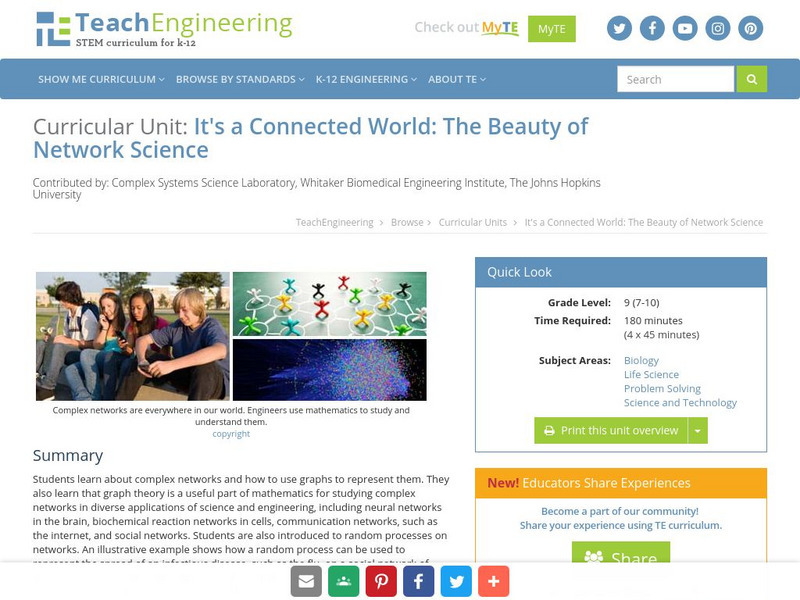
Students learn about complex networks and how to use graphs to represent them. They also learn that graph theory is a useful part of mathematics for studying complex networks in diverse applications of science and engineering, including neural networks in the brain, biochemical reaction networks in cells, communication networks, such as the internet, and social networks. Students are also introduced to random processes on networks. An illustrative example shows how a random process can be used to represent the spread of an infectious disease, such as the flu, on a social network of students, and demonstrates how scientists and engineers use mathematics and computers to model and simulate random processes on complex networks for the purposes of learning more about our world and creating solutions to improve our health, happiness and safety.

6 Views 4 Downloads
Concepts

probability, stem, graphs

Additional Tags

complex networks, modeling, network, simulation, social network, spread of disease, integrated teaching and learning program and laboratory, teachengineering, graph
Show More Show Less

Resource Details

Grade
9th - 10th
Subjects
Science
2 more...
Resource Type
Unit Plans
Audiences
For Administrator Use
1 more...
Lexile Measures
0L

See similar resources:

Instructional Video

The Origin of Species: The Making of a Theory

Howard Hughes Medical Institute
The heartbreaking story of Alfred Wallace's loss of collected evidence opens this documentary about the development of the theory of evolution. You will find supportive resources to use with the movie in your biology class.
31 mins 6th - 12th Science
Instructional Video

A Guide to the Energy of the Earth

TED-Ed
What is energy, anyway? Use this featurette as an introduction to your middle school energy unit. It successfully touches each of Earth's physical systems, the sun as our main source of energy, and the flow of energy through the food...
5 mins 6th - 12th Science
Instructional Video

Great Transitions: The Origin of Tetrapods

Howard Hughes Medical Institute
The featured movie focuses on the ancestry of our four-footed friends. Find the fundamental pattern of their limbs and vertebrae in fossils of fish. After viewing, biology learners can enjoy interactive websites to zoom in on the...
17 mins 6th - 12th Science
Instructional Video

The Benefits of a Bilingual Brain

TED-Ed
What does it really mean to know a language? Did you know that knowing two or more languages means that your brain might actually look and work differently than those of your monolingual friends? Discover the three different types of...
5 mins 7th - 12th Science
CCSS: Adaptable
Lesson Plan

The Making of the Fittest: Got Lactase? The Co-evolution of Genes and Culture

Howard Hughes Medical Institute
Got milk? Only two cultures have had it long enough to develop the tolerance of lactose as an adult. Learn how the responsible genes evolved along with the cultures that have been consuming milk. This rich film is supplied with a few...
15 mins 8th - Higher Ed Science
CCSS: Designed
Instructional Video

Could Comets Be the Source of Life on Earth?

TED-Ed
For thousands of years people have observed comets as they pass through the solar system, but could there be more to these celestial bodies than meets the eye? Watch this video to learn how these objects have recently been found to...
4 mins 7th - 12th Science
CCSS: Adaptable
Instructional Video

PS3A - Definitions of Energy

Bozeman Science
Energy has many forms ... but very few sources! How do we present this to young scientists? Explore the Definitions of Energy, PS3A, in a video about the Next Generation Science Standards. The narrator keeps it simple by relating...
8 mins 4th - 12th Science
Activity

The Treatment of Oil Spills—Microscale Chemistry

Royal Society of Chemistry
When oil spills happen, how is the oil cleaned up? Pupils of polymer science discover an amazing substance that turns oil into a solid during a microscale experiment. Individuals observe oil or paraffin before and after addition of the...
6th - 12th Science
Instructional Video

The Chemistry of Clothes

California Academy of Science
Synthetic materials increase in popularity every year. Exploring Energy takes on the chemistry behind synthetic materials, including polyester. The resource opens with a video explaining the difference between natural and synthetic...
4 mins 6th - 10th Science
CCSS: Adaptable
Instructional Video

ESS1C - The History of Planet Earth

Bozeman Science
Take a trip back in time as the history of the earth is uncovered. An interesting video lesson explains the different methods scientists use to learn about the earth's past. While emphasizing teaching strategies, the lesson instructor...
7 mins 2nd - 12th Science
Try It Free
© 1999-2026 Learning Explorer, Inc.
Teacher Lesson Plans, Worksheets and Resources

Sign up for the Lesson Planet Monthly Newsletter

Open Educational Resources (OER)

  • Health
  • Language Arts
  • Languages
  • Math
  • Physical Education
  • Science
  • Social Studies
  • Special Education
  • Visual and Performing Arts
View All Lesson Plans

Discover Resources

  • Our Review Process
  • How it Works
  • How to Search
  • Create a Collection

Manage Curriculum

  • Edit a Collection
  • Assign to Students
  • Manage My Content
Contact Us Site Map Privacy Policy Terms of Use