Lesson Planet
Search educational resources
  • Sign In Try It Free
  • AI Teacher Tools
    • Discover Resources Search reviewed educational resources by keyword, subject, grade, type, and more
    • Curriculum Manager (My Content) Manage saved and uploaded resources and folders To Access the Curriculum Manager Sign In or Join Now
    • Browse Resource Directory Browse educational resources by subject and topic
    • Curriculum Calendar Explore curriculum resources by date
    • Lesson Planning Articles Timely and inspiring teaching ideas that you can apply in your classroom
    • Our Story
    • Frequently Asked Questions
    • Testimonials
    • Contact Us
  • Pricing
  • School Access
    • Your school or district can sign up for Lesson Planet — with no cost to teachers
      Learn More
  • Sign In
  • Try It Free

Hi, what do you want to do?

Create a lesson plan
Generate resources with 80+ AI teacher tools
Search 200,000 instructional videos
Find a teaching resource
Teach Engineering: Physics of Roller Coasters Lesson PlanTeach Engineering: Physics of Roller Coasters Lesson Plan
Publisher
TeachEngineering
Resource Details
Curator Rating
Educator Rating
Not yet Rated
Grade
7th - 9th
Subjects
Science
3 more...
Resource Type
Lesson Plans
Audiences
For Administrator Use
1 more...
Lexile Measures
1350L
Lesson Plan

Teach Engineering: Physics of Roller Coasters

Curated by ACT

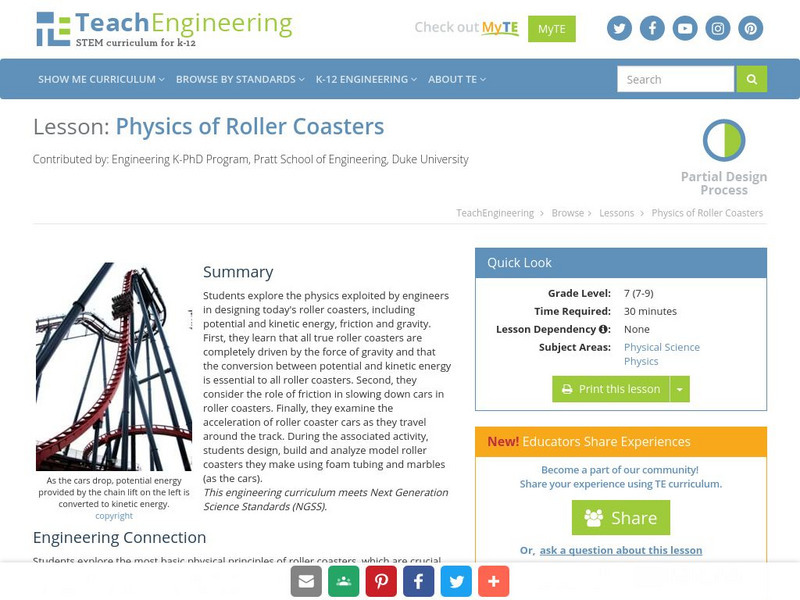
Students explore the physics utilized by engineers in designing today's roller coasters, including potential and kinetic energy, friction, and gravity. First, students learn that all true roller coasters are completely driven by the force of gravity and that the conversion between potential and kinetic energy is essential to all roller coasters. Second, they also consider the role of friction in slowing down cars in roller coasters. Finally, they examine the acceleration of roller coaster cars as they travel around the track.

3 Views 0 Downloads

Concepts

engineering, friction, gravity, kinetic energy, potential energy, stem

Additional Tags

g-force, physics, integrated teaching and learning program and laboratory, ms-ps3-2, teachengineering, roller coaster, amusement park physics

Classroom Considerations

  • Knovation Readability Score: 4 (1 low difficulty, 5 high difficulty)

See similar resources:

Lesson Plan

Physics of Roller Coasters

Curated OER
Students design a roller coaster and demonstrate their knowledge of Potential and Kinetic Energy. They determine the average velocity a given marble travels on their roller coaster and apply their knowledge of various measurement systems...
4th - 8th Science
Activity

Roller Coaster Mania!

MENSA Education & Research Foundation
Raise the energy level of your physical science class with this exciting hands-on activity. Applying their knowledge of kinetic and potential energy and Newton's laws of motion, young engineers use foam tubing and marbles to create...
3rd - 10th Science
CCSS: Adaptable
Activity

Build a Roller Coaster

DiscoverE
Let the good times roll as young thrill seekers build a roller coaster on school grounds. Future engineers design and build a roller coaster from flexible tubing. The roller coaster is for a marble, so there will be plenty of room to let...
3rd - 8th Science
Lesson Plan

Roller Coasters

Curated OER
Twisting and turning through the sky, roller coasters are popular attractions at amusement parks around the world, but how exactly do they work? Explore the physics behind these thrilling rides with an engineering design activity....
3rd - 7th Science
Instructional Video

The Physics of Roller Coasters

SciShow
Applied physics excites learners because it is about race cars, airplanes, and even roller coasters. Roller coasters are the focus of a video that focuses on the physics of roller coasters starting and stopping. It highlights the...
4 mins 9th - 12th Science
CCSS: Adaptable
Interactive

Roller Coaster

CK-12 Foundation
Roller coasters rely on both kinetic and potential energy, but how much total energy does a roller coaster need? Scholars vary the mass of a coaster and the height of the initial hill. Graphs showing the types of energy and total energy...
6th - 12th Science
CCSS: Adaptable
Instructional Video

Roller Coaster Science

Curated OER
The science of roller coasters is explained along with Newton's Laws of Physics, to an extent. Show to your physics class for a little fun explanation of gravity.
2 mins 9th - 12th Science
Activity

Science Buddies: The Chills and Thrills of Roller Coaster Hills

Science Buddies
Lots of people enjoy roller coasters, but not many understand why they feel the strange excitement they do when riding them. In this science fair project, you will build and use an accelerometer to figure out and measure gravity-induced...
6th - 8th Science
Instructional Video

The Physics of Human Sperm vs. the Physics of the Sperm Whale

TED-Ed
Here is an unusual comparison: the swimming conditions of a sperm cell and a sperm whale. Introduce your physics class to the Reynolds number by sharing this video comparison during your fluid mechanics unit. Afterward, teach them to...
4 mins 9th - 12th Science
CCSS: Adaptable
Interactive

The Physics Classroom: Circular and Satellite Motion: Roller Coaster Model

Physics Classroom
An interactive playground for students to explore the physics of roller coasters. Learners investigate by changing the variables of force, velocity, friction, and vectors. Energy bar charts are displayed as the coaster car moves along...
9th - 10th Science
Try It Free
© 1999-2026 Learning Explorer, Inc.
Teacher Lesson Plans, Worksheets and Resources

Sign up for the Lesson Planet Monthly Newsletter

Open Educational Resources (OER)

  • Health
  • Language Arts
  • Languages
  • Math
  • Physical Education
  • Science
  • Social Studies
  • Special Education
  • Visual and Performing Arts
View All Lesson Plans

Discover Resources

  • Our Review Process
  • How it Works
  • How to Search
  • Create a Collection

Manage Curriculum

  • Edit a Collection
  • Assign to Students
  • Manage My Content
Contact Us Site Map Privacy Policy Terms of Use