Lesson Planet
Search educational resources
  • Sign In Try It Free
  • AI Teacher Tools
    • Discover Resources Search reviewed educational resources by keyword, subject, grade, type, and more
    • Curriculum Manager (My Content) Manage saved and uploaded resources and folders To Access the Curriculum Manager Sign In or Join Now
    • Browse Resource Directory Browse educational resources by subject and topic
    • Curriculum Calendar Explore curriculum resources by date
    • Lesson Planning Articles Timely and inspiring teaching ideas that you can apply in your classroom
    • Our Story
    • Frequently Asked Questions
    • Testimonials
    • Contact Us
  • Pricing
  • School Access
    • Your school or district can sign up for Lesson Planet — with no cost to teachers
      Learn More
  • Sign In
  • Try It Free

Hi, what do you want to do?

Create a lesson plan
Generate resources with 80+ AI teacher tools
Search 200,000 instructional videos
Find a teaching resource
Teach Engineering: Population Growth Curves ActivityTeach Engineering: Population Growth Curves Activity
Publisher
TeachEngineering
Curator Rating
Educator Rating
Not yet Rated
Activity

Teach Engineering: Population Growth Curves

Curated by ACT

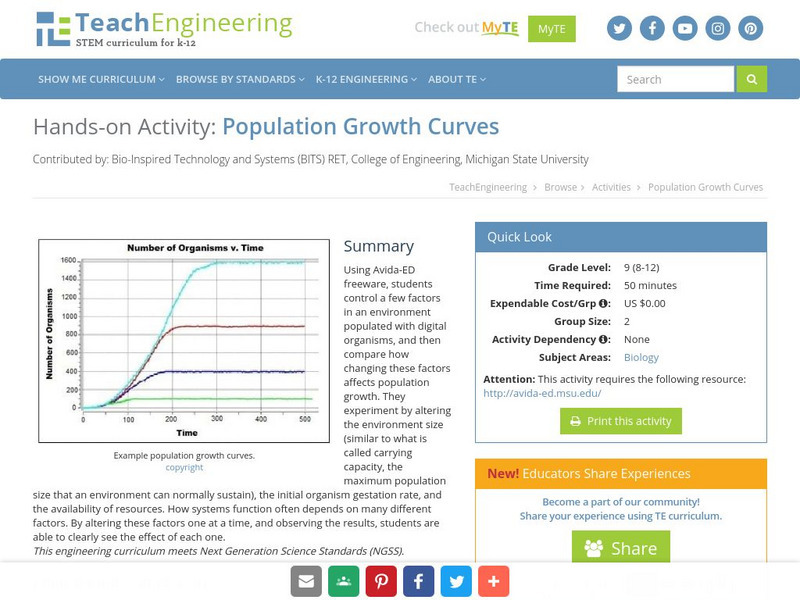
Using Avida-ED freeware, students control a few factors in an environment populated with digital organisms, and then compare how changing these factors affects population growth. They experiment by altering the environment size (similar to what is called carrying capacity, the maximum population size that an environment can normally sustain), the initial organism gestation rate, and the availability of resources. How systems function often depends on many different factors. By altering these factors one at a time, and observing the results, students are able to clearly see the effect of each one.

6 Views 7 Downloads
Concepts

carrying capacity, graphing, population, stem

Additional Tags

environmental engineering, logistic, systems analysis, avida, hs-ls2-1, integrated teaching and learning program and laboratory, teachengineering, teachengineering: population growth curves, digital organisms
Show More Show Less

Resource Details

Grade
9th - 10th
Subjects
Science
3 more...
Resource Type
Activities & Projects
Audiences
For Administrator Use
1 more...
Lexile Measures
0L

See similar resources:

Worksheet

Population Ecology

Curated OER
A complete study of population ecology is covered by this worksheet. Biology or ecology learners answer questions and interpret population graphs. This can be used as the intended guided notes worksheet or assigned as homework.
9th - Higher Ed Science
Worksheet

AP: Chapter 52: Population Ecology

Curated OER
For AP biology or ecology classes, here is a worksheet that explores population growth. Carrying capacity, limiting factors, and k-strategies are dealt with using short-answer questions. 
9th - 12th Science
PPT

Population Growth

Curated OER
A single slide depicts the normal population growth curve. The curve reaches a steady state when the population reaches carrying capacity. You can use this slide when teaching about populations, but it may be more effective to insert it...
9th - 12th Science
Lesson Plan

Teach Engineering: Biomes and Population Dynamics

TeachEngineering
This lesson begins with a PowerPoint slideshow that covers important ecological concepts about biomes, limiting factors, carrying capacity, and population growth. Students will look at the population dynamics involved with the diversity...
9th - 10th Science
Unit Plan

Teach Engineering: Cellular Respiration and Population Growth

TeachEngineering
Two lessons and their associated activities explore cellular respiration and population growth in yeasts. Yeast cells are readily obtained and behave predictably, so they are very appropriate to use in middle school classrooms. In the...
9th - 10th STEM
Lesson Plan

Population Growth in Yeasts

Curated OER
Students design an investigation using yeast. In this environmental engineering activity, students design an investigation to determine how environmental factors affect the growth of yeast. They will collect quantitative data and discuss...
7th - 10th Science
Interactive

Palomar College: Principles of Population Growth

Palomar Community College District
An excellent interactive review from Palomar College of population growth and how it can be described. Try out the interactive calculators of population size.
9th - 10th Science
Lesson Plan

Population Biology - Biology Teaching Thesis

Curated OER
High schoolers explore the effects of different density-dependent and density-independent factors on population growth. They explore how the interactions of organisms can affect population growth. Students explore the pattern of...
9th - 12th Science
Activity

Teach Engineering: How to Make Yeast Cells Thrive

TeachEngineering
Students set up and run the experiments they designed in the lesson Population Growth in Yeasts, using simple yeast-molasses cultures in test tubes. Population growth is indicated by the amount of respiration occurring in the cultures,...
9th - 10th Science
Instructional Video

ETS2B - Influence of Science, Engineering and Technology on Society and the Natural World

Bozeman Science
Science, engineering, and technology have an impact on our natural world. As the world population increases, the demands on natural resources also increase. Science, technology, and engineering work together to address these concerns...
5 mins K - 12th Science
Try It Free
© 1999-2026 Learning Explorer, Inc.
Teacher Lesson Plans, Worksheets and Resources

Sign up for the Lesson Planet Monthly Newsletter

Open Educational Resources (OER)

  • Health
  • Language Arts
  • Languages
  • Math
  • Physical Education
  • Science
  • Social Studies
  • Special Education
  • Visual and Performing Arts
View All Lesson Plans

Discover Resources

  • Our Review Process
  • How it Works
  • How to Search
  • Create a Collection

Manage Curriculum

  • Edit a Collection
  • Assign to Students
  • Manage My Content
Contact Us Site Map Privacy Policy Terms of Use