



Lesson Planet
Search educational resources
  • Sign In Try It Free
  • AI Teacher Tools
    • Discover Resources Search reviewed educational resources by keyword, subject, grade, type, and more
    • Curriculum Manager (My Content) Manage saved and uploaded resources and folders To Access the Curriculum Manager Sign In or Join Now
    • Browse Resource Directory Browse educational resources by subject and topic
    • Curriculum Calendar Explore curriculum resources by date
    • Lesson Planning Articles Timely and inspiring teaching ideas that you can apply in your classroom
    • Our Story
    • Frequently Asked Questions
    • Testimonials
    • Contact Us
  • Pricing
  • School Access
    • Your school or district can sign up for Lesson Planet — with no cost to teachers
      Learn More
  • Sign In
  • Try It Free

Hi, what do you want to do?

Create a lesson plan
Generate resources with 80+ AI teacher tools
Search 200,000 instructional videos
Find a teaching resource
Teach Engineering: What Is the Best Insulator: Air, Styrofoam, Foil, or Cotton? Activity
Publisher
TeachEngineering
Resource Details
Curator Rating
Educator Rating
Not yet Rated
Grade
3rd - 5th
Subjects
Science
2 more...
Resource Type
Activities & Projects
Audiences
For Administrator Use
1 more...
Lexile Measures
970L
Activity

Teach Engineering: What Is the Best Insulator: Air, Styrofoam, Foil, or Cotton?

Curated by ACT

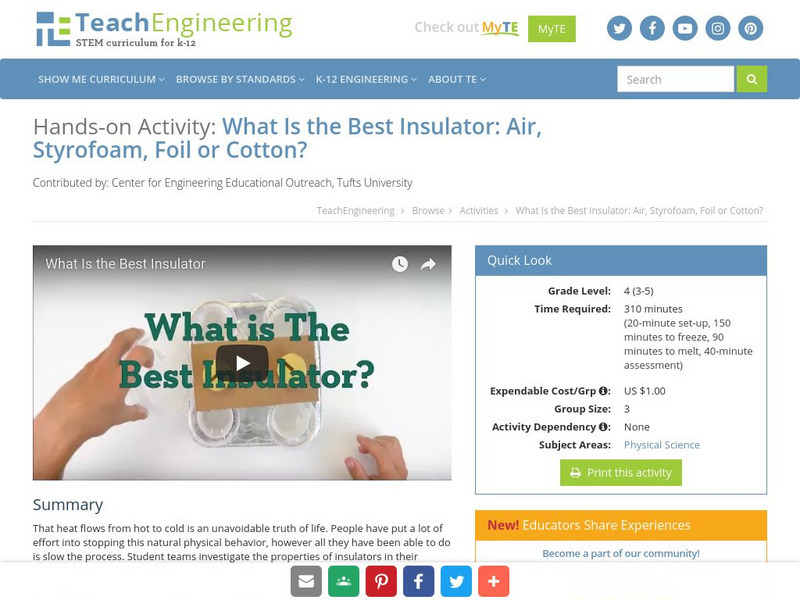
That heat flows from hot to cold is an unfortunate truth of life. People have put a lot of effort into stopping this fact, however all they have been able to do is slow the process. Working in groups of three to four, students will investigate the properties of insulators in attempts to keep a cup of water from freezing, and once it is frozen, to keep it from melting.

5 Views 5 Downloads

Concepts

energy, engineering, heat, stem, insulation

Additional Tags

freeze, integrated teaching and learning program and laboratory, teachengineering, conductor, insulator

Classroom Considerations

  • Knovation Readability Score: 3 (1 low difficulty, 5 high difficulty)

See similar resources:

Lesson Plan

What Is the Water Cycle?

Baylor College
Small groups place sand and ice in a covered box, place the box in the sunlight, then observe as evaporation, condensation, and precipitation occur. These models serve as miniature water cycles and demonstrations of the three phases of...
3rd - 5th Science
Unit Plan

What Is The Ocean?

University of Southern California
Go on a tour of the ocean through the lens of a scientist. Learners read maps of the ocean floor, study tide behavior, examine wave motion, and analyze components of soil. Each lesson incorporates a hands-on component.
4th - 8th Science
Instructional Video

What Is the Milky Way?

SciShow Kids
The Milky Way is the focus of an engaging video that details the galaxy in which we live, equipped with an energetic host, a cartoon sidekick, and eye-catching graphics.   
3 mins Pre-K - 5th Science
CCSS: Adaptable
Lesson Plan

What is the Best Insulator: Air, Styrofoam, Foil, or Cotton?

Curated OER
Students investigate the properties of insulators by attempting to keep a cup of water from freezing, and once it is frozen, to keep it from melting. They conduct the experiment, record and analyze the results, and answer discussion...
3rd - 5th Science
Instructional Video

Science & Nature Information : What Is the Water Cycle?

Curated OER
An expert on the water cycle is featured giving a lecture about the basics of the water cycle. The teacher stands at a whiteboard that has a particularly good illustration that shows how the cycle works quite nicely. He makes a special...
2 mins 4th - 8th Science
Lesson Plan

Teach Engineering: What Is Newton's Third Law?

TeachEngineering
Young scholars are introduced to Newton's third law of motion, and then learn that engineers apply Newton's third law and an understanding of reaction forces when designing a wide range of creations, from rockets and aircraft to door...
5th - 7th Science
Lesson Plan

Teach Engineering: What Is Newton's First Law?

TeachEngineering
Students are introduced to the concepts of force, inertia, and Newton's first law of motion: objects at rest stay at rest and objects in motion stay in motion unless acted upon by an unbalanced force.This lesson is the first in a series...
5th - 7th Science
Lesson Plan

Teach Engineering: What Is Engineering? What Is Design?

TeachEngineering
An overview of engineering and design which introduces the students to the basic steps of the engineering design process. This lesson challenges students to plan a picnic for their friends by considering its various components as they go...
4th - 8th STEM
Lesson Plan

Teach Engineering: What Is Heat?

TeachEngineering
Learners learn about the definition of heat as a form of energy and how it exists in everyday life. They also learn about the three types of heat transfer as well as the connection between heat and insulation.
5th - 7th Science
Lesson Plan

Bio Ed Online: What Is the Water Cycle?

BioEd Online
In this lesson learners will create and investigate a simple model of the water cycle. Student sheets are provided in English and in Spanish.
3rd - 8th Science
Try It Free
© 1999-2026 Learning Explorer, Inc.
Teacher Lesson Plans, Worksheets and Resources

Sign up for the Lesson Planet Monthly Newsletter

Open Educational Resources (OER)

  • Health
  • Language Arts
  • Languages
  • Math
  • Physical Education
  • Science
  • Social Studies
  • Special Education
  • Visual and Performing Arts
View All Lesson Plans

Discover Resources

  • Our Review Process
  • How it Works
  • How to Search
  • Create a Collection

Manage Curriculum

  • Edit a Collection
  • Assign to Students
  • Manage My Content
Contact Us Site Map Privacy Policy Terms of Use