Lesson Planet
Search educational resources
  • Sign In Try It Free
  • AI Teacher Tools
    • Discover Resources Search reviewed educational resources by keyword, subject, grade, type, and more
    • Curriculum Manager (My Content) Manage saved and uploaded resources and folders To Access the Curriculum Manager Sign In or Join Now
    • Browse Resource Directory Browse educational resources by subject and topic
    • Curriculum Calendar Explore curriculum resources by date
    • Lesson Planning Articles Timely and inspiring teaching ideas that you can apply in your classroom
    • Our Story
    • Frequently Asked Questions
    • Testimonials
    • Contact Us
  • Pricing
  • School Access
    • Your school or district can sign up for Lesson Planet — with no cost to teachers
      Learn More
  • Sign In
  • Try It Free

Hi, what do you want to do?

Create a lesson plan
Generate resources with 80+ AI teacher tools
Search 200,000 instructional videos
Find a teaching resource
Texas Instruments: Finding the % Salt in Seawater ActivityTexas Instruments: Finding the % Salt in Seawater Activity
Publisher
Texas Instruments
Resource Details
Curator Rating
Educator Rating
Not yet Rated
Grade
9th - 10th
Subjects
Science
2 more...
Resource Type
Activities & Projects
Audiences
For Administrator Use
1 more...
Lexile Measures
0L
Activity

Texas Instruments: Finding the % Salt in Seawater

Curated by ACT

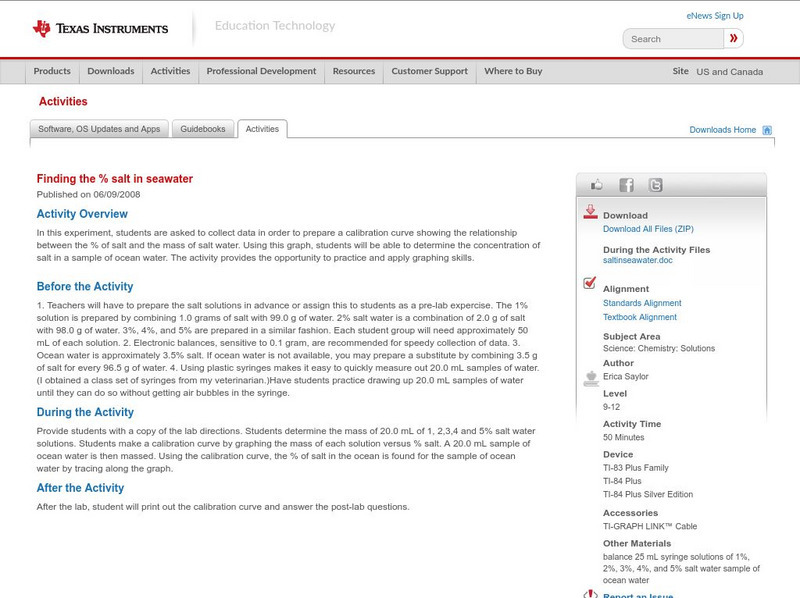
In this experiment, students are asked to collect data in order to prepare a calibration curve showing the relationship between the percentage of salt and the mass of salt water. Using this graph, students will be able to determine the concentration of salt in a sample of ocean water. The activity provides the opportunity to practice and apply graphing skills.

3 Views 0 Downloads

Concepts

salinity, saltwater

Additional Tags

graphing skills, percentages, salt in seawater, finding the % salt in seawater, ti, texas instruments

Classroom Considerations

  • Knovation Readability Score: 3 (1 low difficulty, 5 high difficulty)

See similar resources:

Interactive

Understanding the Effects of Differences in Speed—Problem Set D

NASA
Fall back and slow down. The fourth lesson in a six-part series on air traffic control leads the class to find the difference in distance traveled based upon the difference in speed. Pupils work through a problem related to walking...
5th - 9th Math
CCSS: Adaptable
Lesson Plan

Is There Salt in a Glacier?

Polar Trec
What can conductivity tell us about a glacier? Groups analyze glacial melt to determine salt content through an analysis of the pH and conductivity measurements of two samples. Groups then determine the source of the salts. 
6th - 12th Science
CCSS: Adaptable
Instructional Video

The Universe in a Cup of Coffee

American Chemical Society
Connect the chemical aspects of coffee to the world in which we live! Scholars consider the molecules within coffee and how they interact with the environment as they view an episode of the ACS Reaction series. From caffeine as a...
5 mins 9th - Higher Ed Science
CCSS: Adaptable
Instructional Video

How These Sea Shells Know the Weather in Greenland

MinuteEarth
Does a single-celled organism know more about the history of our planet than we do? A video explains how single-celled organisms manage to build a house and hold the secrets to the weather. They contain the information about the changes...
3 mins 6th - 12th Science
CCSS: Adaptable
Instructional Video

Picture of the Big Bang (a.k.a. Oldest Light in the Universe)

MinutePhysics
Everyone knows the Big Bang Theory ... but, then what happened? Go beyond the bang in an illustrated video that discusses the after effects of the event that set our universe in motion. Physics scholars discover how the creation of...
4 mins 9th - 12th Science
Instructional Video

Salts in Solution

Teacher's Pet
Neutralization always happens when you mix an acid with a base, right? Well ... sort of. Expand the class' view of acid-base chemistry using an informative video. The narrator shows examples of salt hydrolysis, how buffers influence...
3 mins 9th - 12th Science
CCSS: Adaptable
Interactive

Acids and Salts

Royal Society of Chemistry
How well do your young chemists know their acid-base reactions? Reinforce neutralization reaction and problem-solving skills with a challenging interactive. Learners examine the reactants, then predict the outcome in a series of...
6th - 12th Science
Instructional Video

How Does the Immune System Work?

TED-Ed
The human immune system doesn't always prevent us from getting sick, so what is it doing? Young scientists watch a short video explaining what the immune system is and how it works. Then, they answer eight questions to prepare for an...
5 mins 9th - Higher Ed Science
CCSS: Adaptable
Lesson Plan

The Temperature Effect

Teach Engineering
How temperature affects the efficiency of a solar panel is the focus of the third in a series of eight resources that presents how engineers are able to control the temperatures of photovoltaic panels. Class members find out how the...
9th - 12th Science
CCSS: Designed
Activity

Texas Instruments: Setting the Trend

Texas Instruments
In this activity you will - Determine the trend in atomic radius for the periodic table. Determine the trend in first ionization energy for the periodic table. Determine the trend in electronegativity for the periodic table.
9th - 10th Science
Try It Free
© 1999-2026 Learning Explorer, Inc.
Teacher Lesson Plans, Worksheets and Resources

Sign up for the Lesson Planet Monthly Newsletter

Open Educational Resources (OER)

  • Health
  • Language Arts
  • Languages
  • Math
  • Physical Education
  • Science
  • Social Studies
  • Special Education
  • Visual and Performing Arts
View All Lesson Plans

Discover Resources

  • Our Review Process
  • How it Works
  • How to Search
  • Create a Collection

Manage Curriculum

  • Edit a Collection
  • Assign to Students
  • Manage My Content
Contact Us Site Map Privacy Policy Terms of Use