Lesson Planet
Search educational resources
  • Sign In Try It Free
  • AI Teacher Tools
    • Discover Resources Search reviewed educational resources by keyword, subject, grade, type, and more
    • Curriculum Manager (My Content) Manage saved and uploaded resources and folders To Access the Curriculum Manager Sign In or Join Now
    • Browse Resource Directory Browse educational resources by subject and topic
    • Curriculum Calendar Explore curriculum resources by date
    • Lesson Planning Articles Timely and inspiring teaching ideas that you can apply in your classroom
    • Our Story
    • Frequently Asked Questions
    • Testimonials
    • Contact Us
  • Pricing
  • School Access
    • Your school or district can sign up for Lesson Planet — with no cost to teachers
      Learn More
  • Sign In
  • Try It Free

Hi, what do you want to do?

Create a lesson plan
Generate resources with 80+ AI teacher tools
Search 200,000 instructional videos
Find a teaching resource
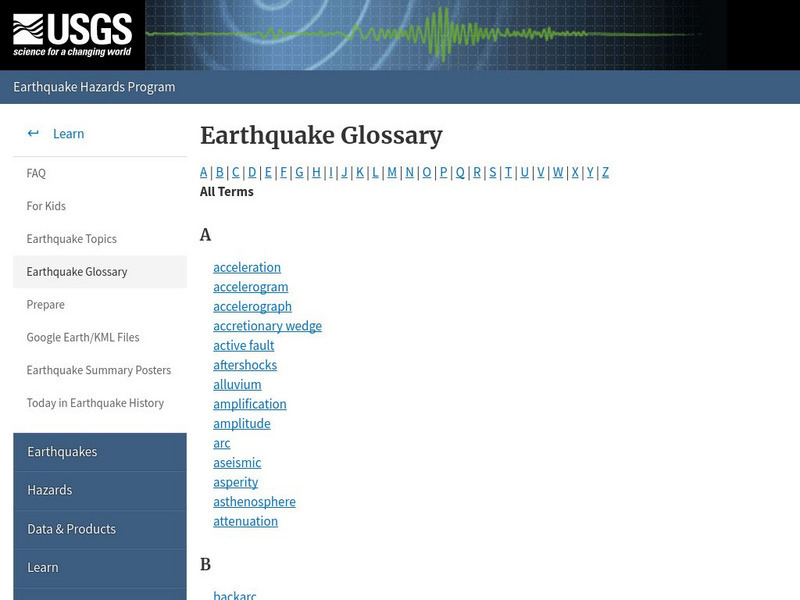
U.s. Geological Survey: Earthquake Center: Glossary HandoutU.s. Geological Survey: Earthquake Center: Glossary Handout
Publisher
US Geological Survey
Resource Details
Curator Rating
Educator Rating
Not yet Rated
Grade
3rd - 8th
Subjects
Science
2 more...
Resource Type
Handouts & References
Audiences
For Administrator Use
2 more...
Lexile Measures
0L
Handout

U.s. Geological Survey: Earthquake Center: Glossary

Curated by ACT

This resource provides definitions of important earthquake related terms.

3 Views 1 Download

Concepts

earthquakes, faults, seismology

Additional Tags

aftershock, body waves, core, crust, earthquake glossary, earthquake risk states, earthquake terms, focus, foreshock, p-waves, richter scale, s-waves, seismic body waves, seismogram, seismographic, seismometer, stresses, strike-slip fault, surface waves, tectonics, p-wave, s-wave, shear wave, earthquake, epicenter, fault, fault line, seismograph, tsunami

Classroom Considerations

  • Knovation Readability Score: 4 (1 low difficulty, 5 high difficulty)

See similar resources:

Handout

U.s. Geological Survey: Rock'n on Shakey Ground [Pdf]

US Geological Survey
The basics of earthquake science including factual information about how and why they happen. Also includes some hands-on activities and experiments for students.
3rd - 8th Science
Website

U.s. Geological Survey: Earthquakes for Kids

US Geological Survey
A collection of articles, games, printouts, facts, science fair ideas, and links through which students learn about the history and science of earthquakes and also explore what it takes to be an "earthquake scientist."
3rd - 8th Science
Handout

U.s. Geologic Survey: Rocks

US Geological Survey
What are rocks made of? Where do rocks come from? What is an igneous rock? These are just some of the questions answered by the scientists of the U.S. Geologic Survey.
3rd - 8th Science
Lesson Plan

U.s. Geological Survey: Volcanoes

US Geological Survey
Six-part interdisciplinary teaching packet. Through the story of the 1980 eruption of Mount St. Helens, students will answer fundamental questions about volcanoes. By learning about volcanoes, students will understand that the Earth...
4th - 8th Science
Interactive

U.s. Geological Survey: Science Stories

US Geological Survey
Go on an exciting journey with Beatrice, Emily and Polina and learn about the bee population, climate change and how to care for wildlife. A wonderful tool for independent reading practice or a perfect read-aloud activity. Useful links...
3rd - 5th Science
Graphic

U.s. Geological Survey:the Water Cycle for Kids and Students: Advanced Students

US Geological Survey
Hyperlinked diagram provides an in-depth explanation of each phase of the Earth's water cycle.
3rd - 8th Science
Activity

U.s. Geological Survey: Make a Birdhouse

US Geological Survey
Illustrated, step-by-step directions on how to build a birdhouse for a bluebird or other similar species.
3rd - 8th Science
Handout

U.s. Geological Survey: Where Is Earth's Water Located?

US Geological Survey
Find out how much of the water on Earth is actually usable by humans, and where the rest of it is located. Learn where our water comes from and why it never runs out. Click Home to access the site in Spanish.
3rd - 8th Science
Graphic

Usgs: Water Cycle for Schools

US Geological Survey
The U.S. Geological Survey (USGS) and the Food and Agriculture Organization of the United Nations (FAO) have teamed up to create a water-cycle diagram for schools. Use the interactive version and download printable files of the diagram.
1st - 8th Science
Instructional Video

Illinois Geological Survey: Earthquake Liquefaction Example

Other
A simple and effective demonstration of what happens during liquefaction in an earthquake. [1:13]
3rd - 8th Science
Try It Free
© 1999-2026 Learning Explorer, Inc.
Teacher Lesson Plans, Worksheets and Resources

Sign up for the Lesson Planet Monthly Newsletter

Open Educational Resources (OER)

  • Health
  • Language Arts
  • Languages
  • Math
  • Physical Education
  • Science
  • Social Studies
  • Special Education
  • Visual and Performing Arts
View All Lesson Plans

Discover Resources

  • Our Review Process
  • How it Works
  • How to Search
  • Create a Collection

Manage Curriculum

  • Edit a Collection
  • Assign to Students
  • Manage My Content
Contact Us Site Map Privacy Policy Terms of Use