Lesson Planet
Search educational resources
  • Sign In Try It Free
  • AI Teacher Tools
    • Discover Resources Search reviewed educational resources by keyword, subject, grade, type, and more
    • Curriculum Manager (My Content) Manage saved and uploaded resources and folders To Access the Curriculum Manager Sign In or Join Now
    • Browse Resource Directory Browse educational resources by subject and topic
    • Curriculum Calendar Explore curriculum resources by date
    • Lesson Planning Articles Timely and inspiring teaching ideas that you can apply in your classroom
    • Our Story
    • Frequently Asked Questions
    • Testimonials
    • Contact Us
  • Pricing
  • School Access
    • Your school or district can sign up for Lesson Planet — with no cost to teachers
      Learn More
  • Sign In
  • Try It Free

Hi, what do you want to do?

Create a lesson plan
Generate resources with 80+ AI teacher tools
Search 200,000 instructional videos
Find a teaching resource
Virginia Institute of Marine Science: Ghostbusting in the Chesapeake Lesson PlanVirginia Institute of Marine Science: Ghostbusting in the Chesapeake Lesson Plan
Publisher
Virginia Institute of Marine Science
Resource Details
Curator Rating
Educator Rating
Not yet Rated
Grade
9th - 10th
Subjects
Science
2 more...
Resource Type
Lesson Plans
Audiences
For Administrator Use
1 more...
Lexile Measures
0L
Lesson Plan

Virginia Institute of Marine Science: Ghostbusting in the Chesapeake

Curated by ACT

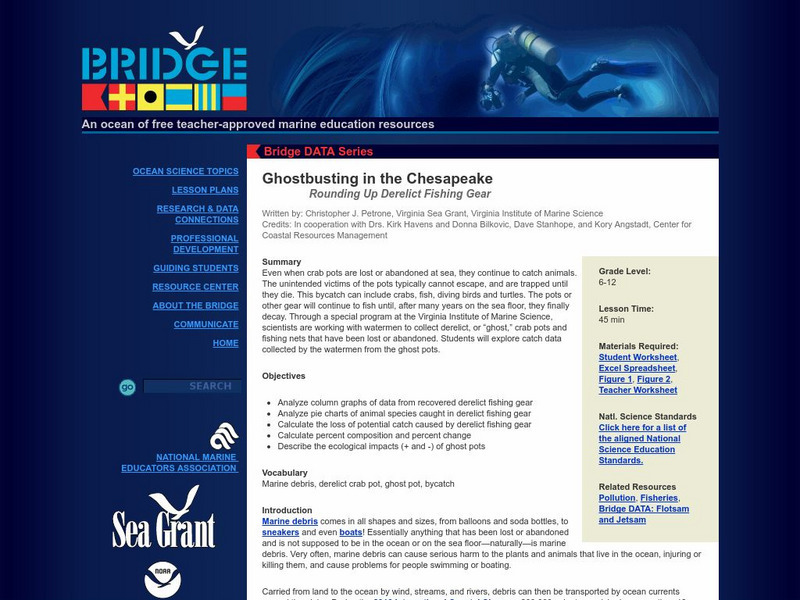
Because abandoned crab fishing pots can create havoc in the marine ecosystem, scientists and fishermen are researching ways in which to collect them. In this lesson students will explore catch data collected by the watermen from the "ghost" pots.

3 Views 1 Download

Concepts

marine debris, fishing, water pollution

Additional Tags

bycatch, ghostbusting in the chesapeake, virginia institute of marine science, crab fishing, derelict crab pot, ghost pot

Classroom Considerations

  • Knovation Readability Score: 4 (1 low difficulty, 5 high difficulty)
  • The intended use for this resource is Instructional

See similar resources:

Lesson Plan

Turning the Tide on Trash: A Learning Guide on Marine Debris

NOAA
The lessons in this learning guide are designed to increase youngsters' awareness of the impacts of marine debris and to teach them about pollution prevention techniques. This fabulous, 30-page packet is chock full of important...
1st - 12th Science
Instructional Video

The Brightest Part of a Shadow Is in the Middle

Veritasium
Shed some light on the nature of shadows! Science sleuths investigate a 200-year-old theory that light will form a bright spot in the center of a sphere's or circle's shadow with a video from Veritasium. The resource explains the...
7 mins 9th - 12th Science
CCSS: Adaptable
Lesson Plan

Ghostbusting in the Chesapeake

Curated OER
Ghost pots, fishing gear lost during crabbing expeditions, continue to trap crabs that are never collected. Increase your budding ecologists' awareness of human impact on the environment as well as conservation efforts using this...
9th - 12th Science
Instructional Video

The Surprising (And Invisible) Signatures of Sea Creatures

TED-Ed
Airplanes resulted from observations of birds flying. What inventions could be inspired by watching sea creatures move? Viewers are challenged to consider how bio-observation might lead them to design something to overcome...
7 mins 7th - 12th Science
Lesson Plan

National Marine Sanctuaries Fish

Curated OER
Information is provided on Gray's Reef, Florida Keys, and Flower Garden Banks marine sanctuaries. Young marine biologists then visit the FishBase and REEF databases to collect fish species information for each location. They then...
9th - 12th Science
Interactive

What do You Know About Marine Biology

American Museum of Natural History
Show me what you know about the sea. Learners answer 10 questions about marine biology. The questions range from what evidence points to the origin of life to the biggest threat to oceans.
6th - 12th Science
Website

What is Marine Biology?

American Museum of Natural History
A marine environment covers the majority of the earth but is arguably the least understood. Teach young scientists about the characteristics of oceans and ocean species using an interactive online lesson. The in-person or remote learning...
6th - 12th Science
Instructional Video

Should We Be Looking for Life Elsewhere in the Universe?

TED-Ed
Is there life beyond Earth? If so, should we make contact with that life? Carl Sagan, along with other astronomers, packed the Voyager 1 and Voyager 2 with sounds of the Earth and Earth's inhabitants, hoping to reach...
5 mins 5th - 12th Science
Lesson Plan

Ocean Circulation in the North Atlantic

PBS
Swirling and churning, the waters of the North Atlantic play a vital role in Earth's climate! Discover the many factors that produce circulation using a multimedia lesson from PBS's Weather and Climate series for high schoolers. Scholars...
9th - 12th Science
CCSS: Adaptable
Website

American Museum of Natural History: Milstein Hall of Ocean Life

American Museum of Natural History
Tour the museum's famed exhibition hall dedicated to ocean life at this online recreation. Find videos, maps, species specimens, and images that let you experience many of the museum's resources on ocean life right from your desktop.
9th - 10th Science
Try It Free
© 1999-2026 Learning Explorer, Inc.
Teacher Lesson Plans, Worksheets and Resources

Sign up for the Lesson Planet Monthly Newsletter

Open Educational Resources (OER)

  • Health
  • Language Arts
  • Languages
  • Math
  • Physical Education
  • Science
  • Social Studies
  • Special Education
  • Visual and Performing Arts
View All Lesson Plans

Discover Resources

  • Our Review Process
  • How it Works
  • How to Search
  • Create a Collection

Manage Curriculum

  • Edit a Collection
  • Assign to Students
  • Manage My Content
Contact Us Site Map Privacy Policy Terms of Use