



Lesson Planet
Search educational resources
  • Sign In Try It Free
  • AI Teacher Tools
    • Discover Resources Search reviewed educational resources by keyword, subject, grade, type, and more
    • Curriculum Manager (My Content) Manage saved and uploaded resources and folders To Access the Curriculum Manager Sign In or Join Now
    • Browse Resource Directory Browse educational resources by subject and topic
    • Curriculum Calendar Explore curriculum resources by date
    • Lesson Planning Articles Timely and inspiring teaching ideas that you can apply in your classroom
    • Our Story
    • Frequently Asked Questions
    • Testimonials
    • Contact Us
  • Pricing
  • School Access
    • Your school or district can sign up for Lesson Planet — with no cost to teachers
      Learn More
  • Sign In
  • Try It Free

Hi, what do you want to do?

Create a lesson plan
Generate resources with 80+ AI teacher tools
Search 200,000 instructional videos
Find a teaching resource
Virtual Nerd: How Do You Use the Fcp to Count the Number of Outcomes in a Sample Instructional VideoVirtual Nerd: How Do You Use the Fcp to Count the Number of Outcomes in a Sample Instructional Video
Publisher
Virtual Nerd
Resource Details
Curator Rating
Educator Rating
Not yet Rated
Grade
6th - 8th
Subjects
Math
2 more...
Resource Type
Instructional Videos
Audiences
For Administrator Use
2 more...
Lexile Measures
1220L
Instructional Video

Virtual Nerd: How Do You Use the Fcp to Count the Number of Outcomes in a Sample

Curated by ACT

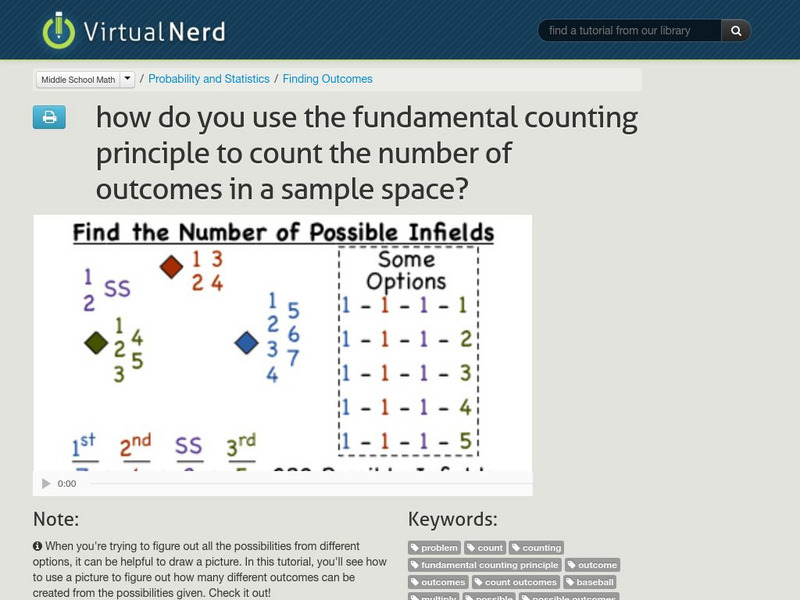
Using baseball as an example, watch how you can apply the Fundamental Counting Principle to count the number of different ways a coach can fill his infield. This video will show you how to make a drawing to better understand the problem. [4:48]

3 Views 0 Downloads

Concepts

fundamental counting principle

Additional Tags

counting outcomes

Classroom Considerations

  • Knovation Readability Score: 3 (1 low difficulty, 5 high difficulty)
  • The intended use for this resource is Instructional

See similar resources:

Instructional Video

How Do You Use The Discriminant to Determine the Number of Solutions of a Quadratic Equation?

Curated OER
What is the discriminant? The what? The discriminant? It has something to do with quadratic equations. It's used to determine how many answers a quadratic equation has, but what is it? It's an equation that is actually a part of the...
6 mins 8th - 11th Math
Instructional Video

How Do You Use an Equation to Find a Part of a Whole?

Virtual Nerd
Watch the instructor change a percent into a decimal and multiply it by the original number to determine the percent. One idea would be to embed this video in a PowerPoint presentation, or assign it as homework with your flipped...
2 mins 6th - 8th Math
CCSS: Adaptable
Instructional Video

How Do You Use an Equation to Find a Part of a Whole?

Curated OER
Watch the instructor change a percent into a decimal in order to multiply the two values to get the percent of a number.
1 min 6th - 8th Math
Instructional Video

How Do You Use the Fundamental Counting Principle to Count the Number of Outcomes in a Sample Space?

Curated OER
Sometimes all you need is an image to help solve a word problem. This tutorial shows how drawing picture can help you determine a correct number of possibilities with given data. You can also use the FCP or fundamental counting principle...
5 mins 6th - 11th Math
Instructional Video

How Do You Use a Proportion to Find a Part of a Whole?

Virtual Nerd
There are two methods for finding the percentage of a number. One is to use an equation, and the other is to use a proportion. This tutorial demonstrates with clear examples how to implement the proportion method. Insert this video into...
3 mins 6th - 8th Math
CCSS: Adaptable
Instructional Video

How Do You Find the Rate of Change Between Two Points on a Graph?

Curated OER
The instructor uses a graph representing time and distance to illustrate how to solve this word problem. She explains each step: rate of change, distance, time, vertical change over horizontal change, change in distance, and change in...
5 mins 6th - 9th Math
Instructional Video

How Do You Use the Formula for Inverse Variation?

Curated OER
Inverse, reverse, indirect, what? Indirect variation, indirect proportion, constant of variation, inverse proportion, inverse variation, oh my!! Just watch the video and the instructor will explain these things rather straightforward.
3 mins 8th - 11th Math
Instructional Video

How Do You Find the Rate of Change Between Two Points in a Table?

Curated OER
Given a table of values, find the rate of change. First, set up the given table, and identify the values that will be used to calculate the change. Of course, there is a formula. So use the formula to solve the problem. Still confused?...
4 mins 6th - 9th Math
Instructional Video

How Do You Use Dimensional Analysis to Convert Units on Both Parts of a Rate?

Curated OER
The video just before this lesson showed how to do unit analysis and rate conversions. This lesson also shows conversion of unit rates, feet, miles, seconds, hours. So pay attention and learn how to figure out how many feet per second...
7 mins 6th - 11th Math
Instructional Video

How Do You Use Compatible Numbers to Estimate a Part of a Whole?

Curated OER
What are compatible numbers? What are they used for? Is it like estimating? Is it like rounding numbers? The teacher will answer these questions and explain how to use compatible numbers.
2 mins 4th - 7th Math
Try It Free
© 1999-2026 Learning Explorer, Inc.
Teacher Lesson Plans, Worksheets and Resources

Sign up for the Lesson Planet Monthly Newsletter

Open Educational Resources (OER)

  • Health
  • Language Arts
  • Languages
  • Math
  • Physical Education
  • Science
  • Social Studies
  • Special Education
  • Visual and Performing Arts
View All Lesson Plans

Discover Resources

  • Our Review Process
  • How it Works
  • How to Search
  • Create a Collection

Manage Curriculum

  • Edit a Collection
  • Assign to Students
  • Manage My Content
Contact Us Site Map Privacy Policy Terms of Use