Hi, what do you want to do?






Howard Hughes Medical Institute
Explore Your Inner Animals
Human bodies prove evolution thanks to our genes, bones, and more. Learning about specific body parts and how they evolved from other species helps individuals better understand the transition species that helped us become who we are today.

Curated OER
Human Ancestry
In this human ancestry worksheet, students will answer questions about hominids, "Lucy", and the emergence of modern humans. Then students will compare the characteristics of Neanderthals and Cro-Magnons. This worksheet has four short...

Curated OER
The Earliest Primates
In this early primate worksheet, students will read information about the fossil evidence of the earliest primates. Students will complete 3 short answer questions based on their reading.

Curated OER
A Little Horse Sense
How have horses evolved over time? How do horse skulls reveal this evolution? How have the roles horses play changed over time? What kind of social structure do horse herds have? How should wild horse populations be managed? To find the...

Curated OER
Primary Source: Lucy
In this primary source worksheet, students read a selection about Lucy, a skeleton discovered in 1974, then complete a set of 4 document-based questions.

Curated OER
Critical Reading: Intelligence Augmentation
In this critical reading activity, students read a short passage regarding intelligence augmentation and then answer five questions based on the reading.

Curated OER
ESL: Journalism Article Comprehension
In this ESL comprehension worksheet, students read a passage, then complete a variety of warm-up and pre/post reading activities. Homework suggestions are included.
Scientific American
Scientific American: Oldest Member of the Human Family
This article, published by Scientific American (July 11, 2002), highlights the discovery of a nearly complete skull of the oldest and most primitive member of the human family known yet. This fossil, found in central Africa, contains a...

Science Daily
Science Daily: The Oldest Homo Sapiens
The oldest fossils of modern humans (Homo Sapiens) found near Omo Kibish, Ethiopia, have been identified as being approximately 196,000 years old. This article points out the amazing significance of these findings.
Nature Research
News @ Nature: Flores Man
Site from News @ Nature provides the story of the remarkable discovery on the Island of Flores, Flores Man. See a great picture of the skull and read explanations and reflections from the leading palaeoanthropologists on the dig.
Talk Origins Archive
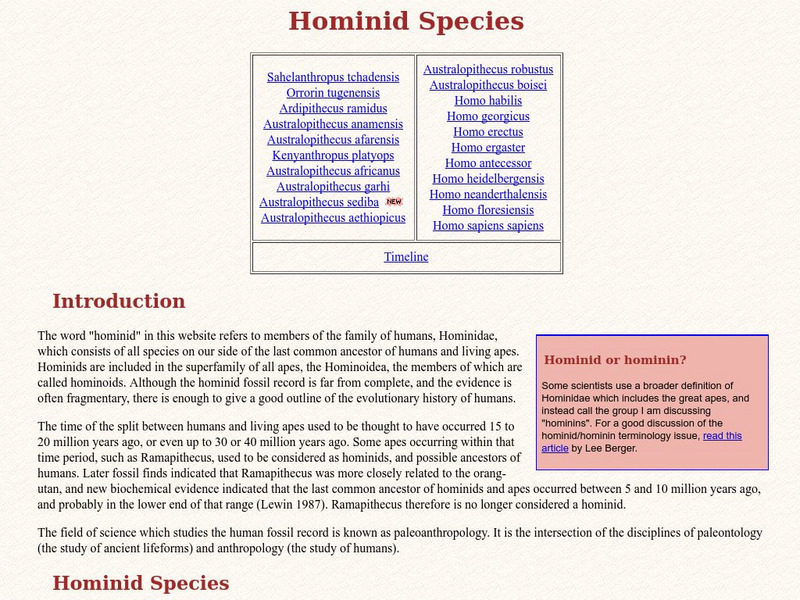
Talk Origins: The Hominid Species
Talk Origins gives a broad description of the types of Hominid species, and then gives a description of each species. Includes the specific characteristics of each, and explains the differences between the species.