Hi, what do you want to do?






EngageNY
TASC Transition Curriculum: Workshop 8
Lights, camera, action! Math educators consider how to improve their instruction by examining a model of the five-practice problem-solving model involving a movie theater. Participants examine cognitive demand in relation to problem...

EngageNY
TASC Transition Curriculum: Workshop 15
What do a cheetah, Audi commercial, and air have in common? They're all topics of an engaging inquiry-based, hands-on workshop for educators about background knowledge, reading strategies, the CER model, and argumentative writing. The...

New York State Education Department
TASC Transition Curriculum: Workshop 11
You'll C-E-R a difference in classroom achievement after using a helpful lesson. Designed for economics, civics, government, and US history classes, participants practice using the CER model to craft arguments about primary and secondary...

EngageNY
TASC Transition Curriculum: Workshop 6
Is a college education necessary for success in today's world? The class investigates the question, along with others at the end of the sixth workshop in a 15-part series. The instructional activity has four parts with multiple...

New York State Education Department
TASC Transition Curriculum: Workshop 10
How have educational standards evolved? Educators of adults examine expectations in the 10th workshop out of 15 to better determine how standards have grown. Participants respond to a variety of sample questions to determine how they...

New York State Education Department
TASC Transition Curriculum: Workshop 5
Are video games sports? Pupils investigate this question as well as various nonfiction selections to learn more about claims and the support that defines them. All of the selections mimic the rigor on state tests and encourage close...

New York State Education Department
TASC Transition Curriculum: Workshop 4
Why is it important to use precise language? Participants explore this question in the fourth activity in a series of 15 on effective instruction. Perfect for all content areas, the activity promotes appropriate language choice through...

EngageNY
TASC Transition Curriculum: Workshop 12
How can opinions slant facts? Workshop participants learn how to examine primary and secondary sources and identify the author's point of view. They also examine how visual art impacts the meaning and rhetoric of sources. Full of...
TES Global
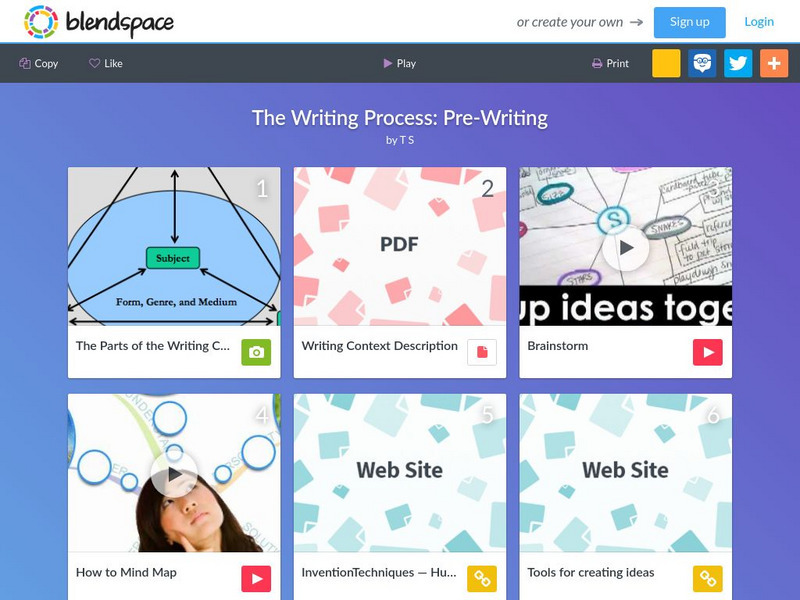
Blendspace: The Writing Process: Pre Writing
A six-part learning module with images, videos, and web links to teach different pre-writing strategies.

Joe Landsberger
Organizing and Pre Writing: Seven Stages of Writing Assignments
This research-based site provides step-by-step directions needed to complete an extended writing piece.
Reading Rockets
Reading Rockets: Looking at Writing: Pre K
In this section, you'll find writing assessment resources, writing strategies, and additional tip sheets for teachers and parents on how to help preschoolers build strong writing skills. You'll also find a video modeling classroom...
ReadWriteThink
Read Write Think: Can You Convince Me?: Developing Persuasive Writing
This effective tool for teaching persuasive writing contains thorough lesson plans which encourage students to take a stance and create arguments to support their position. Contains printable worksheets, rubrics, a PowerPoint...
ReadWriteThink
Read Write Think: Collaborative Prewriting and Drafting
A very useful lesson that incorporates the process of collaboration to elementary students. Students brainstorm and use prewriting strategies to write a group story.
ReadWriteThink
Read Write Think: Using Thieves to Preview Nonfiction Texts
Contains plans for three lessons that introduce a nonfiction prereading strategy with the acronym THIEVES, which stands for Title, Headings, Introduction, Every first sentence, Visuals and vocabulary, End Questions, and Summary. In...
AdLit
Ad lit.org: Teaching Writing to Diverse Student Populations
Writing is a complex operation requiring knowledge of text structure, syntax, vocabulary, and topic, and sensitivity to audience needs; so it is not surprising that many teens find writing challenging. This article identifies the...
Other
Ncrel: Reading Strategies: Before, During, and After [Pdf]
This page provides a detailed chart to aid students' understanding of texts. It goes through the steps of pre-reading, during reading, and after reading, outlining what students should be thinking about as they interact with a text. This...
AdLit
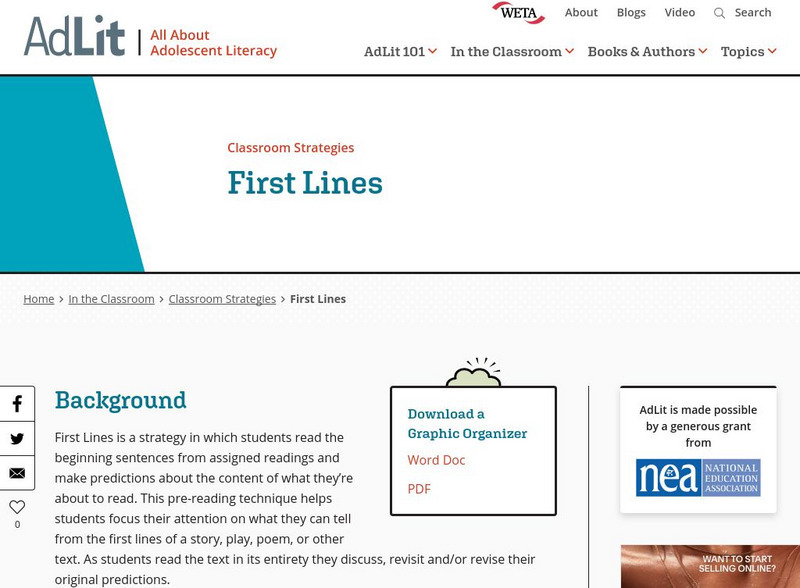
Ad lit.org: Classroom Strategies: First Lines
First Lines is a strategy in which students read the beginning sentences from assigned readings and make predictions about the content of what they're about to read. This pre-reading technique helps students focus their attention on what...
Free Reading
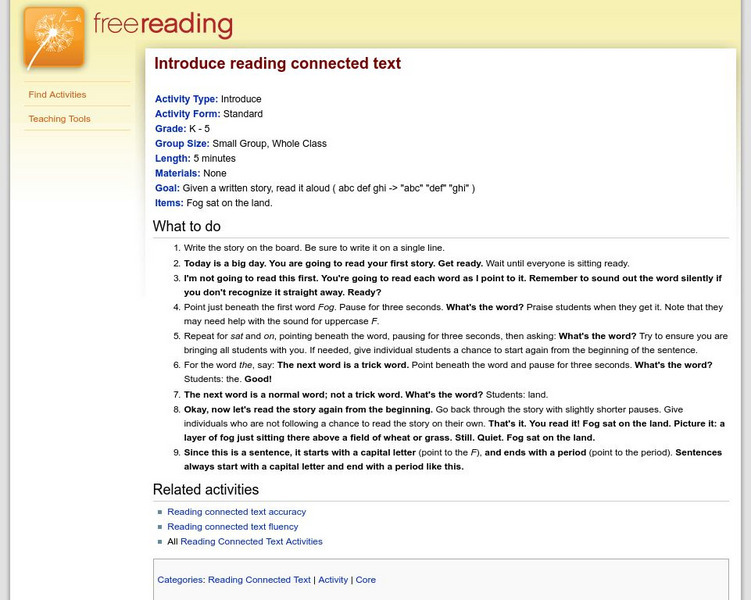
Free Reading: Amplify Education, Inc.: Introduce Reading Connected Text
An exciting introduction to reading! The instructor writes a simple, one-line story on the board from literature, and the learners learn to sound out the words.
ReadWriteThink
Read Write Think: Exploring How Section Headings Support Understanding
Teaching students to pay attention to headings and titles as they read? Here you'll find a practical application for using an expository text to apply the concept of using headings. Geared toward older elementary students, but lesson...
Utah Education Network
Uen: Safety Safari
Second graders will engage in nonfiction reading and writing strategies that will help them describe and adopt safe and healthy behaviors. An anticipation guide, a song, and several high-interest trade books will engage the the readers...