Hi, what do you want to do?






New York State Education Department
TASC Transition Curriculum: Workshop 11
You'll C-E-R a difference in classroom achievement after using a helpful activity. Designed for economics, civics, government, and US history classes, participants practice using the CER model to craft arguments about primary and...

New York State Education Department
TASC Transition Curriculum: Workshop 5
Are video games sports? Pupils investigate this question as well as various nonfiction selections to learn more about claims and the support that defines them. All of the selections mimic the rigor on state tests and encourage close...

EngageNY
TASC Transition Curriculum: Workshop 15
What do a cheetah, Audi commercial, and air have in common? They're all topics of an engaging inquiry-based, hands-on workshop for educators about background knowledge, reading strategies, the CER model, and argumentative writing. The...

EngageNY
TASC Transition Curriculum: Workshop 6
Is a college education necessary for success in today's world? The class investigates the question, along with others at the end of the sixth workshop in a 15-part series. The lesson has four parts with multiple activities and...

New York State Education Department
TASC Transition Curriculum: Workshop 7
Designed specifically for math instructors, the seventh workshop of a 15-part series allows time to explore Webb's DOK, ponder open-ended questions, and create lessons to apply what is learned. Teachers craft high-quality math problems...

EngageNY
TASC Transition Curriculum: Workshop 8
Lights, camera, action! Math educators consider how to improve their instruction by examining a model of the five-practice problem-solving model involving a movie theater. Participants examine cognitive demand in relation to problem...

American Psychological Association
Sexual Orientation and Youth
A 24-page manual provides principals, educators, and other school personnel with factual information about sexual orientation development, important legal principles they must consider, and problematic efforts to change sexual...

EngageNY
TASC Transition Curriculum: Workshop 12
How can opinions slant facts? Workshop participants learn how to examine primary and secondary sources and identify the author's point of view. They also examine how visual art impacts the meaning and rhetoric of sources. Full of...

College Board
AP® Psychology: Teaching Statistics and Research Methodology
Psychologists use statistics? Scholars investigate the research behind the methodology of statistical analysis. Using hands-on practice, case-studies, and scatterplots, they complete various tasks to understand the very roots of high...

American Psychological Association
Developing Adolescents
Why to young people act the way they do? Scholars investigate the stages of adolescent development incorporating high school psychology techniques. Using research from the American Psychological Association, they uncover the five areas...
Texas Education Agency
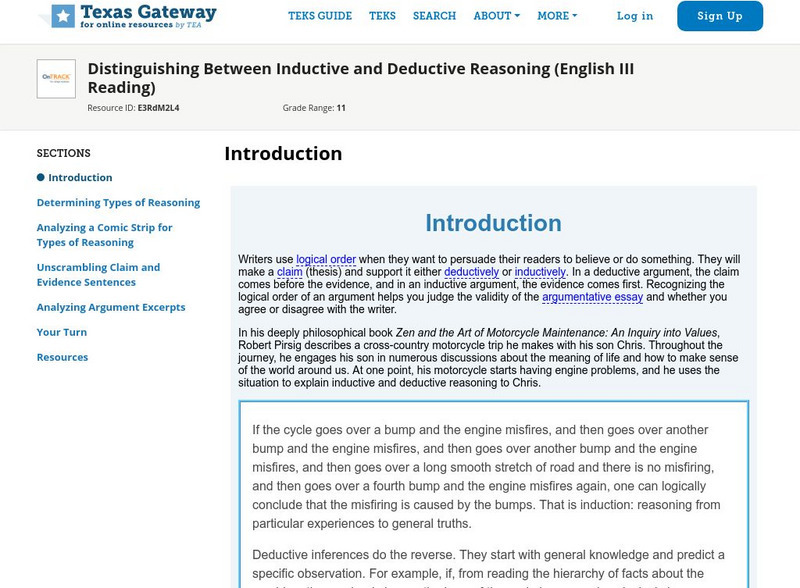
Texas Gateway: Distinguishing Between Inductive and Deductive Reasoning
This lesson focuses on distinguishing between inductive and deductive reasoning. Sometimes it's difficult to separate these two types of reasoning because we often use them together; drawing conclusions in inductive reasoning is likely...
Texas Education Agency
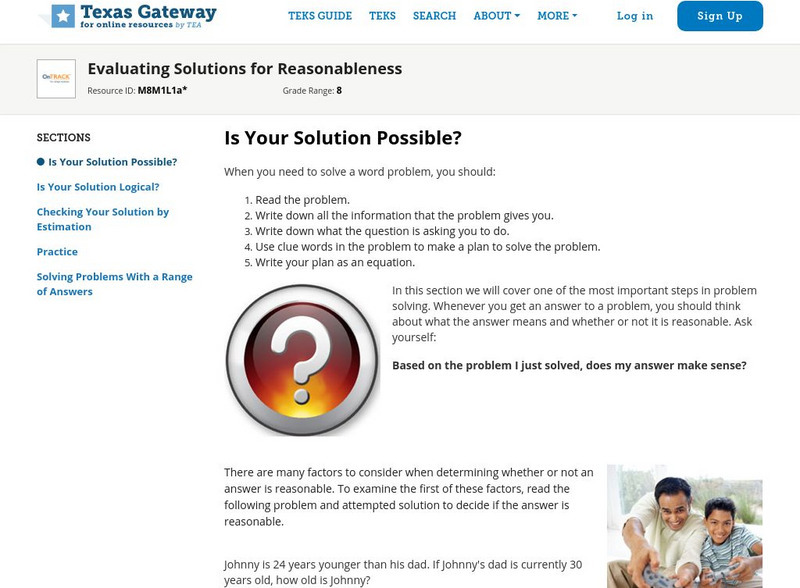
Texas Gateway: Evaluating Solutions for Reasonableness
Given problem situations, the student will determine if the solutions are reasonable.
Other
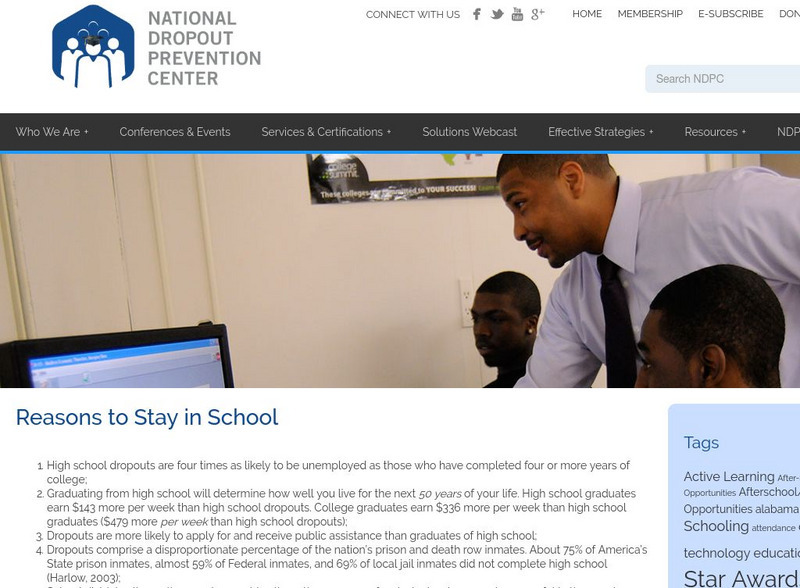
Dropout Prevention: Reasons to Stay in School
This list explains the top five reasons that staying in school can provide many advantages in life.

PBS
Pbs Learning Media: Teaching Tips: Deductive and Inductive Reasoning (1St Grade)
Use these teaching tips from the PBS Kids Lab to help children make sense of problems and persevere in solving them, determine the unknown whole number in an addition or subtraction equations, use addition and subtraction within 20 to...
University of Groningen
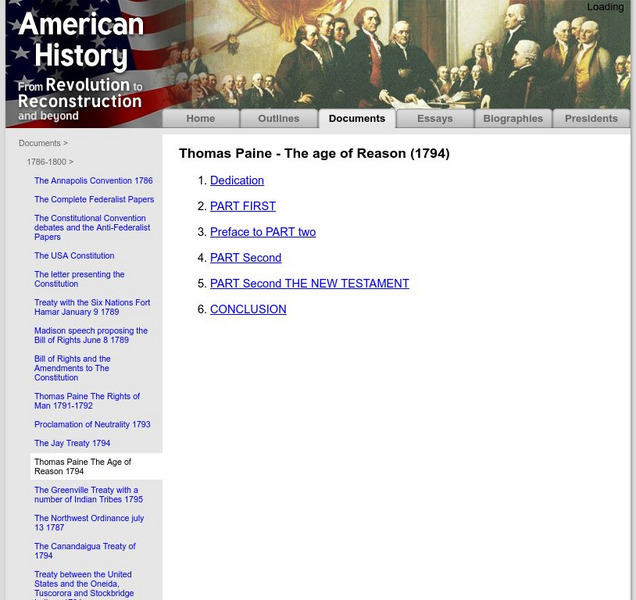
American History: Documents: Thomas Paine the Age of Reason (1794)
Presented is the complete text of Thomas Paine's The Age of Reason written in 1794.
PBS
Pbs Learning Media: Reasons to Write
This video segment from Between the Lions features a motivating, kid-friendly song that celebrates the reasons to write in everyday life.
Independence Hall Association
U.s. History: Age of Reason by Thomas Paine
The original text of Thomas Paine's work,"Age of Reason," written in 1794, describing the principles of enlightened government and society.
Texas Education Agency
Texas Gateway: Using Logical Reasoning to Prove Conjectures About Quadrilaterals
Given conjectures about quadrilaterals, the student will use deductive reasoning and counter examples to prove or disprove the conjectures.
Texas Education Agency
Texas Gateway: Using Logical Reasoning to Prove Conjectures About Circles
Given conjectures about circles, the student will use deductive reasoning and counterexamples to prove or disprove the conjectures.

Texas Education Agency
Texas Gateway: Determining Reasonable Domains and Ranges (Verbal/graph)
Given a graph and/or verbal description of a situation (both continuous and discrete), the student will identify mathematical domains and ranges and determine reasonable domain and range values for the given situations.
Texas Education Agency
Texas Gateway: Determining Reasonableness of Solutions (System of Equations)
Given verbal descriptions of situations involving systems of linear equations, the student will determine the reasonableness of the solutions to the system of equations.

Other
U. Of Rhode Island: Media Education Lab: Document the Fair Use Reasoning Process
When using copyrighted materials as part of the creative production process, you can document your own (or your students') fair-use reasoning process using this Google form. It's a tool to strengthen your critical thinking and reasoning...
CK-12 Foundation
Ck 12: Geometry: Types of Reasoning Study Guide
[Free Registration/Login may be required to access all resource tools.] Reasoning is a fundamental part of geometric proofs. There are several types of reasoning, many of which we innately and naturally picked up. However, the different...
Science Struck
Science Struck: Examples of Deductive Reasoning
Learn what deductive reasoning is and look at examples of how to apply it.
Other popular searches
- Deductive Reasoning Puzzles
- Deductive Reasoning
- Inductive Reasoning
- Logical Reasoning
- Proportional Reasoning
- Reason for the Seasons
- Mathematical Reasoning
- Deductive Reasoning Math
- Thinking and Reasoning
- Thinking & Reasoning
- Inferential Reasoning
- Proportional Relationships