Hi, what do you want to do?






PBS
Pbs Learning Media: Centripetal Force: Roller Coaster Loops
This video segment explains centripetal force and illustrates how roller coasters rely on it to give you a thrilling ride. Includes background reading material and discussion questions. [4:40]
Science Buddies
Science Buddies: The Chills and Thrills of Roller Coaster Hills
Lots of people enjoy roller coasters, but not many understand why they feel the strange excitement they do when riding them. In this science fair project, you will build and use an accelerometer to figure out and measure gravity-induced...
Utah Education Network
Uen: Trb 3:4 Investigation 4 Roller Coaster Fun
Third graders will design and build a roller coaster to help understand gravity.
TeachEngineering
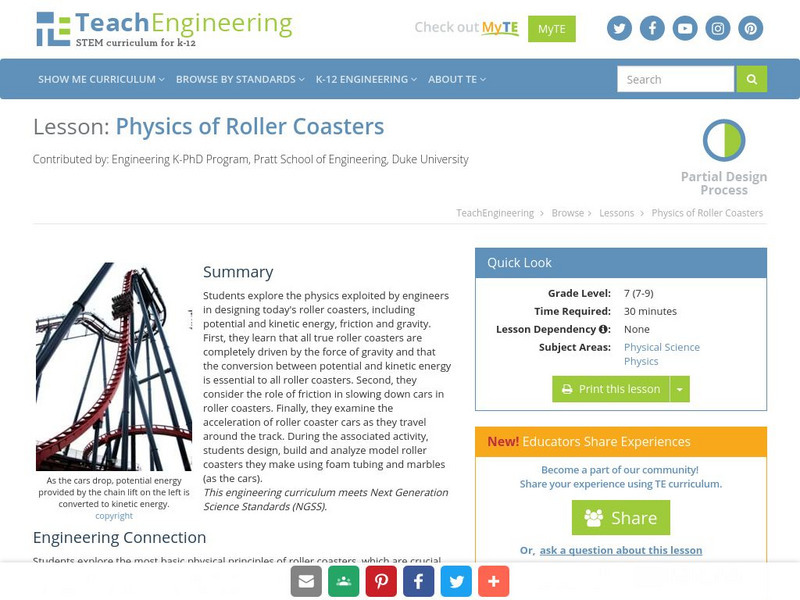
Teach Engineering: Physics of Roller Coasters
Students explore the physics utilized by engineers in designing today's roller coasters, including potential and kinetic energy, friction, and gravity. First, students learn that all true roller coasters are completely driven by the...
NC State University
The Engineering Place: Roller Coasters [Pdf]
A lesson where young scholars construct a roller coaster and test it under different conditions to learn about force and motion.
Physics Classroom
The Physics Classroom: Circular and Satellite Motion: Roller Coaster Model
An interactive playground for students to explore the physics of roller coasters. Learners investigate by changing the variables of force, velocity, friction, and vectors. Energy bar charts are displayed as the coaster car moves along...
Annenberg Foundation
Annenberg Learner: Amusement Park Physics: Roller Coaster
This interesting and interactive exhibit demonstrates how Newton's Laws of Motion impact the design and safety of roller coasters.
Physics Classroom
The Physics Classroom: Circular, Satellite, Rotational: Roller Coaster G Forces
Roller coaster rides are notorious for creating accelerations and g-forces. The magnitude and direction of normal force and gravity during the motion through a coaster's loop are depicted this animation.
Annenberg Foundation
Annenberg Learner: Amusement Park Physics: Roller Coaster
Learn about Newton's Laws of Physics, g-force, the causes of motion sickness, and more by reading about different rides at an amusement park.
TeachEngineering
Teach Engineering: Building Roller Coasters
In this hands-on activity students learn about the laws of physics by creating a marble roller coaster.
Science Buddies
Science Buddies: Centripetal Force
What keeps you in your seat of a giant loop-de-loop roller coaster? Surprisingly, it is not the seatbelt but the seat. It works because of something called centripetal force and it does much more than make a great roller coaster. In this...
Utah Education Network
Uen: Tubularastic Roller Coaster
Third graders will understand the effect of gravity on objects.
CK-12 Foundation
Ck 12 Exploration Series: Simulations: Physics: Loop the Loop
[Free Registration/Login Required] Learn about the centripetal motion in the context of a roller coaster going through a loop-the-loop and over a hill.
Physics Classroom
The Physics Classroom: Circular and Satellite Motion: Amusement Park Physics
In this interactive module, students explore the centripetal acceleration experienced by riders within the circular-shaped sections of a roller coaster track.
Curated OER
May the Force Be With You
Students explore the science behind thrill rides, including the physics of a roller coaster, human emotions, and physiological effects on the body. A related article is accessible through free registration.
TeachEngineering
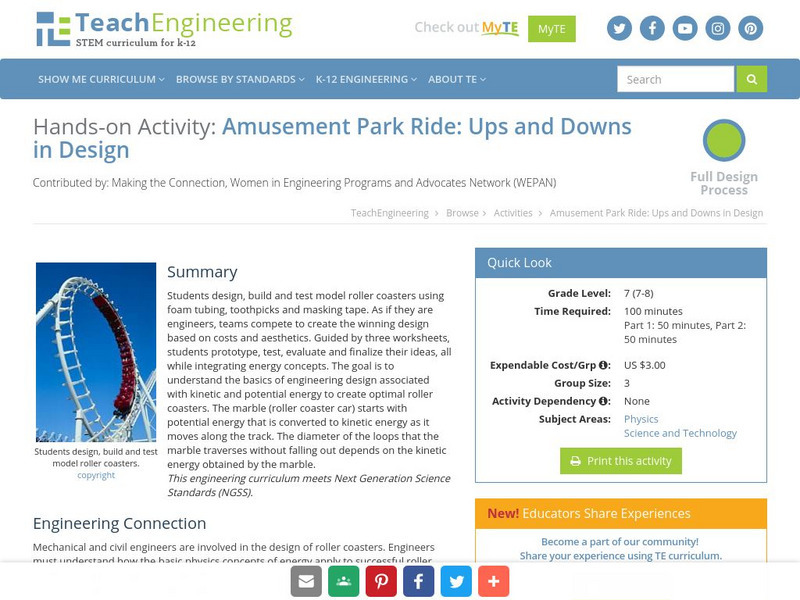
Teach Engineering: Amusement Park Ride: Ups and Downs in Design
This unit has students design and build foam tubing roller coasters. The design process integrates energy concepts as they test and evaluate their designs that address the task as an engineer would. The goal is for students to understand...
Physics Classroom
The Physics Classroom: Work, Energy, and Power: Mechanical Energy Is Conserved
In this interactive exercise, explore the quantitative relationship between work and mechanical energy in situations in which there are no external forces doing work.
TeachEngineering
Teach Engineering: Energy of Motion
By taking a look at the energy of motion all around us, students learn about the types of energy and their characteristics. They first learn about the two simplest forms of mechanical energy: kinetic and potential energy, as illustrated...