Hi, what do you want to do?






FuseSchool
Anaerobic Respiration in the Muscles
Ever wondered why feel all stiff the day after doing lots of exercise, in order for you to contract your muscles they need the energy that is released in respiration. However, when you're doing heavy exercise for a long time the muscles...
Curated Video
The History and Recipe of Chutney
Chutney is a combination of spices and fruits that can be served fresh or pickled. It began around 500 B.C.E in India and spread to Europe during British colonization of the Indian subcontinent. Learn how to make one kind of chutney and...
Professor Dave Explains
The Birth of Microbiology
As we have come to understand in this series, the most devastating diseases to ever plague mankind have been the cause of pathogenic organisms. Although strategies had been developed to combat some of these diseases, it was not until the...
Mazz Media
Cellular Respiration
In this live-action program viewers will learn that all living cells get the energy the need through a chemical reaction called respiration. Students will come to understand that cellular respiration is the metabolic process that breaks...
FuseSchool
Making Alcohols By Fermentation & From Ethane
Learn the basics about making alcohols by fermentation and from ethene, as part of organic chemistry.
Food Farmer Earth
Fermentation Revolution: Sandor Katz's Insights on Beer and Beyond
Sandor Katz discusses the widespread and historical significance of fermentation, addressing misconceptions about it being a mere trend. He emphasizes its fundamental role in human diets and its resurgence as part of a broader movement...
Professor Dave Explains
Anaerobic Respiration and Fermentation
We took a look at aerobic respiration in the biochemistry series, and we know that it requires molecular oxygen to occur. But there are other forms of energy production that do not require oxygen. Those are anaerobic respiration and...
Mazz Media
Cellular Respiration Process
In this live-action program viewers will learn that cellular respiration is the metabolic process that breaks down organic molecules to release energy for use by cells. Students will come to understand the process turns glucose from food...
Learning Mole
Microbes
This kitchen science video lesson is all about microbes. Some can make you sick, others keep you healthy. Students will love this engaging and interactive video as they learn about science they can do at home.
Journey to the Microcosmos
The Microbe You Eat All The Time
Yeast: the most coveted microbe during this pandemic. This week we’re taking a close look at the little guys that make up our bread and beer and the vital role they’ve had for thousands of years.

Crash Course
Micro-Biology: Crash Course History of Science #24
Robert Koch and his team of scientists identified the germs that cause diphtheria, typhoid, pneumonia, gonorrhea, meningitis, whooping cough, tetanus, plague, leprosy, syphilis, and more—that's some important work! Over a period of 100...

PBS
The Sweet Science of Chocolate
Mesoamericans discovered the cocoa tree more than 2,000 years ago, and chocolate has been popular ever since. The PBS video, part of a series on food science, iexamines cocoa trees, the history of the uses of cocoa, and how people make...

PBS
Secrets of Sourdough
What makes sourdough bread different from other types of bread? An installment of a PBS food science video series explains the science behind fermentation, yeast, bacteria, and their relationship with sourdough bread. It also discusses...

PBS
The Science and Art of Cheese
The United States produces more than a billion pounds of cheese every month. The video, part of the PBS food science series, explains the science of making cheese. It introduces cheese makers and their processes. In addition, it...

Deep Look
These Termites Turn Your House into a Palace of Poop
Everyone knows that termites are bad news for the wooden parts of a home. How do they do it, and how can we stop them? Go inside a termite (literally) to discover the scores of bacteria and protists that help make wood taste good. The...

Teacher's Pet
Cellular Respiration Steps and Pathways
Cellular respiration takes in food and creates energy in the form of ATP. The video explains both aerobic and anaerobic cellular respiration. Both types begin with glycolysis, which the resource concisely describes.

SciShow
Why Are There Bacteria In My Yogurt?
The process of making yogurt, starting with fresh cow milk, is the subject of a video that focuses on the importance of bacteria and the many different types of bacteria that can be used in yogurt making.

Crash Course
ATP and Respiration
The Krebs cycle is the focus of a video that shows how ATP, or adenosine triphosphate, is made by the body through the complex processes of glycolysis, the Krebs cycle, and the electron transport chain.

Bozeman Science
Anaerobic Respiration
Just when you thought you had a good grasp of aerobic respiration, in the presence of oxygen, you learn that respiration can occur without oxygen. What?! In the video, learners see how organisms, in the absence of oxygen, can survive...

Curated OER
Introduction to Cellular Respiration
See chemical formulas and notes written out on a Smart Board as cellular respiration is explained. The role of glucose and the process of glycolysis enter into the conversation, as well as the Kreb's cycle. This resource would work well...

Curated OER
In Praise of Yeast
The fungus yeast makes items like bread and beer delicious! See how yeast reproduces and hear what is happening chemically. Use this clip in your introductory college biology classroom.

Khan Academy
Khan Academy: Lactic Acid Fermentation
Video lecture presents an overview of lactic acid fermentation and how organisms like lactobacillus convert pyruvic acid to lactic acid and oxidize NADH to NAD+ in the process. [11:21]
Khan Academy
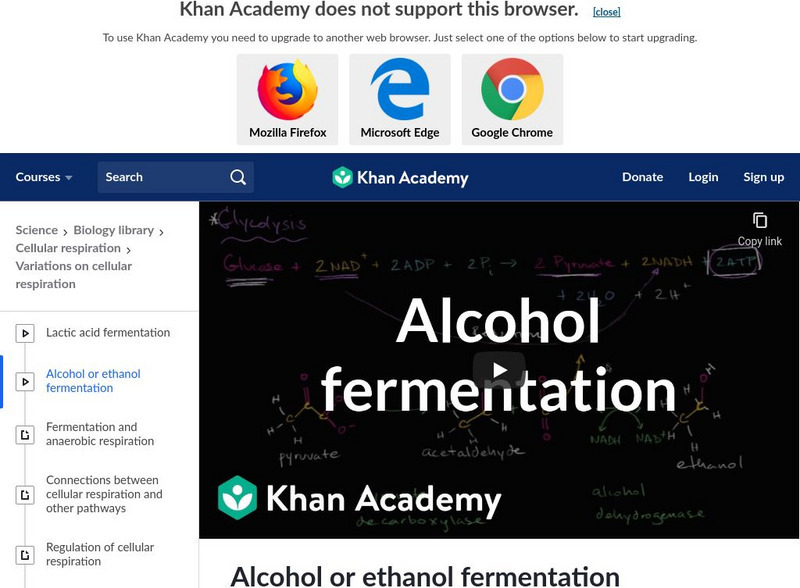
Khan Academy: Alcohol or Ethanol Fermentation
Video tutorial discusses the process of alcohol or ethanol fermentation, including yeast and its role in bread and wine production. [6:22]

Khan Academy
Khan Academy: Biology: Introduction to Cellular Respiration
The conversion of energy into ATP and then into waste. [14:19]