Hi, what do you want to do?






Curated Video
Conventions of English
Conventions of English demonstrates how to use conventions of English by writing sentences using correct spelling, capitalization, and punctuation.

Ereading Worksheets
Interjections | Parts of Speech App
Discover what an interjection is, and how to use it in a sentence, with a video that provides a detailed definition, captivating examples, an interactive pop quiz, and a review to check for understanding.

Ereading Worksheets
Subordinating Conjunctions | Parts of Speech App
Get an in depth look into subordinating conjunctions with a video that thoroughly explains and demonstrates what they are and how to use them in a sentence. Following instruction, an interactive pop quiz and review is available to check...

Scratch Garden
The Sentence Song ♫♪♫ | Scratch Garden
A laid back beat and silly animation makes a music video about sentence structure a hit among young learners. Find out what a capital letter is and when we use them, as well as end punctuation; the period, exclamation point, and question...
Sophia Learning
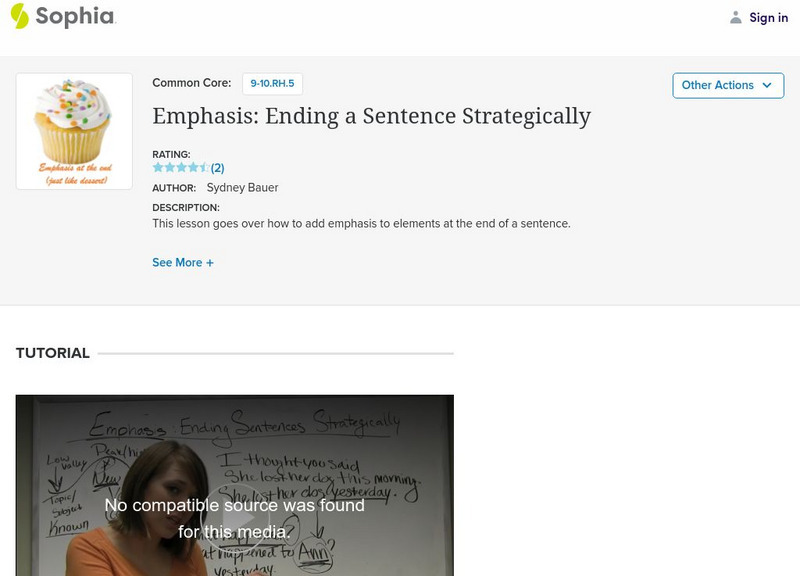
Sophia: Emphasis: Ending a Sentence Strategically
This video lesson focuses on creating emphasis by placing main idea at the end of the sentence. It offers two strategies to create emphasis: trimming excess words from the end of sentences and putting the main ideas in main clauses at...
Khan Academy
Khan Academy: What Is a Sentence?
A video [4:33] explaining that a sentences is a grammatically correct idea with a subject and a verb.
Sophia Learning
Sophia: Emphasis: Framing
A video lesson explaining how to use sentence framing to emphasize a specific sentence or idea. [3:46]
Yossarian the Grammarian
Comma Splices, Independent Clauses, and Subordinate Clauses
This video lesson from Yossarian the Grammarian explains how to avoid comma splices when working with independent and subordinate clauses. [6:42]

Khan Academy
Khan Academy: What Is a Sentence?
A sentence is a grammatically complete idea. All sentences have a noun or pronoun component called the subject, and a verb part called the predicate. David and Paige explore this division across several different example sentences.

Khan Academy
Khan Academy: Writing: Within Sentence Punctuation Basic Example
In this video [1:33] watch Sal work through a basic within-sentence punctuation question from the SAT Writing and Language Test.

Khan Academy
Khan Academy: Writing: Within Sentence Punctuation Harder Example 1
In this video [2:16] watch Dave and David work through a harder within-sentence punctuation question from the SAT Writing and Language Test.

Khan Academy
Khan Academy: Writing: Within Sentence Punctuation Harder Example 2
In this video [2:04] watch Sal work through another harder within-sentence punctuation question from the SAT Writing and Language Test.

Khan Academy
Khan Academy: Writing: Syntax Harder Example
In this video [3:02] watch David work through an SAT Writing: Syntax question.

Imagine Learning Classroom
Learn Zillion: Use Prepositional Phrases to Expand Sentences
Writers add prepositional phrases to add details to their sentences. Let's expand our sentences by adding prepositional phrases. [7:52]

Imagine Learning Classroom
Learn Zillion: Recognize Sentence Fragments and Produce Complete Sentences
Writers produce complete sentences, recognizing and correcting sentence fragments. Let's practice making sure each of our sentences has a subject and a predicate. [9:49]
Sophia Learning
Sophia: Correcting Run on Sentences and Comma Splices: Lesson 2
This lesson goes over how to correct a run-on sentence or a comma splice. It is 2 of 3 in the series titled "Correcting Run-on Sentences and Comma Splices."
Sophia Learning
Sophia: Correcting Run on Sentences and Comma Splices: Lesson 1
This lesson goes over how to correct a run-on sentence or a comma splice. It is 1 of 3 in the series titled "Correcting Run-on Sentences and Comma Splices."

Sophia Learning
Sophia: Restrictive and Non Restrictive Elements
This lesson introduces restrictive elements and non-restrictive elements and the appropriate punctuation. [6:46]