Hi, what do you want to do?






Bozeman Science
Natural Ecosystem Change
In this video Paul Andersen explains how the Earth's climate will natural change due to interactions between the Sun and Earth, volcanism, and plate tectonics. Species may go extinct leading to adaptive radiation or may move to a...
Bozeman Science
Biogeochemical Cycles
In this video Paul Andersen explains how biogeochemical cycles move required nutrients through the abiotic and biotic spheres on our planet. Matter on the Earth is conserved so producers must receive required nutrients through the water...
Crash Course
What Are Ecosystems? Crash Course Geography
Today we're going to take a closer look at ecosystems -- which are communities of living organisms in an area interacting with their environment -- and how this relationship between the amount of energy a place receives and the movement...

Bozeman Science
Biogeochemical Cycling
A woman had a job crushing cans at the recycling plant; it was soda pressing. Video focuses on the ways our environment recycles, including the water cycle, carbon cycle, nitrogen cycle, and the phosphorus cycle. It also describes the...

Crash Course
The Hydrologic and Carbon Cycles: Always Recycle!
Introduce biogeochemical cycles and goes into detail about the hydrologic and carbon cycles. A scientific video engages learners and teaches them at the same time.

PBS
Pbs Learning Media: Cave Formation: Kane Cave
This video segment adapted from NOVA describes a simple experiment that confirmed the idea that microbes can accelerate the biogeochemical process of cave formation. [4:12]
Howard Hughes Medical Institute
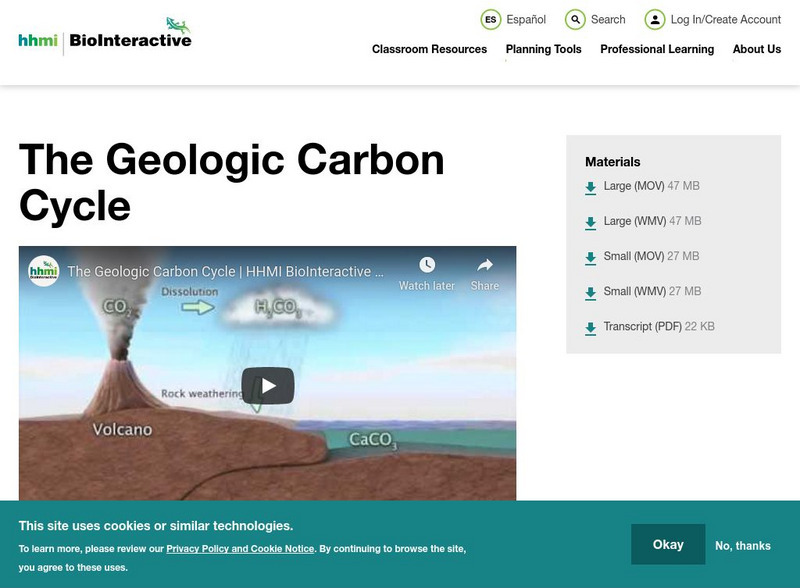
Hhmi: Biointeractive: The Geologic Carbon Cycle
A college-level video lecture explaining and discussing the carbon cycle. Gives an interesting perspective on the chemistry of the carbon cycle and how essential it is to the survival of life on Earth. [6:20]
PBS
Pbs Learning Media: Crash Course Ecology: The Hydrologic and Carbon Cycles: Always Recycle!
Hank introduces us to biogeochemical cycles by describing his two favorites: carbon and water. The hydrologic cycle describes how water moves on, above, and below the surface of the Earth, driven by energy supplied by the sun and wind....
PBS
Pbs Learning Media: Crash Course Ecology: Nitrogen & Phosphorus Cycles: Always Recycle! Part 2
Hank describes the desperate need many organisms have for nutrients (specifically nitrogen and phosphorus) and how they go about getting them via the nitrogen and phosphorus cycles. [9:21]
Bozeman Science
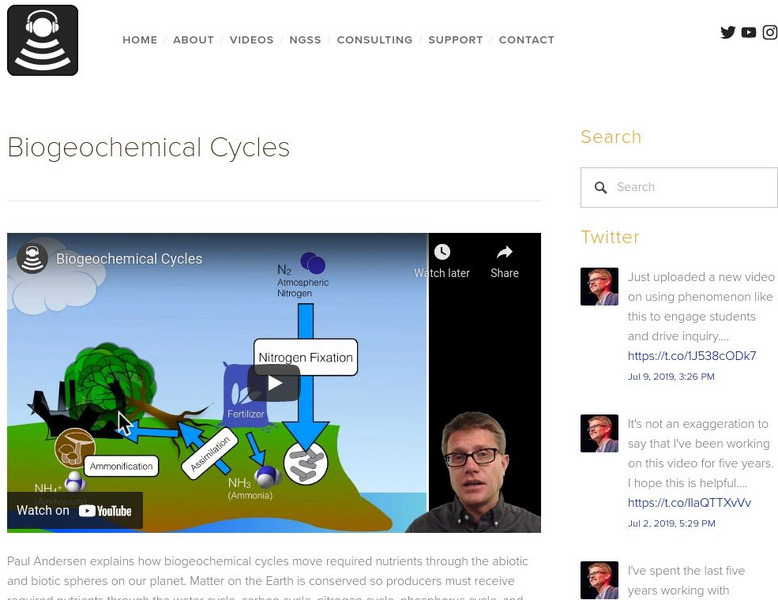
Bozeman Science: Biogeochemical Cycles
Paul Andersen explains how biogeochemical cycles move required nutrients through the abiotic and biotic spheres on our planet. Matter on the Earth is conserved so producers must receive required nutrients through the water cycle, carbon...
Crash Course
Crash Course: Ecology #8: The Hydrologic and Carbon Cycles: Always Recycle!
Hank introduces us to biogeochemical cycles by describing his two favorites: carbon and water. The hydrologic cycle describes how water moves on, above, and below the surface of the Earth, driven by energy supplied by the sun and wind....
Crash Course
Crash Course Ecology #9: Nitrogen & Phosphorus Cycles: Always Recycle Part 2
Hank describes the desperate need many organisms have for nutrients (specifically nitrogen and phosphorus) and how they go about getting them via the nitrogen and phosphorus cycles. [9:23]