Hi, what do you want to do?






Curated OER
Human Rights Violations
Students explore how human rights are different in each part of the world. In this freedome activity, students define human rights, research how human rights in one country ultimately affect other countries, and share their...

Curated OER
Identifying Continents and Oceans
Students locate and identify the four major oceans and the seven continents on a world map. They use an unlabeled world map and compass rose to describe relative locations of the continents and oceans.

Curated OER
Plants and Animals: Partners in Pollination
Learners identify the plant parts and bee structures that are involved in pollination. They simulate pollination in a group activity and process the information.

Curated OER
Children in the United States and Japan
Students locate Japan on a map or globe and describe the relative location of Japan. They use the Internet to investigate cultural characteristics of children in the United States and in Japan. They use a Venn Diagram as an...

Curated OER
Haiku
Students study various forms of poetry and the culture of Japan. They are introduced to a haiku- a traditional form of poetry and an art form in the Japanese culture. They write a haiku and create a student haiku booklet with the classes...

Curated OER
Island Countries
Students define the meaning of an island. In this island mapping lesson, students identify islands on the map. Students discuss the sizes of various islands.

Curated OER
Japan and Art
Students discuss the art of Japan as it relates to Japanese culture and geography and then create individual postcards reflecting the information learned from the lesson plan. This lesson plan includes possible enrichments.

Curated OER
Baga Drum
Students examine a Baga Drum in order to explore the history of the Baga people of West Africa. In this art history lesson, students recognize figures used in Baga Drum design that represent aspects of Baga culture. They also design and...

Curated OER
Spy on a Spider
Students view slides or live specimens to name and describe the distinguishing features of groups of arthropods, especially spiders and insects. They complete worksheets, observe webs and then search for and record where spiders can be...

Curated OER
Creatures from Planet X: Spiders
Young scholars are given a description of some fascinating animals from "Planet X". They follow the descriptions given to illustrate one of these animals paying careful attention to introduced vocabulary such as 'appendages',...

Curated OER
Facts, Feats and Folklore: Spiders
Students review and discuss a variety of sayings, folklore and superstitions about spiders. They discuss this information and choose either an interesting fact or appealing foklore tradition to illustrate.

Curated OER
Veni, Vidi, Vici
Students participate in a Roman festival to complete a unit on Roman Civilization. In this Roman Civilization lesson plan, students learn about Cleopatra, Julius Caesar, the Mediterranean Region, and more. Students share what they...

Curated OER
Equator, North Pole, and South Pole
Students identify the Equator, North Pole, and South Pole on the globe. In this map skills instructional activity, students use a globe marker to locate specific locations on the globe. Students find where they live in relation to the...

Curated OER
Around the World
Students discuss the major geographical and cultural differences in the world. In this social science lesson plan, students pretend they are traveling and research information about where they wish to stay by finding information about...

Curated OER
Plants and Animals: Partners in Pollination
Students describe the complementary relationships between pollinators and the plants they pollinate, identify adaptations that flowers have developed to "encourage" pollination, and create and draw their own "designer" flowers.

Curated OER
Where In the World Am I?
Learners identify their location in the world after studying latitude, longitude, relative location, and absolute location. They use assigned web site to find information to make a flipbook that answers questions about their location in...

Curated OER
Minerals, Crystals, and Gems
Students discover the relationships between minerals, crystals and gems. They bring in rocks that they find at home, in the schoolyard, etc. and examine them and attempt to identify them. They set up a classroom exhibit that includes all...

Curated OER
History Close to Home: Creating Your Own Special Museum
Students create their own museum exhibit. In this museum creation lesson plan, students research their local history so they can decide on a theme for their exhibit and what objects they will use in order to design a museum exhibit. A...

Curated OER
Art to Zoo: Celebration
Students research and develop a report on birthday rituals around the world. In this research lesson plan, students compare birthday rituals from other cultures to their own. Images and resources are included.

Curated OER
Animal Encounters
Pupils use their visualizing and interpreting skills to produce original writings and artwork.

Ducksters
Ducksters: Geography Games: Capital Cities of Asia
Play this fun geography map game to learn about the capital cites of the countries of Asia.
Digital Dialects
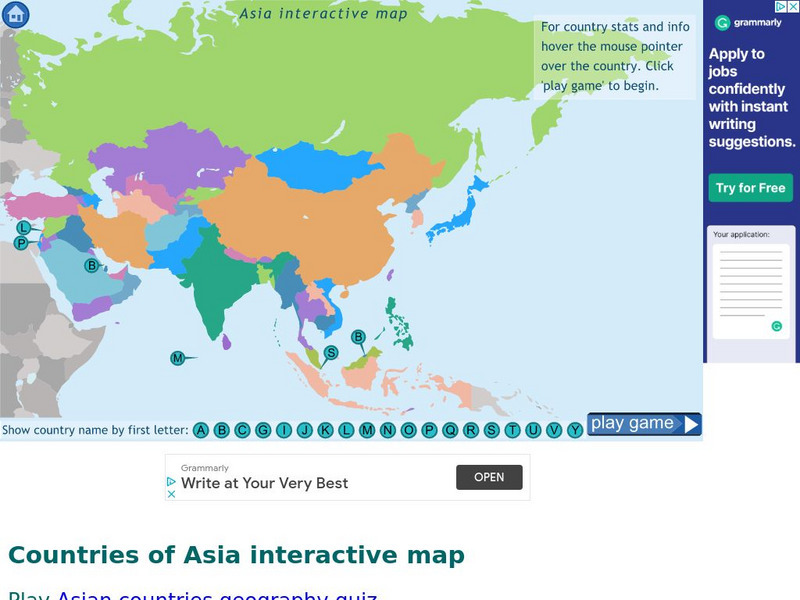
Digital Dialects: Geography Games: Countries of Asia
Study a map showing the countries in Asia, and then try to match their names to their locations on a blank map.

Ducksters
Ducksters: Geography Games: Flags of Asia
Play this fun geography map game to learn about the flags of the countries of Asia.

Ducksters
Ducksters: Geography for Kids: Asian Countries and the Continent of Asia
Learn about the geography and the countries of Asia. Facts such as flags, maps, exports, natural resouces, people, languages.