Hi, what do you want to do?






Curated OER
SNACK TIME
Students explore writing sequential information by composing the simple recipe of peanut buttera and jelly sandwiches.

Curated OER
Time Line Of Chinese And Japanese Art
Students create individual time lines placing various works of Asian art into chronological order. The information gathered is used to create one class time line for display.

Curated OER
Ozone Pollution: Smog Alert
Students explain ozone pollution and make them aware of how it is formed. They simulate the development of smog and infer how it occurs in nature.

Curated OER
Stretch to the Math Tables
Students count by multiples while performing stretches or exercises. They listen to music and skip count by a given multiple. The rhythm of the music as well as the repitition assists them in their memorization of multiplication facts.

Florida Center for Reading Research
Comprehension: Narrative Text Structure, Story Pieces
An activity boosts reading comprehension by challenging scholars to answer questions about a narrative tale detailing elements—plot, characters, setting, theme, problem, and solution.

Curated OER
Summing the Disaster
Students assume the role of a newspaper editor during the time of the Titanic disaster. They must search out the accurate answers to the questions: What? When? Where? Who? and Why? students then write their own newspaper article...

Curated OER
All About Me Museum
Learners investigate the concept of self-esteem and image with the creation of a personal display of items of significance. They put together a project composed of pictures and writings to describe themselves and are assessed according...

Curated OER
Why Can't I Vote?
Fourth graders take an unannounced test (failure is expected) and the top scores are rewarded with candy bars. They compare this test to the literacy tests given before 1960 and votes to candybars. They journal their responses.

Pennsylvania Department of Education
Informational Writing: Lesson 2 of 5
Introduce expository writing to your elementary learners. Young authors write a three-paragraph informational paper using the steps of the writing process. They follow guided lessons to experience each of five steps. Included are tons of...

Curated OER
Pop Up Fables
Students read a fable and create a pop-up book of the fable. Students add the moral of the story to the back of the book.

Alabama Learning Exchange
Landforms Acrostic Poetry
Fourth graders apply scientific information about various landforms. They use the information to write and word process acrostic poems which they illustrate with clip art or pictures from magazines.


Curated OER
President's Day: George Washington
Students celebrate President's Day by studying George Washingtion, the US flag, and the American colonies. They sing, Yankee Doodle Dandy.

Curated OER
Elaborate It
Students read writing samples and discuss the differences between the writing with and without anecdotal examples. They write expository essays that include personal anecdotes.

Curated OER
Weather/Climate
Students examine traditional Native American weather/climate knowledge. They keep a weather journal and research cloud cover.

Curated OER
Frog Metamorphosis
Students play 20 Questions with animal characteristics and then view an animation of how a tadpole changes into a frog. They consider the importance of camouflage to frogs and write out the story of a frog from tadpole to adult.

Curated OER
Ecology Explorers: Historical Air Photo Interpretation
Students identify and analyze land use changes over time with historic aerial photographs, and classify different land use into categories.

Curated OER
The World (With an emphasis on the United States)
Fourth graders recognize the different continents. They are introduced to longitude and latitude and how to find locations using these measurements. This series ends with an emphasis on the fifty states of the United States and their...

Curated OER
You Mean I Am Part of History?
Fourth graders open the lines of communication between family members and to gain a historical understanding about family history. They research and interview their grandparents and parents and create a research paper.
Quia
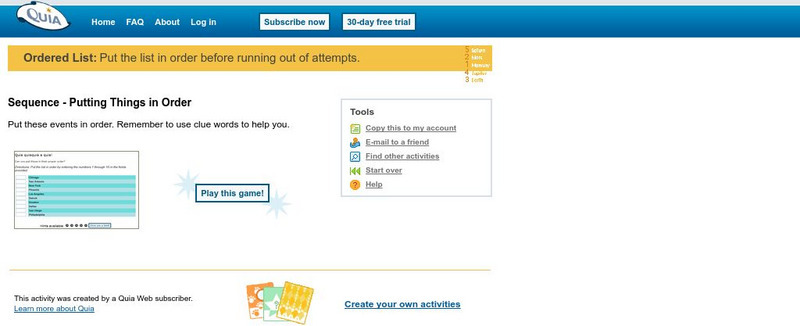
Quia: Sequence: Putting Things in Order
Using clue words, students are asked to number a list of events in order from 1-10 and then check answers. Students have up to three attempts to solve.
ReadWriteThink
Read Write Think: Sequencing a Strategy to Succeed at Reading Comprehension
Contains plans for lessons that use the story of Paul Bunyan to teach about sequencing and order of events. In addition to objectives and standards, this instructional plan contains links to sites used in the lessons as well as...

Alabama Learning Exchange
Alex: Get Yourself in Order!
A lesson plan that requires students to act out a sequence of events in the form of improvisation. Students learn to improvise and identify the sequence of events in a dramatization.
Read Works
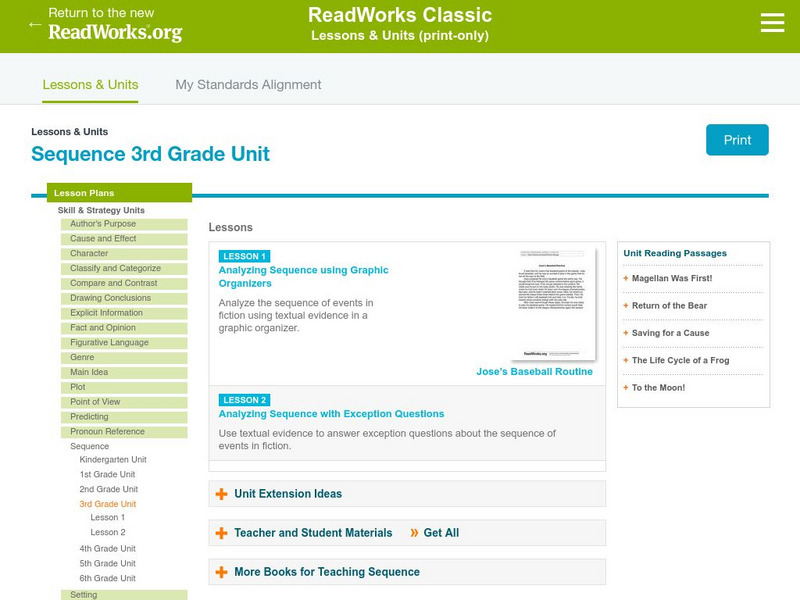
Read Works: Sequence 3rd Grade Unit
[Free Registration/Login Required] This website provides a series of two lesson plans designed to teach students to create a graphic organizer showing the sequence of events in a fiction text. The lessons include ideas for direct...
Quia
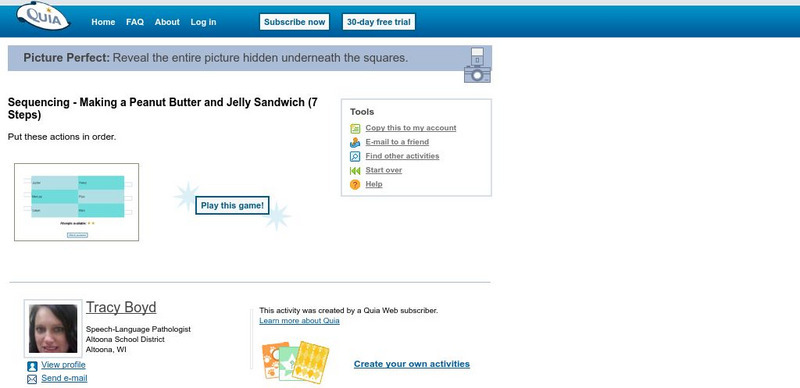
Quia: Sequencing Making a Peanut Butter and Jelly Sandwich (7 Steps)
Uncover the hidden picture by putting the steps in order to make a peanut butter and jelly sandwich in this sequencing game.