Hi, what do you want to do?






Curated OER
Human Rights Violations
Students explore how human rights are different in each part of the world. In this freedome lesson, students define human rights, research how human rights in one country ultimately affect other countries, and share their findings...

Curated OER
Making Cultural Connections
Young scholars explore cultures through storytelling. They read African folktales. Students discuss characteristics of folktales. They research and write a folktale that includes an animal. Additional cross curriculum activities are...

Curated OER
Where is the Water?
Pupils explore freshwater ecosystems. In this geography lesson, students brainstorm all the lakes and rivers they know then mark them on a map. Pupils will then mark all the major freshwater resources on each of the seven continents,...

Curated OER
Animals from Afar
Students visualize the scope of the Roman empire by illustrating the geographic origins of various imported animals. They study how exotic animals were imported into Rome from the farthest regions of the empire.

Curated OER
Students Become Mapmakers
Students practice making a map of a continent and correctly plotting five cities on that map. They place latitude and longitude lines on a map, determine the need for various map projections and explain why map scales are necessary.

Curated OER
Baga Drum
Students examine a Baga Drum in order to explore the history of the Baga people of West Africa. For this art history lesson, students recognize figures used in Baga Drum design that represent aspects of Baga culture. They also design and...

Curated OER
The Rocky Shore
Students compare a realistic landscape painting with a photograph of the same place.

Curated OER
How Things Fly
Pupils, by drawing on their own experiences, discuss and examine the basic physics of flight. They participate in a variety of activities regarding flight.

Curated OER
How Things Fly
Pupils observe photographs of selected twentieth-century aircraft at the National Air and Space Museum and note differences in the design of aircraft wings, fuselages, and engines.

Curated OER
Spy on a Spider
Young scholars view slides or live specimens to name and describe the distinguishing features of groups of arthropods, especially spiders and insects. They complete worksheets, observe webs and then search for and record where spiders...

Curated OER
Facts, Feats and Folklore: Spiders
Students review and discuss a variety of sayings, folklore and superstitions about spiders. They discuss this information and choose either an interesting fact or appealing foklore tradition to illustrate.

Curated OER
Creatures from Planet X: Spiders
Students are given a description of some fascinating animals from "Planet X". They follow the descriptions given to illustrate one of these animals paying careful attention to introduced vocabulary such as 'appendages', 'receptors', and...

Curated OER
Welcome to the Sahara Desert
Learners explore their artistic skills. In this Sahara Desert lesson, students use the Internet to research the Sahara and paint a watercolor picture depicting the desert.

Curated OER
The Roman Empire-Map Activity
In this Roman Empire learning exercise, students complete a map activity in which they label and color civilizations, countries and physical features as instructed. There are no maps included.

Curated OER
Create a Classroom Exhibit: Rocks and Minerals
Young scholars bring in rocks and minerals from home. They observe them and describe them carefully, completing a worksheet. Finally, a classroom exhibit is created.

Curated OER
Plants and Animals: Partners in Pollination
Students describe the complementary relationships between pollinators and the plants they pollinate, identify adaptations that flowers have developed to "encourage" pollination, and create and draw their own "designer" flowers.

Curated OER
Minerals, Crystals, and Gems
Students discover the relationships between minerals, crystals and gems. They bring in rocks that they find at home, in the schoolyard, etc. and examine them and attempt to identify them. They set up a classroom exhibit that includes all...

Curated OER
History Close to Home: Creating Your Own Special Museum
Students create their own museum exhibit. In this museum creation lesson plan, students research their local history so they can decide on a theme for their exhibit and what objects they will use in order to design a museum exhibit. A...

Curated OER
Animal Encounters
Young scholars use their visualizing and interpreting skills to produce original writings and artwork.
The History Cat
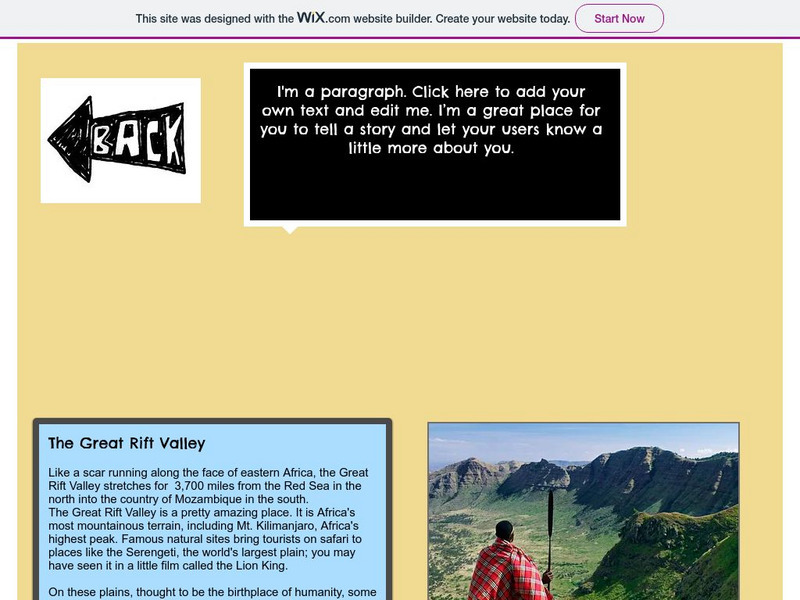
The History Cat: Geography: Places: Africa's Great Rift Valley
Describes the geography of the Great Rift Valley in Africa, how it was formed by tectonic plate separation, and the majestic lakes and falls that have been created by it.

The History Cat
The History Cat: Geography: Places: Africa's Serengeti
Discusses the wildlife of Africa and how many species are being threatened by poaching as well as by those who hunt them for food. Some countries try to protect their wildlife, recognizing that it is a rich natural resource that attracts...

The History Cat
The History Cat: Geography: People: San Bushmen of the Kalahari
Describes the way of life of the Bushmen or Khoi and the threats they face to their traditional way of life.
The History Cat
The History Cat: Geography: People: Taureg Nomads of the Sahara
Read about the characteristics of the Taureg, a nomadic people who inhabit the Sahara region. Their lifestyle is described and what they do to survive in the extreme heat of the desert.
Other
Kids World Travel Guide: Continent Facts
Provides interesting and fun facts on the continents of the world.