


PBS
Thermal Energy 101: Heat Transfer | UNC-TV Science
Discover what makes a cup of tea feel hot one minute and cold the next. Young physicists learn about thermal energy, why substances feel hot or cold, and the three means of thermal energy transfer: conduction, convection, and radiation...
PBS
Water Cycle and Watersheds: Ways of Watersheds | UNC-TV Science
Take a field trip with water as it moves on and below Earth's surface. Investigators discover the link between water and land in the water cycle and the importance of watersheds while viewing an animated video. Scholars test their...
PBS
Properties of Matter: Matter's Physical Properties | UNC-TV Science
Does gold really boil? Learn what temperature gold boils at and more using an animated activity about the properties of matter. Scientists learn about the properties of matter including examples of physical properties, the effect changes...
PBS
Phase Changes | Phases of Matter | UNC-TV Science
Take an energetic ride through the phase changes of a water molecule in a compact activity. Young scientists learn about the phases of matter and discover the role of thermal energy in governing phase changes while watching a short...

PBS
The 3 Phases | Phases of Matter | UNC-TV Science
Explore the states of matter without the mess or expensive equipment in a compact, informative activity. Scientists watch as the narrator explains the three states of matter using a glass of ice and soda in an animated video that...
PBS
Watershed Management: Ways of Watersheds | UNC-TV Science
Inspire young conservationists to protect the environment with a short activity on water quality and watersheds. Participants discover the importance of watershed management, learn about water quality problems, and discover possible...
PBS
The Water Cycle: Ways of Watersheds | UNC-TV
Explore water on Earth without getting wet using a short animated activity. Scientists learn how water interacts with the land, the importance of watersheds, and relevant vocabulary as they watch an informative and engaging video....

American Museum of Natural History
Beyond Planet Earth
Scholars take a journey through space with 16 eye-catching images. Along the way, learners read captions starting with the moon, then move onto asteroids, Mars, and Jupiter.

American Museum of Natural History
Journey to the Stars
Fifteen detailed pictures and informative captions delve deep into the exploration of stars—their life cycle and importance in the universe.

American Museum of Natural History
Make Your Own Marine Biology Stationary
Encourage letter writing with marine biology-themed stationary. Three versions showcase a variety of underwater creatures.
American Museum of Natural History
What Do You Know About the Human Microbiome?
Scholars answer 10 multiple choice questions to test their knowledge about the human body and microbes. Correct answers come with a rewarding tone and brief description.
American Museum of Natural History
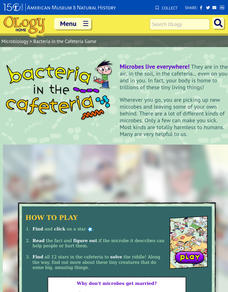
Bacteria in the Cafeteria
Scholars examine an animated picture to locate stars that, when chosen, provide a brief scenario, question, and answer. With each answer, a letter appears that later reveals a word.

American Museum of Natural History
Microbes Coloring Book and Scavenger Hunt
Coloring pages showcase microbes—bacteria, viruses, and protists. Scholars have the option to download a coloring book and scavenger hunt or color the page directly on the computer. Three paragraphs describe each microbe.

American Museum of Natural History
Are YOU Cut Out for Mars?
A brief, 6-question quiz identifies whether or not a scholar is ready for a mission to Mars.

American Museum of Natural History
A Kid's Guide to Stargazing
Get kids interested in stargazing with a step-by-step guide. The guide begins with the do's and don'ts, what the defines a star, and introduces a journal. The page is linked to see stars if light pollution keeps stars away in your area.

American Museum of Natural History
Being an Astronomer: Neil deGrasse Tyson
An interview delves deep into the life of famous astronomer Neil deGrasse Tyson.

American Museum of Natural History
Cosmic Cookies
Scholars read about each planet then bake a plate of cosmic cookies—no-bake cookies decorated to look like the planets; Mercury, Venus, Earth, Mars, Jupiter, Saturn, Uranus, Neptune, and Pluto.
PBS
Categorizing Matter | UNC-TV Science
Take the difficulty out of classifying matter with an easy-to-follow activity that makes distinguishing between pure substances and mixtures simple. Scholars explore how matter is grouped between two categories—pure substances and...
American Museum of Natural History
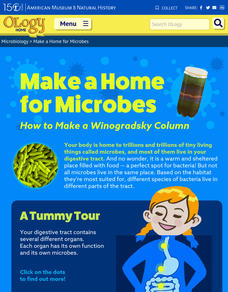
Make a Home for Microbes
Make a Winogradsky Column to discover how microbes live within the digestive tract. First, participants take a tour of the stomach. Then, gather supplies and start building using a variety of materials. Over eight to 10 weeks, learners...
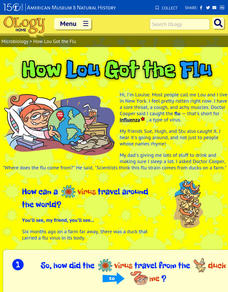
American Museum of Natural History
How Lou Got the Flu
Six questions probe participants to discover the possibility of catching a virus from others—even animals. Here, the influenza virus travels from duck to person in a round-about way. The quiz concludes with helpful tips to stay healthy.
PBS
Volume and Amplitude | UNC-TV Science
Future physicists pump up the volume while discovering the world of sound waves. Group members learn about the qualities of sound waves, the relationship between energy and sound volume, and the definition of amplitude while viewing an...

American Museum of Natural History
Make Your Own Weather Station
Scholars build a weather station equipped with a wind vane, rain gauge, and barometer. Following an informative page about the weather, learners follow steps to build their pieces then turn into meteorologists to chart the weather they...

American Museum of Natural History
Make a Terrarium
Scholars read a brief overview of what a terrarium is and how it creates the greenhouse effect, then click on a link to discover the materials and 10 steps they need to build their own.

American Museum of Natural History
T. Rex Roar Mixer
Scholars predict the sound of a tyrannosaurus rex roar with a mixing board equipped with audio from crocodiles, chickens, loon, macaw, peccary, sea lion, and bison.