Hi, what do you want to do?






Center for Learning in Action
Introduction to Matter
Begin your states of matter lessons with a demonstration designed to introduce the concept that all matter has properties. Reinforce this concept through vocabulary exploration, and the creation of atom models; salt, water, and carbon...

Center for Learning in Action
Introduction to the States of Matter
Liquids, gases, and solids are the states of matter in which scholars investigate in a lesson plan that offers in-depth information and engaging activities that look into the three states and the changes their properties make when mixed...

Center for Learning in Action
Challenge with Solids, Liquids, and Gases
There's a container for every matter—liquid, solid, and gas. Pupils design three different containers, each with the capability to hold one of the states of matter, and share their design with the class.

Center for Learning in Action
Investigating Physical and Chemical Changes
Super scientists visit ten stations to predict, observe, and draw conclusions about the physical and chemical changes that occur when different states of matter—liquid, solid, and gas—are placed under a variety of conditions. To...

Center for Learning in Action
Density
Explore the concept of density within states of matter—gases, liquids, and solids—through a group experiment in which young scientists test objects' texture, color, weight, size, and ability to sink or float.

Resources for Educators
Math & Science Connection
Whether you're using a collection of Dr. Seuss books to teach basic math skills like counting, adding, and subtracting, or exploring the different states of matter by melting a crayon with a hairdryer, a series...

Center for Learning in Action
Introducing Physical and Chemical Changes
Young scientists investigate chemical and physical changes to the states of matter—gas, liquid, and solid—as well as solutions and suspensions with a variety of demonstrations, grand conversation, and an interactive quiz to check for...

Center for Learning in Action
Properties of Balls
Enhance your states of matter lessons with a hands-on science investigation that compares six different balls' color, texture, size, weight, ability to bounce, and buoyancy.

Center for Learning in Action
Water—Changing States (Part 1)
Here is part one of a two-part lesson in which scholars investigate the changing states of water—liquid, solid, and gas. With grand conversation and up to three demonstrations, learners make predictions about what they think will happen...

Center for Learning in Action
Water – Changing States (Part 2)
Here is part two of a two-part lesson in which scholars investigate the changing states of water—liquid, solid, and gas—and how energy from heat changes its molecules. With grand conversation, two demonstrations, and one hands-on...

Agriculture in the Classroom
Six Kinds Do It All
Teach young engineers that all machines, no matter how complicated or complex, are made up of just six simple devices with this hands-on physical science instructional activity. Using the included templates, students first create...

San Francisco Public Utilities Commission
Let's Save Water: Water Conservation
Did you know that cutting down your shower by one minute a day can save five gallons of water? Learn about water conservation with a science reading activity. After kids finish reading key terms and water-saving tips in a reading...

Center for Learning in Action
Gases
Explore the properties of gases through one activity and two investigations in which super scientists observe the changes gas makes when encountering different conditions.

Brooklyn Children’s Museum
Rocks and Minerals in Our Lives
Young geologists discover the important role that rocks and minerals play in our everyday lives through this series of hands-on activities. Starting off with a lesson that defines the difference between plants, animals, and...

K12 Reader
Elements & Atoms
Study matter in a new way with a cross-curricular assignment for language arts and math. Learners answer five reading comprehension questions after reading a few paragraphs about the periodic table, properties of elements, and how atoms...

Computer Science Unplugged
The Poor Cartographer—Graph Coloring
Color the town red. Demonstrate the concept of graph theory with a task that involves determining the least number of colors needed to color a map so that neighboring countries are not represented by the same color. Pupils...

Curriculum Corner
Earth Day Book
This Earth Day, celebrate our beautiful planet with an activity book that challenges scholars to show off their map skills, complete a crossword puzzle, write acrostic poems, alphabetize, and reflect on their personal Earth-friendly habits.

K5 Learning
Changes
You can't unring a bell, but can you unmelt an ice cube? Readers consider reversible and irreversible changes with a short informational reading passage and accompanying comprehension questions.

San Francisco Public Utilities Commission
Desalination: Turning Salt Water into Fresh Water
How does San Francisco supply its citizens with enough water, even during a drought? Learn about reservoirs and why desalination could be a good solution with a reading passage about water conservation. After kids finish the...

San Francisco Public Utilities Commission
Our Water: Many Users - Many Uses
California's water supply is not always stable. Learn about the ways that California weathers a drought with a reading activity about water usage and agriculture. Once kids finish the reading passage, they answer a series of...
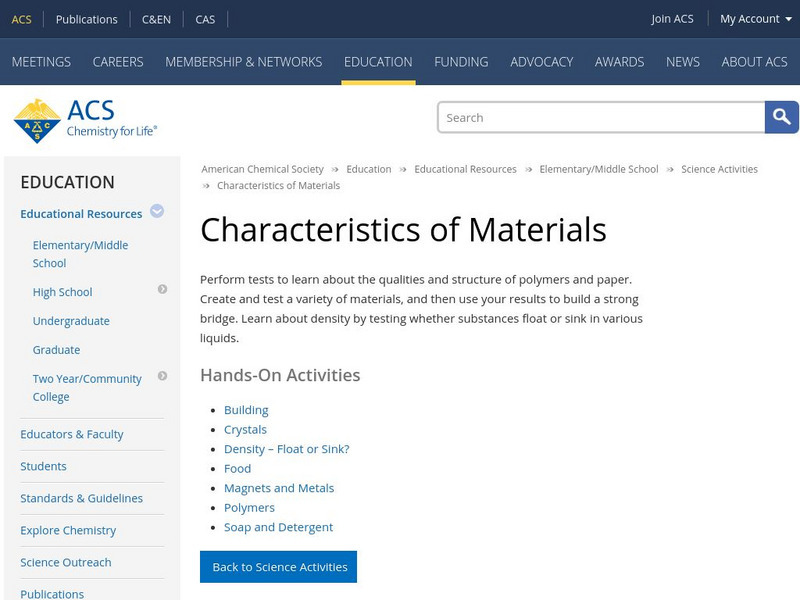
American Chemical Society
American Chemical Society: Science for Kids: Characteristics of Materials
Engaging hands-on science lessons for grades 2-6 on the properties of different materials.
Scholastic
Scholastic: Study Jams! Science: Matter: Acids and Bases
Studying acids and bases? Look no further for an entertaining video to help understand how they work. Check comprehension with the test.
E-learning for Kids
E Learning for Kids: Science: North Sea: Netherlands: What Is It Made Of?
Finn is joining his father on their boat. Join them and help Finn sort materials based on their properties.
E-learning for Kids
E Learning for Kids: Science: North Sea: How Do We Choose Materials to Make Objects?
Help Emilie keep the winery stable and sturdy. Join her to learn about different materials and their properties.
Other popular searches
- Physical Science Matter
- Grade 2 Science Matter
- 2nd Grade Science Matter
- Science Matter Unit
- Physical Science Matter
- Webquest Science Matter
- Earth Science Matter
- Physcial Science Matter
- Science Matter Lesson Plans
- Science Matter Experiments
- Matter Science
- Science Matter and Nutrition