Hi, what do you want to do?






Mr. Nussbaum
Abraham Lincoln Reading Comprehension—The Middle Years (Part 3)
How did Abraham Lincoln begin to change the minds of American citizens? Join him in his quest with a reading passage about Lincoln's experiences as a congressman and public denouncement of slavery. The resource contains reading...

Polk Country Schools
The Death of Abraham Lincoln DBQ
The assassination of Abraham Lincoln was a pivotal moment in American history, but what were the immediate effects throughout the newly unified country? A document-based question focuses on the consequences of the first...

Mr. Nussbaum
Abraham Lincoln Reading Comprehension—The Presidential Years (Part 3)
Abraham Lincoln abolished slavery and led the Union out of the most tumultuous time in American history. An informative passage and paired questions evaluate learners' understanding of main ideas, supporting points, and domain-specific...

National Constitution Center
Abraham Lincoln's Crossroads
History enthusiasts participate in an interactive website that brings Abraham Lincoln to life as he shares his personal experiences between 1854-1864. Scholars listen and read carefully to form their own opinions and discover if they...

Lessons on American Presidents
Abraham Lincoln
Honor Abe Lincoln with a set of activity-based worksheets that can be used independently and in collaborative groups. Young historians participate in a listening activity where they fill in the missing blanks in a passage while being...

Humanities Texas
Primary Source Worksheet: Abraham Lincoln, Second Inaugural Address
Your young historians will be intrigued to read and analyze Abraham Lincoln's second inaugural address, which discusses the president's take on the causes of the Civil War and connections between the North and the South.

Reading Through History
The Emancipation Proclamation
The Emancipation Proclamation: one of the most important primary sources for studying American history! An interdisciplinary resource includes a reading of Abraham Lincoln's seminal speech quoted directly. Following the reading, pupils...

Core Knowledge Foundation
The Civil War
A unit focuses on the Civil War. Second graders follow along with an informational reading about the war—why it started, how it ended, and essential individuals such as Harriet Beecher Stow, Harriet Tubman, Abraham Lincoln, Ulisses, S....

DocsTeach
Who Were Some of the People Who Worked to End Slavery?
As pupils match information to photographs, a document is revealed—the Joint Resolution Proposing the Thirteenth Amendment. Scholars read about some of the people who worked to end slavery, then list each person and at least one way that...

Core Knowledge Foundation
The Civil War
A unit covers many aspects of the Civil War. Over six weeks, fifth graders delve deep into the history of slavery, the Civil War—before, during, and after—Abraham Lincoln, women's contributions, the Emancipation Proclamation, and...

Core Knowledge Foundation
The U.S. Civil War Tell It Again!™ Read-Aloud Anthology
Over three weeks, second graders listen to stories about the United States Civil War. Informational texts explore the war, slavery, Harriet Tubman, Abraham Lincoln, Robert E. Lee, Clara Barton, the Emancipation Proclamation, and Ulysses...

Core Knowledge Foundation
The Civil War
A 48-page Student Reader focuses on the Civil War. Scholars gain information from a text that explores when, why, and where the Civil War occurred, as well as important people such as Harriet Beecher Stowe, Harriet Tubman, Abraham...

Annenberg Foundation
Slavery and Freedom
How do nineteenth-century texts by African American and Native American writers contribute to the country's ideals of freedom and individuality? Learners explore the topic by watching and discussing a video, reading biographies, writing...

Core Knowledge Foundation
The Civil War
A student reader shares information about the history of slavery, the Civil War, President Abraham Lincoln, women's contributions to the war, the Emancipation Proclamation, and reconstruction.

National Endowment for the Humanities
Slavery and the American Founding: The "Inconsistency Not to Be Excused"
High schoolers examine slavery in the revolutionary and colonial eras of the United States. In this slavery lesson, high schoolers investigate the presence of slavery in early America, the language of the Constitution, and the intent of...

C3 Teachers
Uncle Tom’s Cabin: Can Words Lead to War?
"Words, words, words." Despite Hamlet's opinion, words can be significant. In this inquiry lesson, middle schoolers learn how the words in Harriet Beecher Stowe's Uncle Tom's Cabin, in the view of many, lead to the American Civil War. To...

National Constitution Center
Thirteenth Amendment Poster
President Lincoln believed in the Thirteenth Amendment so strongly that he signed 14 copies of it, but died before he could see it passed on December 18, 1965. Explore the text that forever abolished slavery in America with a document...

College Board
2002 AP® English Language and Composition Free-Response Questions
It is not what you say but how you say it. Scholars use an essay prompt from the 2002 AP® English Language and Composition Free-Response Questions to analyze how an author uses language to describe her past. They also support or argue a...

DocsTeach
How Effective were the Efforts of the Freedmen’s Bureau?
Effective or ineffective? As part of a study of post Civil War America, young historians analyze a series of primary sources to evaluate the effectiveness of the Freedmen's Bureau in addressing the challenges faced by the slaves freed by...

MCHS Early US History
Ken Burn’s Civil War, Episode 1: The Cause
Ken Burn's epic documentary miniseries The Civil War, broadcast in 1990, was the most-watched PBS program ever. A question sheet helps viewers keep track of events in the first episode of the documentary.

Curated OER
Mount Rushmore
How did those faces get on that mountain, and why did they choose those particular presidents? Learn about Mount Rushmore's construction and the history behind the men represented on the mountainside with a short reading passage and set...

Education World
Every Day Edit - Harriet Beecher Stowe
In this everyday editing worksheet, learners correct grammatical mistakes in a short paragraph about Harriet Beecher Stowe, the author of Uncle Tom's Cabin. The errors range from punctuation, capitalization, spelling, and grammar.

West Virginia Department of Education
A State of Convenience: The Creation of West Virginia
Ever wondered why there is a West Virginia but not an East Virginia? The resource answers questions like this one and more as it takes an in-depth and detailed look at the history of West Virginia and how it became a state. Several...
Other
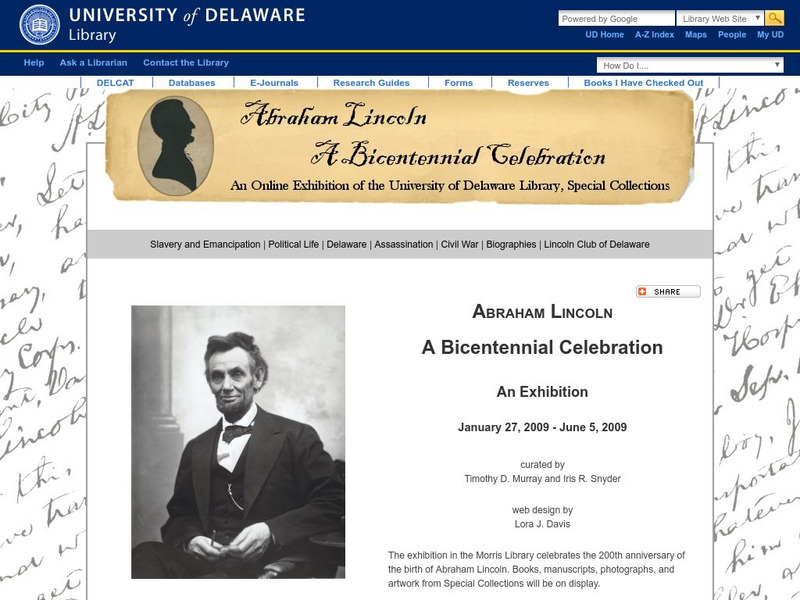
University of Delaware: Abraham Lincoln: A Bicentennial Celebration
Commemorating Abraham Lincoln's 200th birthday, this exhibition provides several documents and photographs remembering the President's life. Resources cover his political career, slavery, the civil war and his assassination.