Hi, what do you want to do?






Mr. E. Science
Changes in Matter
Do solids, liquids, and gases even matter? The presentation focuses on changes in matter, including phases, Boyle's Law, Charles' Law, and physical changes.

Center for Learning in Action
Water – Changing States (Part 2)
Here is part two of a two-part lesson in which scholars investigate the changing states of water—liquid, solid, and gas—and how energy from heat changes its molecules. With grand conversation, two demonstrations, and one hands-on...

Center for Learning in Action
Water—Changing States (Part 1)
Here is part one of a two-part lesson in which scholars investigate the changing states of water—liquid, solid, and gas. With grand conversation and up to three demonstrations, learners make predictions about what they think will happen...

Center for Learning in Action
Introducing Physical and Chemical Changes
Young scientists investigate chemical and physical changes to the states of matter—gas, liquid, and solid—as well as solutions and suspensions with a variety of demonstrations, grand conversation, and an interactive quiz to check for...

Mr. E. Science
An Introduction to Matter
What's the matter? Gas, solid, liquid, or plasma. The presentation covers how to describe and identify matter, changes in matter, types of matter, measuring matter, particles of matter, Democritus, and John Dalton's Atomic Theory.

Aquarium of the Pacific
States of Matter: Making Ice Cream
Who knew that learning about the states of matter could taste so sweet? This fun hands-on lesson captures the attention of learners as they use what they know about solids, liquids, and gases to create their very own batch of ice cream.

Center for Learning in Action
Investigating Physical and Chemical Changes
Super scientists visit ten stations to predict, observe, and draw conclusions about the physical and chemical changes that occur when different states of matter—liquid, solid, and gas—are placed under a variety of conditions. To...

K5 Learning
Changes
You can't unring a bell, but can you unmelt an ice cube? Readers consider reversible and irreversible changes with a short informational reading passage and accompanying comprehension questions.

Center for Learning in Action
Introduction to the States of Matter
Liquids, gases, and solids are the states of matter in which scholars investigate in a lesson plan that offers in-depth information and engaging activities that look into the three states and the changes their properties make when mixed...

Serendip
Using Models to Understand Photosynthesis
Is your class in the dark about photosynthesis? Shed some sunlight on an important biological process with a thoughtful activity. After answering questions to help determine their level of knowledge, learners work with chemical equations...

Center for Learning in Action
Challenge with Solids, Liquids, and Gases
There's a container for every matter—liquid, solid, and gas. Pupils design three different containers, each with the capability to hold one of the states of matter, and share their design with the class.

Mr. E. Science
Chemical Reactions
Once I told a chemistry joke, but there was no reaction. Get young chemists involved in changes and reactions with a presentation that begins with physical and chemical changes and chemical reactions. It moves on to chemical...

Center for Learning in Action
Gases
Explore the properties of gases through one activity and two investigations in which super scientists observe the changes gas makes when encountering different conditions.

Curated OER
Whales and Fish: Creatures of the Deep
Practice comparing and contrasting details in informational text with a reading passage about whales. It explains the ways that fish and whales are similar, as well as the ways they are different, and specific characteristics of various...

Science Matters
That’s An Otter Story
Young scientists discover how sea otters' habitats have changed due to human impact. Through conversation, video observation, and story reading, scholars identify how human interactions change a specific ecosystem in both positive and...

Cornell University
Glued into Science—Classifying Polymers
Explore the unique characteristics of polymers. A complete lesson begins with a presentation introducing polymers. Following the presentation, young scientists develop a laboratory plan for creating substances using polymers. They...

LABScI
Freezing Point Depression: Why Don’t Oceans Freeze?
Can you go ice fishing in the ocean? Learners examine the freezing point of different saltwater solutions. Each solution has a different concentration of salt. By comparing the freezing points graphically, they make conclusions...

Mr. E. Science
Thermal Energy and Heat
The presentation covers Fahrenheit, Celsius, and Kelvin scales for temperature as well as conduction, convection, and radiation.

NASA
Taking Apart the Light
Break down light into spectra. Scholars learn how atoms emit and absorb photons and come to understand how this process allows scientists to identify different atoms based on either absorption lines or emission lines. Learners then...

American Chemical Society
Middle School Chemistry: Changing State: Melting
Discover the concept that energy transfer and molecular motion cause the change in state from a solid to a liquid. Also compare state changes of water to the state changes of other substances.

BBC
Bbc Schools: Ks2 Bitesize: Science: Materials: Changing States
Investigate the changing states of water as you help Steve stay alive while in the Arctic. Includes background information about changing states of matter and about the water cycle, as well as a quiz.
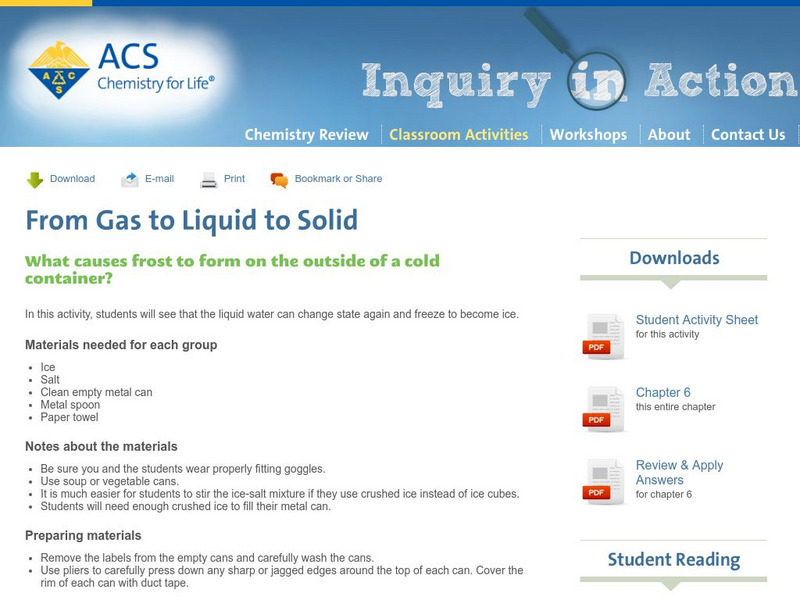
American Chemical Society
Inquiry in Action: From Liquid to Gas to Solid
What causes frost to form on the outside of a cold container? In this activity, students will see that the liquid water can change state again and freeze to become ice.
Chem Tutor
Chem Tutor: Chemistry: States of Matter
This lesson focuses on the states of matter: solids, liquids, and gases. It also discusses the Kinetic Theory of Matter, Thermodynamics, Triple point, Phase Change Graphs and the Heating Curve of Water. It provideds adrawing of a heating...
E-learning for Kids
E Learning for Kids: Science: Loch Ness: What Happens When Solids and Liquids Are Heated or Cooled?
Students will look at what happens to different types of matter when they have a change of state.