Hi, what do you want to do?






Concord Consortium
What Is a Chemical Reaction?
Take your class inside a beaker for an up-close view of a chemical reaction! Junior chemists examine how chemical reactions occur using an interactive resource. The activity allows users to change the temperature and observe how it...

Biology Junction
Chemistry Crossword
Scholars complete a crossword puzzle in this chemistry worksheet with 20 questions about chemistry concepts like atoms and chemical reactions.

Pingry School
Comparing Activities of Selected Metals
Don't overreact! A simple experiment demonstrates chemical reactions as scholars mix chemical solutions and metals in a large well plate. They note all changes to the metals, solutions, precipitate, colors, and more. A full data table...

Serendip
How Do Biological Organisms Use Energy?
When an organism eats, how does food become energy? Young biologists follow glucose through the process of cellular respiration to the creation of ADP using a discussion-based activity. The resource also highlights conservation of mass...

Royal Society of Chemistry
Metals—Gifted and Talented Chemistry
Malleable, magnetic, mesmerizing metals! Pupils love learning about metallic elements, especially through the hands-on activities in an engaging lesson plan. The resource provides thorough instruction on the properties of metals, the...

American Chemical Society
Development of Baking Powder
Did you know baking powder can be used to treat acne, whiten teeth, and make sugar cookies? The instructional activity on the development of baking powder is ready-to-go with no preparation required. Through readings, pupils answer...
Concord Consortium
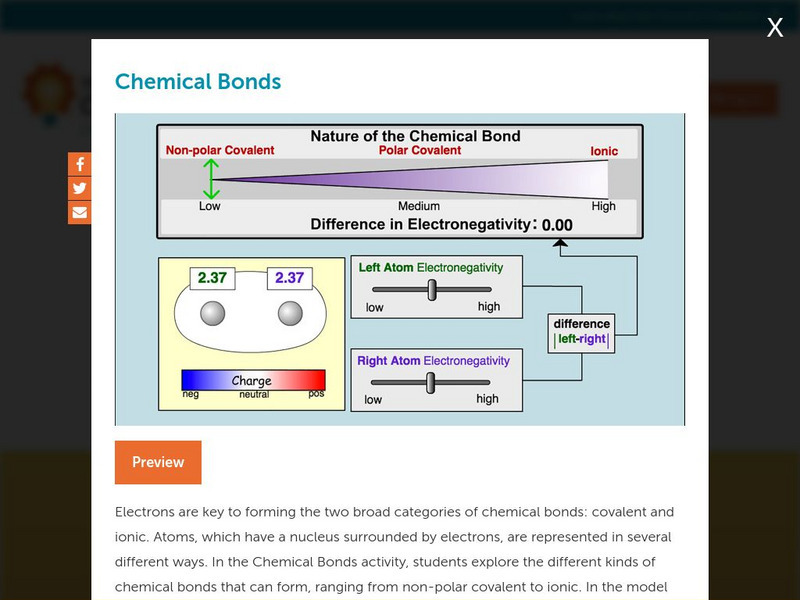
Concord Consortium: Stem Resources: Chemical Bonds
By working through this web-based activity, students differentiate between ionic, non-polar covalent, and polar covalent bonds. Specifically, distinctions are made between bonding types based on orbital shapes and electronegativity...
Texas Instruments
Texas Instruments: Chemical Bonds
This StudyCards stack enables students to review the vocabulary that describes chemical bonding.
Concord Consortium
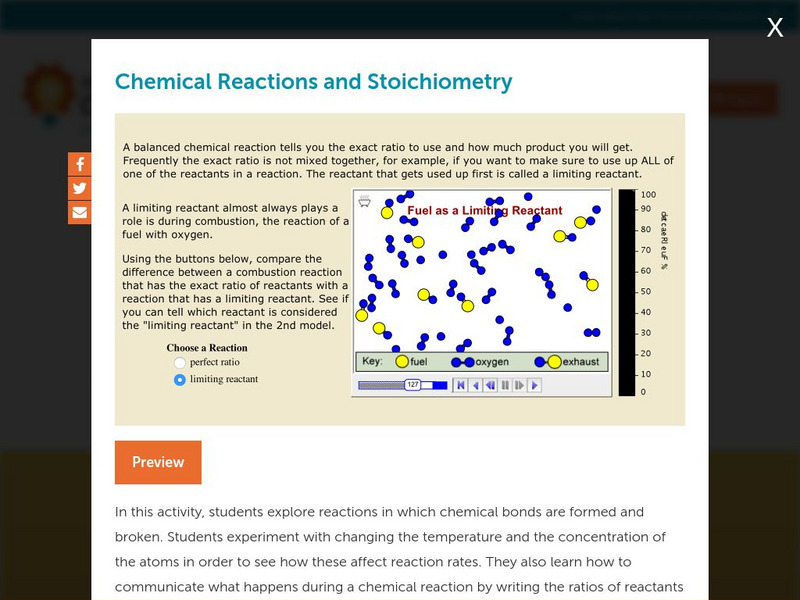
Concord Consortium: Chemical Reactions and Stoichiometry
In this activity, students explore reactions in which chemical bonds are formed and broken. Students experiment with changing the temperature and the concentration of the atoms in order to see how these affect reaction rates. They also...

American Chemical Society
Middle School Chemistry: Energy Levels, Electrons, Ionic Bonding
Students discover that ionic bonding occurs when electrons are transferred from one atom to the other and not shared as in covalent bonding.
American Chemical Society
Middle School Chemistry: Lesson Plans: What Is a Chemical Reaction?
After observing a demonstration of a chemical reaction between a burning candle and the oxygen in the air, young scholars use atom model cut-outs to model the reaction and see that all the atoms in the reactants show up in the products.
Concord Consortium
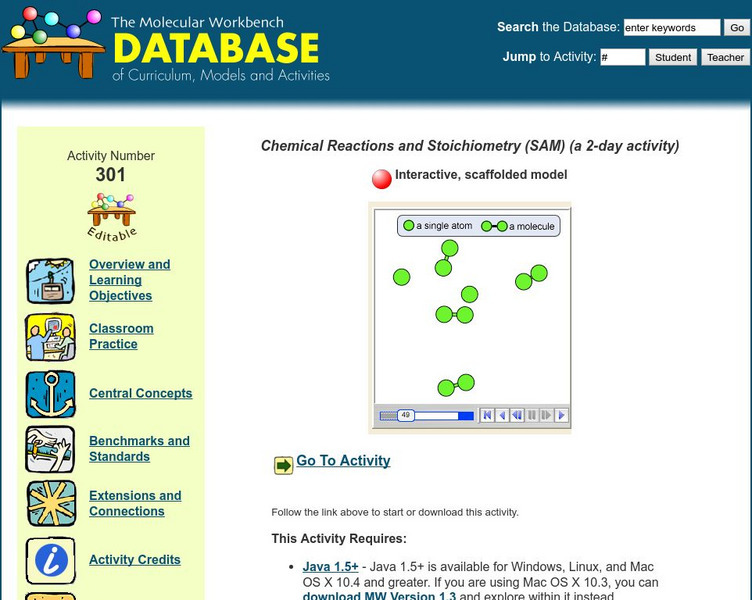
The Molecular Workbench Database: Chemical Reactions and Stoichiometry
This simulation helps students investigate the basics of chemical equations. Students will review stoichiometry and what effects their reaction rates.
Concord Consortium
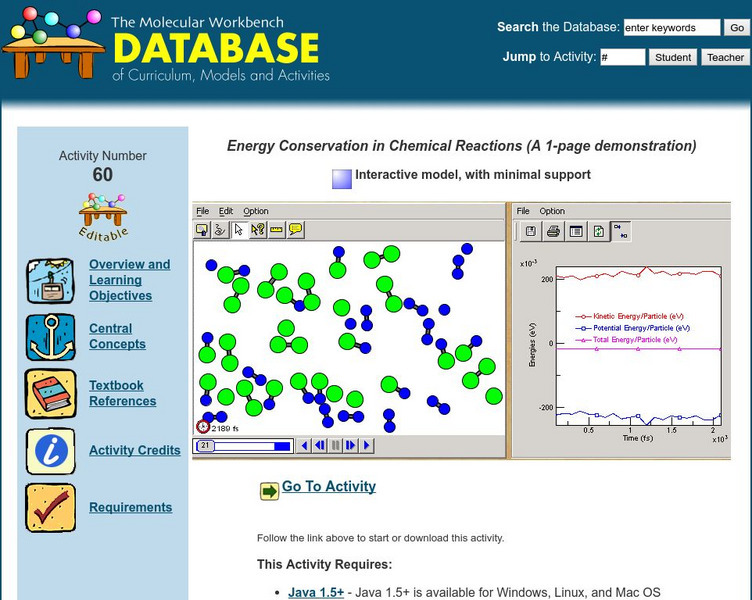
The Molecular Workbench Database: Energy Conservation in Chemical Reactions
Follow the energy conversion from potential to kinetic in this interactive activity that explores total energy in chemical reactions.
American Chemical Society
Middle School Chemistry: Lesson Plans: Temperature Changes in Dissolving
Media-rich lesson in which students discover that it takes energy to break bonds, and that energy is released when bonds are formed during the process of dissolving. They also determine whether dissolving is either exothermic or...
Concord Consortium
Concord Consortium: Where Does All the Energy in an Explosion Come From?
In this module Activity 3 investigates What changes in energy occur when atoms rearrange during a chemical reaction? This activity explores the relationship between energy and chemical reactions. A bonus reading includes Energy and...
Museum of Science
The Atom's Family: Mighty Molecules
In this activity, students construct models of molecules using marshmallows and gum drops.