Hi, what do you want to do?






Center for Learning in Action
Introducing Physical and Chemical Changes
Young scientists investigate chemical and physical changes to the states of matter—gas, liquid, and solid—as well as solutions and suspensions with a variety of demonstrations, grand conversation, and an interactive quiz to check for...

Center for Learning in Action
Challenge with Solids, Liquids, and Gases
There's a container for every matter—liquid, solid, and gas. Pupils design three different containers, each with the capability to hold one of the states of matter, and share their design with the class.

Center for Learning in Action
Density
Explore the concept of density within states of matter—gases, liquids, and solids—through a group experiment in which young scientists test objects' texture, color, weight, size, and ability to sink or float.

Concord Consortium
Molecular View of a Solid
Why are solids, well ... solid? Take a peek inside a solid substance with an easy-to-use interactive. Science sleuths examine the motion and position of the atoms that make up a solid before drawing conclusions from their observations.

Center for Learning in Action
Introduction to the States of Matter
Liquids, gases, and solids are the states of matter in which scholars investigate in a lesson plan that offers in-depth information and engaging activities that look into the three states and the changes their properties make when mixed...

Center for Learning in Action
Investigating Physical and Chemical Changes
Super scientists visit ten stations to predict, observe, and draw conclusions about the physical and chemical changes that occur when different states of matter—liquid, solid, and gas—are placed under a variety of conditions. To...

Center for Learning in Action
Water—Changing States (Part 1)
Here is part one of a two-part lesson in which scholars investigate the changing states of water—liquid, solid, and gas. With grand conversation and up to three demonstrations, learners make predictions about what they think will happen...

Center for Learning in Action
Gases
Explore the properties of gases through one activity and two investigations in which super scientists observe the changes gas makes when encountering different conditions.

Center for Learning in Action
Introduction to Matter
Begin your states of matter lessons with a demonstration designed to introduce the concept that all matter has properties. Reinforce this concept through vocabulary exploration, and the creation of atom models; salt, water, and carbon...

Illustrative Mathematics
Comparing Freezing Points
Subtracting negative numbers can be confusing to your middle schoolers. Here, they are able to draw a number line and put their answer in sentence form to check their understanding of negative numbers.

Center for Learning in Action
Water – Changing States (Part 2)
Here is part two of a two-part instructional activity in which scholars investigate the changing states of water—liquid, solid, and gas—and how energy from heat changes its molecules. With grand conversation, two demonstrations, and...

EngageNY
Examples of Functions from Geometry
Connect functions to geometry. In the ninth installment of a 12-part module, young mathematicians create functions by investigating situations in geometry. They look at both area and volume of figures to complete a well-rounded lesson plan.

Columbus City Schools
Planet X
How did the earth become the mass that it is now? Your young scientists explore this question through the concept of density. Their inquiries consider the impact of gravity on the formation of planets. The culminating activity of the...
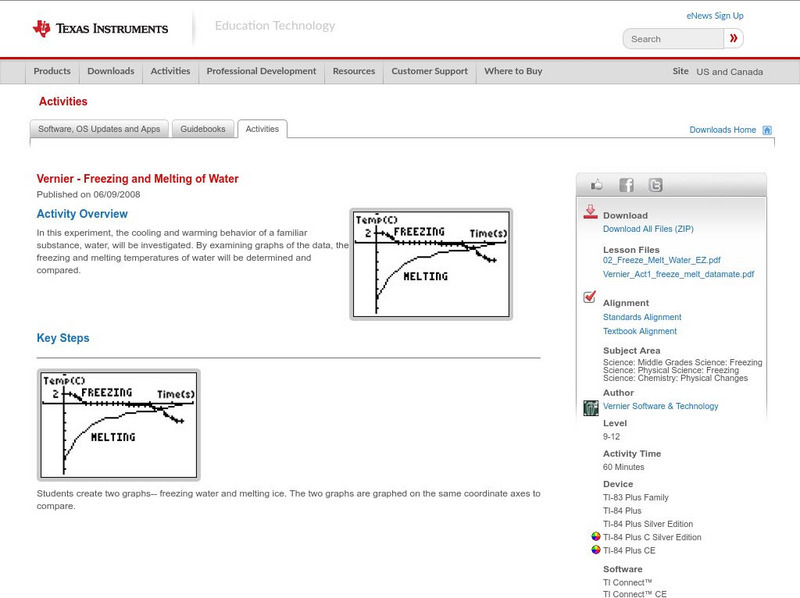
Texas Instruments
Texas Instruments: Freezing and Melting of Water
Freezing temperature, the temperature at which a substance turns from liquid to solid, and melting temperature, the temperature at which a substance turns from a solid to a liquid, are characteristic physical properties. In this...
Sophia Learning
Sophia: Kinetic Energy and States of Matter: Lesson 1
This lesson will compare the relative kinetic energy possessed by molecules in different states. It is 1 of 2 in the series titled "Kinetic Energy and States of Matter."

CK-12 Foundation
Ck 12: Chemistry Simulation: States of Matter
[Free Registration/Login Required] Compare three states of matter: solid, liquid, and gas.
American Chemical Society
Middle School Chemistry: Changing State: Melting
Discover the concept that energy transfer and molecular motion cause the change in state from a solid to a liquid. Also compare state changes of water to the state changes of other substances.