Hi, what do you want to do?






Illustrative Mathematics
What’s Missing?
Now you see them, now you don't! This fun peek-a-boo activity engages young mathematicians in developing their ability to compose and decompose numbers. After being presented with a series of counters, children close their eyes while the...

Illustrative Mathematics
Three Composing/Decomposing Problems
Practice composing and decomposing numbers in base-ten using three word problems. Each problem presents a different scenario requiring learners to explain their thinking, find the number of ones, and find out different ways to make a...

Illustrative Mathematics
Overlapping Rectangle
Challenge young mathematicians' ability to compose and decompose shapes with this fun geometry puzzle. The goal is simple, locate all of the rectangles shown in a picture of three overlapping rectangles. Perform this activity as a whole...

Illustrative Mathematics
Shake and Spill
Entertaining as well as educational, this math activity about decomposing numbers is bound to capture the engagement of young learners. Given a cup and five two-color counters, young mathematicians simply shake and spill the cup,...

Noyce Foundation
Apple Farm Field Trip
Monitor the growth of young mathematicians with a comprehensive addition and subtraction assessment. Using the context of a class field trip to an apple orchard, this series of four story problems allows children to demonstrate their...

Illustrative Mathematics
Pick Two
Learning to break apart numbers into smaller pairs is a critical step young mathematicians take as they develop their number sense. To practice this skill, children are provided with sets of three numbers and are asked to pick the two...

K20 LEARN
Decomposers—Fraction Style: Fractions
"What are fractions composed of?" is the essential question of a lesson designed to enhance understanding and strengthen the foundation of adding fractions. Mathematicians start by discussing what makes an equation true or false,...

Illustrative Mathematics
Make Your Own Puzzle
Puzzling over what geometry instructional activity to teach next? Look no further. This simple activity teaches young mathematicians how shapes can be decomposed into smaller figures, and how smaller figures can be assembled into larger...

National Park Service
Living & Non-Living Interactions
What better way to learn about ecosystems than by getting outside and observing them first hand? Accompanying a field trip to a local park or outdoor space, this series of collaborative activities engages children in...

Odell Education
Composition of Functions
Analyze functions by decomposing complex functions and composing simple functions. Through a detailed lesson plan, pupils learn the vocabulary and notation related to the composition of functions. Practice includes both evaluating and...

New Mexico State University
Gate
Build numbers with place value to save the day. Pupils use the keyboard to control the digits in the hundredths through hundreds place to create target numbers to destroy shadows. As participants build the numbers, a number line shows...

National Security Agency
Fraction Fever
This unit on fractions allows for upper-aged elementary learners to explore ways to find the greatest common factor and least common multiple of two numbers. Ultimately, young mathematicians will be able to identify equivalent fractions,...

Mathematics Vision Project
Module 8: Modeling With Functions
Sometimes there just isn't a parent function that fits the situation. Help scholars learn to combine function types through operations and compositions. Learners first explore a new concept with an introductory activity and then follow...
![Illustrative Mathematics: Three Composing/decomposing Problems [Pdf] Lesson Plan](https://statictemp.lp.lexp.cloud/images/attachment_defaults/resource/large/FPO-knovation.png "Illustrative Mathematics: Three Composing/decomposing Problems [Pdf] Lesson Plan")
Student Achievement Partners
Illustrative Mathematics: Three Composing/decomposing Problems [Pdf]
In this grade 2 instructional activity, students use base ten blocks to compose and decompose numbers.

Study Pad
Splash Learn: Decompose Numbers (11 to 19) Into a Ten and a Few Ones
[Free Registration/Login Required] Using ten frames and number sentences, students will practice decomposing numbers into tens and ones.
Illustrative Mathematics
Illustrative Mathematics: Make Your Own Puzzle
Students will cut a square into four pieces, and then will put those pieces in an envelope for another student to put together. The purpose of this task is to give students a hands-on experience with composing and decomposing geometric...
Illustrative Mathematics
Illustrative Mathematics: Overlapping Rectangles
The purpose of this task is to give students an opportunity to compose and decompose polygons to make rectangles. The students will be shown a picture and are asked to count how many rectangles they see. Explanations and examples are...
Starfall
Starfall: Compose & Decompose Numbers
This learning game focuses on adding tens and ones to fill candy orders and deliver them.
K-5 Math Teaching Resources
K 5 Math Teaching Resources: Decompose a Factor [Pdf]
Students will learn how to determine the product by decomposing the factors.
Khan Academy
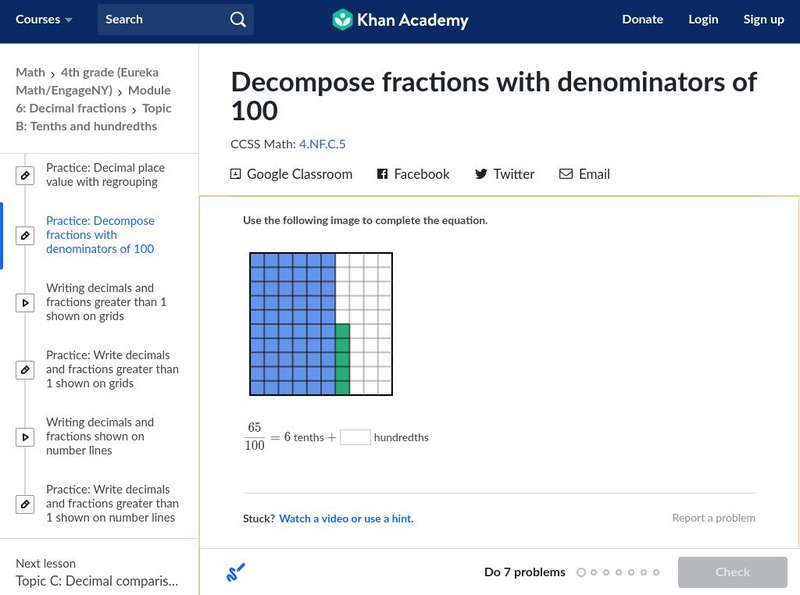
Khan Academy: Decompose Fractions With Denominators of 100
In this exercise, students practice decomposing fractions with denominators of 100. Students receive immediate feedback and have the opportunity to get hints and try questions repeatedly.
Khan Academy
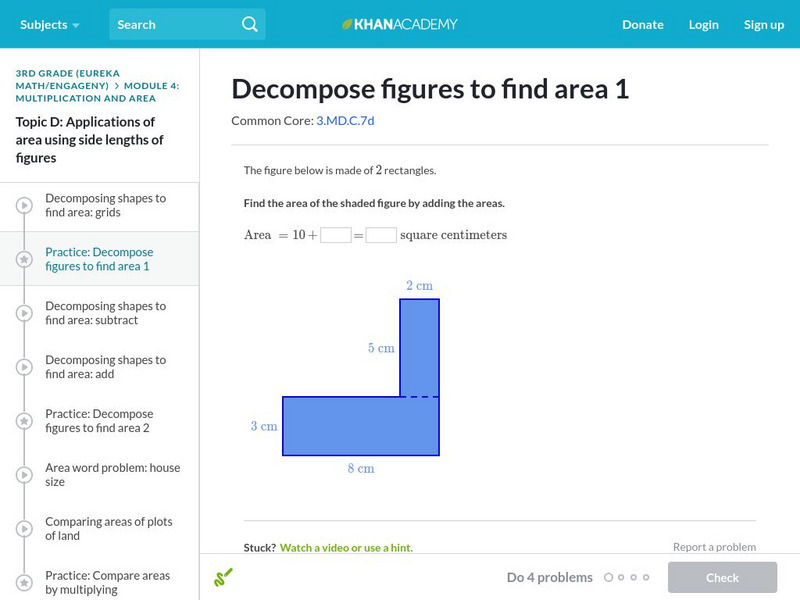
Khan Academy: Decompose Figures to Find Area 1
In this exercise, students practice decomposing figures to find area. Students receive immediate feedback and have the opportunity to get hints and try questions repeatedly.
Khan Academy
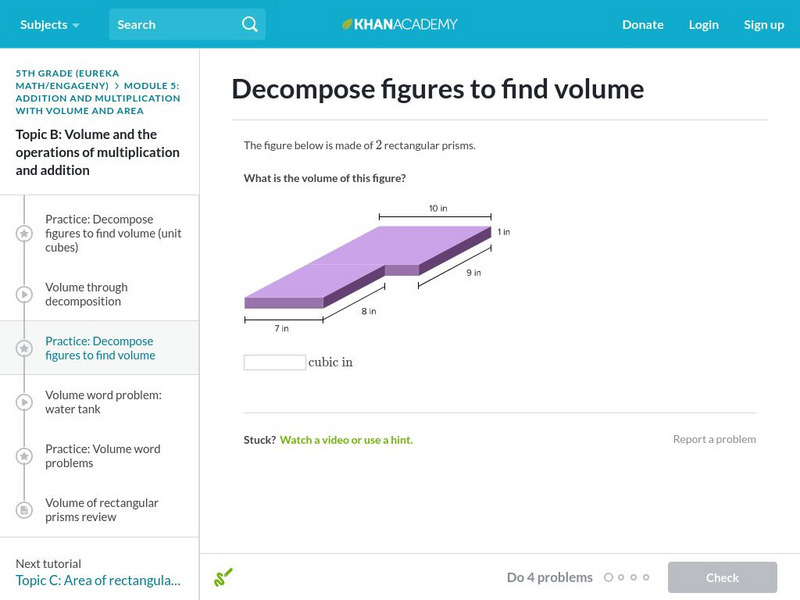
Khan Academy: Decompose Figures to Find Volume
In this exercise, students practice decomposing figures to find the volume. Students receive immediate feedback and have the opportunity to get hints and try questions repeatedly.

Khan Academy
Khan Academy: Decompose Figures to Find Area 2
In this exercise, students practice decomposing figures to find area. Students receive immediate feedback and have the opportunity to get hints and try questions repeatedly.
Khan Academy
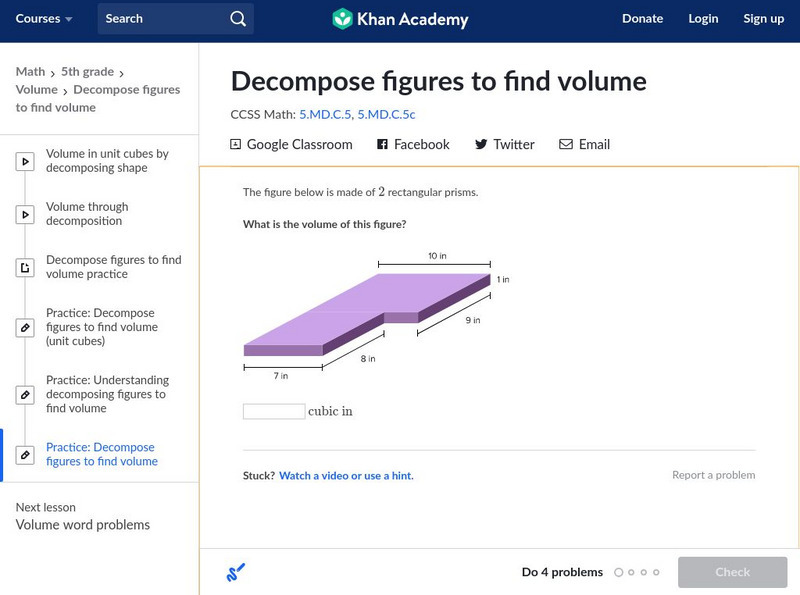
Khan Academy: Decompose Figures to Find Volume
Find the volume of irregular 3D figures by dividing the figures into rectangular prisms and finding the volume of each part. Students receive immediate feedback and have the opportunity to try questions repeatedly, watch a video or...