Hi, what do you want to do?






Student Handouts
The Five W's and How
Here is a great graphic organizer for ensuring that young researchers and writers cover all their bases when brainstorming a topic by considering the five W's (who, what, where, when, and why) and how.

Student Handouts
Writing Exercises: Modern Economic Issues, #2
Modern-day economics is definitely a hot topic. Critical thinkers answer three questions about the economic gap and the turn of events in today's global economy. They'll use the five Ws to determine the meaning of globalization, Korea's...

Student Handouts
Writing Exercises: Imperialism I
Examine the impact of Imperialism on power and industrialization. There are three short-answer questions for critical thinkers to respond to in this handout. They'll describe the relationship between Imperialism and industrialization,...

Pearson
WH-Questions
Why can't you answer a wh- question with yes or no? Learn about the ways you can use the five W's to form questions that will give you the most information in an answer.

Student Handouts
Writing Exercises: Conflicts and Change in the Middle East, #3
Your class will be discussing some hot topics today. This set of three essay questions covers multiple aspects of the conflict in the Middle East. They'll discuss the Iranian Hostage Crisis, define PLO (Palestine Liberation...

Nosapo
Family Titles, Pronouns, Writing about a Person
How is your grandmother related to you? How is your cousin related to your grandmother? Learn about family relationships and pronouns with an activity that guides pupils to write two short narratives about members of their families.

Student Handouts
Writing Exercises: World War II, #4
Using complete sentences and the five W's as guidance, learners will respond to three short-answer questions about WWII. They'll discuss Mussolini's role, the ideologies of nationalism and anti-Semitism that led to the Holocaust, and the...

Student Handouts
Writing Exercise: Collapse of European Imperialism #2
Three excellent writing prompts await your social studies class. They'll consider the reasons for the collapse of European imperialism. They'll use the five W's to answer each question in paragraph form.

Student Handouts
Writing Exercises: Patterns of Change, #2
What kinds of changes have marked the 20th century? Kids consider three patterns of change in Latin America: modernization, urbanization, women's rights and status, and democracy.

Worksheet Web
Burrowing Animals – Ground Squirrels
Why do ground squirrels build their homes in the ground? What's so unique about these burrows? Have individuals read about this burrowing animal, and then respond to five short answer questions that assess their comprehension of the...

Worksheet Web
Heteronyms
Challenge scholars to identify and use heteronyms in a sentence with a two-page activity designed to boost grammar skills.

Worksheet Web
Using Pictographs
If one ice cream cone represents three ice cream scoops, and Bob has four ice cream cones, then how many scoops does Bob have? Learners solve these kind of questions with their new understanding of pictographs.

Student Handouts
Writing Exercises: Modern Economic Issues, #3
Developing nations tend to deal with economic issues differently from developed nations. Learners explore modern economic issues, including the Latin American economy, a cash-crop economy, and an industrial economy, by responding to...

Michigan Farm Bureau
The Little Red Hen
No one will be saying "Not I" with a lesson that combines The Little Red Hen with the life cycle of a wheat stem! After reading the story in your class, pass out wheat stems to your learners and have them examine the plants closely,...

Kid Zone
Groundhog's Day Graphing
This Groundhog's Day, challenge scholars to predict, estimate, tally, and graph in a weather-themed instructional activity in which class members play the role of the groundhog to forecast the weather come February second.

David Pleacher
Candy Math Fun
Few things can motivate children to learn like the promise of a sweet and tasty treat. Given a bag of M&M®s, Skittles®, or other colorful candy, learners first predict the contents of the bag before counting the pieces,...

Humanities Texas
Primary Source Worksheet: Frederick Douglass, “Expression of Gratitude for Freedom”
Here is a fantastic primary source analysis activity regarding Frederick Douglass' speech delivered at the unveiling of the Freedmen's Monument in 1876. The follow-up discussion questions and activities highlight Douglass' discussion of...

Mr. Waynes clas
Kinematics Objectives
Accelerate young physicists' learning with this collection of problem-solving worksheets. Starting off by teaching students to identify the given information and variables in physics problems, this resource goes on to challenge them...
Other
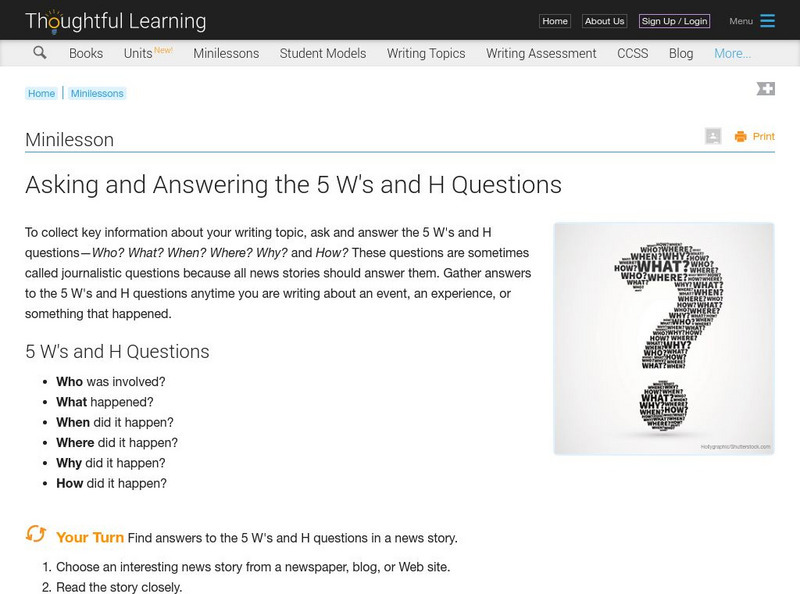
Thoughtful Learning: Minilesson: Asking and Answering the 5 W's and H Questions
Students will learn the "5 W's and H questions" needed to comprehend a news story. Then students will apply these question words [who, what, where, why, when, and how] to real news stories and to events in their own lives.

Other
Lexiconic Resources: 5 W's and How Chart
This downloadable graphic organizer will assist students in taking notes about a news story. Students will use this resource to identify answers to the following five W's and H questions: What happened? Who was there? When did it happen?...

Quia
Quia: Rags to Riches: The Five W's: Version 2
In this exercise/quiz, students select the correct answer to who, what, when, where, and why questions in short passages.

Quia
Quia: Rags to Riches: The Five W's: Version 1
This game focuses on identifying the who, what, when, where, and why, in short passages.
Education Place
Houghton Mifflin: Eduplace: 5 Ws Chart [Pdf]
This site from Houghton Mifflin Company provides a simple, reproducible chart to help students gather details of Who, What, When, Where, and Why. This could be used as a reading comprehension tool, or as prewriting for expository writing.
Enchanted Learning
Enchanted Learning: 5 W's Diagrams
Enchanted Learning provides several examples of graphic organizers that can be used for gathering Who, What, Where, When, and Why information, either for reading comprehension or prewriting. These template suggestions can only be printed...